


What Size Extension Lead Do I Need? A UK Guide to Length and Amps
A coiled extension lead can reach temperatures high enough to melt its own insulation in under 30 minutes when powering a 3kW heater. To decide what size extension lead do i need, you should choose a 13A lead with a cable cross-section of 1.25mm² for light use or 1.5mm² for heavy-duty tools. Keep the length under 10 metres for high-draw appliances to prevent voltage drop and ensure your equipment runs efficiently. Never exceed the maximum UK limit of 13 Amps or 3,120 Watts across all sockets on the lead. Using these specific measurements prevents overheating and protects your expensive power tools from damage.
It's easy to feel overwhelmed by technical labels when you just want to get on with your garden or home projects. We'll show you exactly how to match cable thickness to your specific gear so you can work with total confidence. This guide explains the 13A limit and helps you identify the right mm² cable to buy for a safe, professional setup.
Key Takeaways
- For most UK power tools, a 13A lead with a 1.5mm² cable thickness is the reliable standard to ensure safe and efficient operation.
- Discover exactly what size extension lead do i need by matching the cable’s diameter and length to your appliance's total wattage.
- Avoid dangerous voltage drop by selecting the shortest practical length for your workspace to keep your tool motors running cool.
- Ensure garden safety by choosing leads with the correct IP rating and essential RCD protection for all outdoor DIY tasks.
- Learn how to audit your current equipment for damage and why investing in high-quality workshop gear protects both your tools and your home.
Choosing the correct extension lead depends on the total wattage of your appliances and the distance from the socket.
To determine what size extension lead do i need, you must match the lead's amp rating to your most powerful appliance. For most UK DIY projects and power tools, a 13A lead with a 1.5mm² cable is the standard requirement. This configuration safely handles up to 3120 Watts of power. Physical length matters too, as any lead exceeding 25 metres requires thicker internal wiring to prevent a drop in voltage and overheating. Always check the total wattage of your devices before plugging them into a single socket.
The term 'size' in the electrical world refers to two distinct measurements. First, it describes the physical length of the extension lead in metres. Second, it refers to the Cross-Sectional Area (CSA) of the internal copper wires, measured in mm². Choosing a lead that's too thin or too long for your equipment can cause the cable to melt or damage your expensive tools.
The standard UK 13A limit and what it means for you
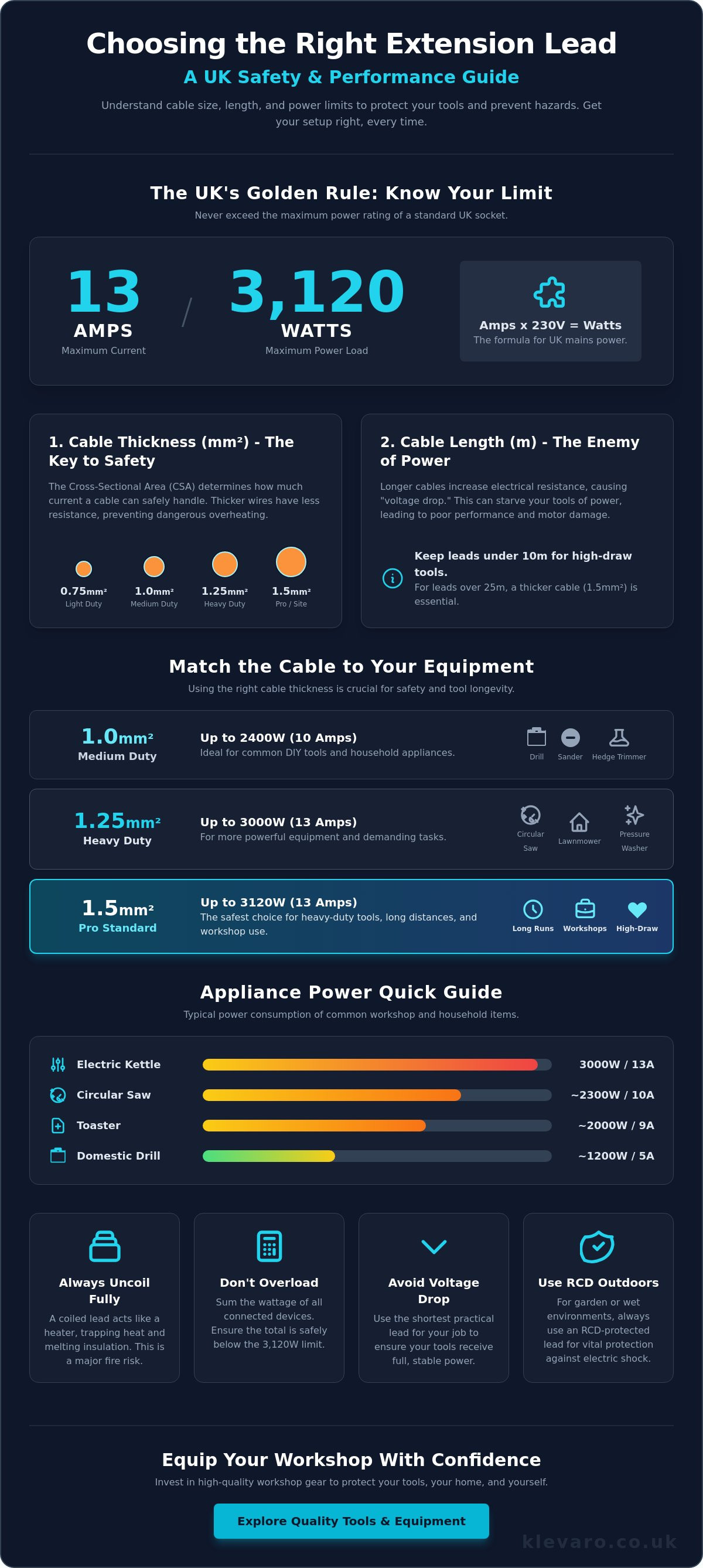
Every standard UK plug is fitted with a fuse, usually rated at 13 Amps. You can calculate your power needs using the simple formula: Amps x Volts = Watts. Since the UK mains supply is 230V, a 13A fuse allows for a maximum load of approximately 3120 Watts. You must never exceed this 13 Amp limit across all devices plugged into a single lead.
It's easy to overload a lead by plugging in multiple high-draw appliances at once. If you're working on home improvements, check our quality range of DIY tools to see their specific power requirements. Here are typical amp draws for common household and workshop items:
- Electric Kettle: 13 Amps (3000W)
- Circular Saw: 8 to 10 Amps (1800W to 2300W)
- Domestic Drill: 3 to 5 Amps (700W to 1200W)
- Toaster: 9 Amps (2000W)
- LED Work Light: 0.2 Amps (50W)
Why cable thickness (mm²) is more important than length
Cable thickness, or Cross-Sectional Area (CSA), determines how much current can flow safely without generating excess heat. Most light-duty domestic leads use 1.0mm² or 1.25mm² wiring, which is fine for lamps or laptops. However, for heavy-duty tasks or garden equipment, you should always opt for 1.5mm² cabling to ensure safety.
Thicker internal wires reduce electrical resistance. When resistance is low, the cable stays cool even under heavy loads. If you use a thin 1.0mm² lead for a 3000W heater, the wire acts like a heating element itself, which creates a significant fire risk. You should also uncoil your lead completely to help dissipate any heat that builds up during use.
Distance also plays a massive role in your choice. If your project is more than 25 metres from the wall socket, voltage drop becomes a major concern. A drop in voltage means your power tools won't run at full speed and could eventually burn out their motors. For these longer distances, 1.5mm² is the absolute minimum thickness required to maintain a steady and safe flow of electricity.
Calculate the required cable thickness based on your tool's power draw and cable length.
To determine what size extension lead do i need, you must match the cross-sectional area of the copper cable (measured in mm²) to the total wattage of your equipment. For standard household devices under 700W, a 0.75mm² cable is often used, but DIY power tools require more substantial wiring. High-draw tools like circular saws or large heaters need a minimum of 1.25mm² or 1.5mm² cable to operate safely without overheating. Using a cable that is too thin for the power load creates electrical resistance, which leads to voltage drops and fire hazards. For any professional or intensive outdoor work, 1.5mm² is the safest and most reliable choice for UK homes.
- Up to 720 Watts (3 Amps): 0.75mm² cable (Lamps, small fans, clock radios).
- Up to 2400 Watts (10 Amps): 1.0mm² cable (Standard drills, orbital sanders, hedge trimmers).
- Up to 3000 Watts (13 Amps): 1.25mm² cable (Circular saws, lawnmowers, pressure washers).
- Over 3000 Watts or Long Distances: 1.5mm² cable (Mitre saws, electric heaters, professional site tools).
The term "heavy-duty" is frequently used in marketing, but in technical terms, it refers to both the thickness of the internal copper cores and the durability of the outer sheath. A genuine heavy-duty lead features 1.5mm² cores and a robust coating, such as H07RN-F rubber, which resists oil, water, and mechanical abrasions. You should never use thin "lamp-style" leads for any DIY or garden equipment. These light-duty cables, often 0.5mm² or 0.75mm², cannot handle the high surge currents required when a power tool starts up, leading to rapid heat buildup.
Matching cable mm² to your specific DIY equipment
Low-draw tools like detail sanders or small corded drills function perfectly well on a 1.0mm² lead. When you move up to high-draw equipment like mitre saws or workshop vacuums, the power demand increases significantly. You can find more details on standard power requirements in Your First DIY Toolkit. For site-work or heavy DIY projects involving long cable runs, 1.5mm² is the professional standard. It ensures your tools receive full power without the motor struggling due to voltage drop.
The dangers of using undersized cables for high-wattage loads
Electrical resistance generates heat inside the cable insulation whenever the wire is too thin for the current passing through it. This heat can cause "nuisance tripping," where your RCD or circuit breaker shuts off power because the system detects an imbalance or overload. If the heat continues to build, it can melt the plastic insulation and lead to a short circuit. Experts warn that overloading sockets with undersized extension leads is a primary cause of domestic fires in the UK. Always check the rating on the cable sheath before plugging in high-wattage gear. Explore our reliable range of tools and equipment to ensure you have the right setup for your next home improvement task.
Match the extension lead length to your workspace while avoiding significant voltage drop.
To decide what size extension lead do i need, you must match the cable length to your specific workspace to prevent voltage drop. Standard domestic tasks are best served by a 1.25mm² lead between 15m and 25m in length. If your project is more than 30 metres from a socket, you should switch to a heavy-duty 2.5mm² cable to maintain power levels. Using a lead that is too long or too thin causes power tools to lose torque and can lead to motor failure. Always select the shortest lead that reaches your work area with enough slack to prevent tension on the plug.
Electricity loses "pressure," known as voltage drop, as it travels through long copper wires. This resistance means your tools receive less power than the wall socket actually provides. High-draw power tools often lose torque or experience motor overheating when the voltage drops by more than 5%. Following Electrical Safety First guidance ensures your equipment runs at peak efficiency without risking internal damage or fire hazards.
For most homes, a 15m lead is the "sweet spot" for indoor DIY and small patios. It provides enough reach without creating excessive resistance. If you frequently work at the bottom of a long driveway, investing in a thicker 2.5mm² cable is a smart move. This thicker core allows electricity to flow more easily over distances exceeding 30 metres, protecting your expensive power tools from burnout.
The uncoiling rule: why you must never leave a lead on the reel
Coiled cables act as induction heaters when electricity flows through them under a heavy load. A lead left on the reel can only safely handle about 30% of its total rated capacity because the heat cannot escape the tightly packed layers. If you use a high-wattage appliance on a coiled reel, the internal heat can melt the plastic insulation and cause a short circuit.
Safely set up your cable reel by following these simple steps:
- Place the reel on a flat surface near your chosen wall socket.
- Pull the entire length of the cable off the drum before plugging it in.
- Lay the cable in loose, tidy loops on the floor to avoid creating tripping hazards.
- Check that the cable isn't pinched under doors or heavy equipment.
Calculating the right length for garden and outdoor projects
Measuring for garden projects requires adding 2 to 3 metres of slack to your total measured distance. If you are using pressure washers or lawnmowers, the cable needs to move with you as you work. Tight cables lead to strained connections, which can cause the plug to pull out or create dangerous electrical arcs.
Daisy-chaining leads, which means plugging one extension lead into another, is strictly prohibited. This practice doubles the resistance and significantly raises the risk of the first lead overheating. If your current gear won't reach the bottom of the garden, browse our garden accessories or tools and equipment for a single-length solution that keeps you safe and powered up.
Select a lead with the correct IP rating and RCD protection for outdoor and workshop use.
To safely power equipment outdoors or in a garage, you need an extension lead with an IP54 rating or higher and a built-in RCD. These features protect you from moisture and electrical faults that occur in damp environments. When asking what size extension lead do i need for DIY projects, you must also look for high-visibility cables in orange or green to prevent trip hazards or accidental cutting. Heavy-duty rubber cables (H07RN-F) are the standard choice for workshops because they resist oil and remain flexible in cold UK weather. Choosing the right protection ensures your tools run safely without risking a blown fuse or a dangerous shock.
Essential safety features for garden extension leads
Outdoor power requires a specific level of Ingress Protection, known as an IP rating. An IP54 rating means the lead is protected against dust and water splashes, while an IP66 rating signifies it's completely dust-tight and can withstand powerful water jets. Using a standard indoor lead in the garden is dangerous because moisture can easily penetrate the sockets. You should always pair your outdoor lead with a Residual Current Device (RCD). This life-saving component monitors the flow of electricity and cuts the power in less than 40 milliseconds if it detects a leak, such as when a lawnmower accidentally clips the cable.
Visibility is another critical safety factor for garden work. Brightly coloured cables like high-vis orange stand out clearly against green grass, making them much harder to trip over or run over with machinery. This is a key part of maintaining a safe workspace. For more advice on setting up your outdoor space, check out this guide to essential gardening tools for beginners.
Choosing a lead that survives the workshop environment
Workshops and garages present unique challenges like oil spills, grease, and heavy foot traffic. While domestic PVC cables are fine for a living room, they often crack or degrade when exposed to chemicals or extreme temperatures. Heavy-duty H07RN-F rubber cables are designed for these tough conditions. They are highly resistant to abrasion and won't become brittle during freezing UK winters. This flexibility makes them much easier to coil and store after a long day of projects.
Dust is the enemy of electrical connections in any workshop. Look for extension leads that feature spring-loaded socket covers. These covers keep sawdust, metal shavings, and debris out of the internal components when the lead isn't in use. This simple feature prevents short circuits and extends the life of your gear. When you consider what size extension lead do i need for your garage, choose a model with a multi-socket block that includes these protective flaps. Ready to upgrade your workspace? You can explore our range of tools and equipment to find the perfect match for your next build.
Equip your home workshop with high-quality extension leads and tools from Klevaro.
Choosing the right power setup is about safety, not just cost. Cheap, unbranded leads often lack the thick copper cores needed to handle high-wattage tools like mitre saws or heat guns. When you ask yourself what size extension lead do i need, always prioritize heavy-duty cables that meet UK safety standards. This ensures your equipment operates efficiently without the risk of overheating.
Take a moment to audit your current gear. Inspect every cable for cracked insulation, exposed wires, or discoloured plastic near the plug pins. If a lead feels warm to the touch during use, it is likely overloaded or damaged. Replace these items immediately to prevent electrical fires or shocks in your home or garage.
Klevaro is your trusted UK partner for reliable DIY essentials. We focus on providing gear that balances durability with practical design. Our products help you work smarter and safer, giving you the confidence to tackle any home improvement task. Use this final checklist to ensure your next project is powered correctly:
- Match the total wattage of your tools to the lead's amp rating.
- Always fully unwind cable reels to prevent heat build-up.
- Check that the lead length allows for slack to avoid trip hazards.
- Ensure the plug contains a correctly rated 13-amp fuse for heavy-duty use.
Shop our curated range of tools and equipment
You can explore our range of tools and equipment to find power solutions built for the British workshop. We stock reliable brands that comply with UKCA and CE marking requirements. This ensures your equipment handles the 13-amp loads common in domestic DIY projects. Our team provides fast UK delivery so you can get back to your build without delay.
Buying from a specialist UK retailer means you receive gear designed specifically for 230V mains power. We select products that stand up to the rigours of a busy workshop. Whether you are fitting a new kitchen or building garden furniture, our tools provide the performance you need. High-quality leads are the foundation of a safe work environment.
Join the Klevaro community for more expert DIY tips
Sign up for our newsletter to receive more guides and practical project inspiration. We share expert advice to help you maintain your home and garden with ease. Our community is the perfect place to find your next big idea. You will get helpful, practical, and enthusiastic support from a team that loves DIY as much as you do.
We are here to help you build and create with total confidence. Having the right knowledge makes every task more enjoyable and successful. Get the gear you can trust and start your next project today. Let's make your home transformation a reality with the best tools for the job.
Power Your Next Project with Confidence
Choosing the correct power setup ensures your tools perform at their peak while your workspace stays safe. When you're asking what size extension lead do i need, start by matching the cable’s amp rating to your highest-wattage tool. Most heavy-duty UK appliances require a 13A lead, but it's vital to keep the length as short as possible to prevent voltage drop. Always ensure your gear has the right IP rating and RCD protection for outdoor or workshop environments.
Reliable results depend on using gear you can trust. We're a Trusted UK Store dedicated to helping you finish every task to a professional standard. With Quality Guaranteed on all DIY tools and Fast UK Delivery, you'll have everything necessary to transform your home or garden without delay. Don't settle for sub-par equipment when safety and performance are on the line.
Upgrade your workshop with professional-grade tools and equipment at Klevaro. It's time to get stuck in and create something brilliant today.
Frequently Asked Questions
Can I plug a 3000W heater into a standard extension lead?
You can only plug a 3000W heater into an extension lead rated for 13 Amps with a cable thickness of at least 1.25mm². It is better to use a 1.5mm² cable because heaters run for long periods and generate significant heat. Always uncoil the lead fully to prevent heat build-up and a potential fire hazard.
Stop using the equipment immediately if the cable or plug feels hot to the touch. High-load devices require constant monitoring to ensure the connection remains safe and stable during use.
What happens if I use an extension lead that's too long?
Using an excessively long lead causes voltage drop, which lowers the electrical pressure reaching your equipment. This makes power tools run slower and can eventually burn out their motors. When deciding what size extension lead do i need for runs over 25 metres, you should choose a 2.5mm² cable to maintain consistent performance.
Is it safe to plug one extension lead into another?
No, you should never plug one extension lead into another as this creates a serious fire hazard. This practice, known as daisy-chaining, increases electrical resistance and often overloads the first lead in the chain. It can also stop your circuit breaker or fuse from tripping correctly during a fault.
Always use a single lead of the correct length for your project. This ensures your home or workspace stays safe while you tackle your DIY tasks.
What does a 13A fuse in an extension lead actually protect?
A 13A fuse is designed to protect the extension lead's cable from melting, not the appliance itself. If your combined devices draw more than 13 Amps, the fuse blows to prevent the wires from catching fire. To stay safe, ensure the total wattage of your equipment doesn't exceed the 3120 Watt limit for standard UK sockets.
Why are some extension leads much cheaper than others?
Cheaper leads usually feature thinner 0.75mm² or 1.0mm² internal copper wires and lower-quality PVC insulation. These are suitable for small lamps but are dangerous for high-load kitchen appliances or power tools. High-quality leads use 1.25mm² or 1.5mm² wire with durable sheathing to ensure your safety and help you decide what size extension lead do i need for heavy-duty tasks.
How do I know if my extension lead is overloaded?
The most obvious sign of an overloaded lead is heat coming from the cable, plug, or wall socket. You might also smell burning plastic or see brown discolouration around the plug pins. If your tools lose power or the fuse blows frequently, you've exceeded the lead's capacity and need to reduce the load immediately.
Leave a comment