


The Ultimate Impact Driver Guide: Choosing and Using the Right Tool in 2026
You’re on the final screw of that new garden decking, and it happens. The bit cams out, the screw head is completely stripped, and your wrist aches from forcing a standard drill to do a job it was never built for.
It’s a frustrating moment every DIY enthusiast knows, and it's the clearest sign that you’ve outgrown your basic toolkit. Fighting with the wrong tool doesn't just waste time; it ruins materials and drains your energy for the project.
This guide is your solution. We'll show you how mastering the power of a quality impact driver lets you drive long fixings effortlessly, completely eliminates stripped screws, and gives you professional-level results on every build.
Get ready to understand the key specs to look for in 2026, compare the best battery systems on the UK market, and finally gain the confidence to choose the perfect tool that will save your screws, your wrists, and your time for years to come.
Key Takeaways
- Find out which battery platform is the ideal choice for UK home and garden projects and if a brushless motor is worth the extra cost for your needs.
- Learn the crucial difference between an impact driver and a combi drill to ensure you always choose the right tool for the job.
- Discover why using specific "impact-rated" bits is a non-negotiable rule for safety and peak performance with any high-torque tool.
- Get practical project ideas to build your confidence and see how this powerful tool can speed up your home and garden renovations.
What is an Impact Driver and Why Do You Need One?
An impact driver is a high-torque power tool designed to drive long screws and large fasteners with exceptional speed and minimal effort. It excels where a standard drill or screwdriver would struggle, delivering powerful rotational bursts to overcome resistance. Unlike a drill's adjustable chuck, it features a quick-change 1/4-inch hex collet made for screwdriver bits. In short, an impact driver is a rotational-impact specialist built for demanding construction and assembly tasks.
This tool is your best friend for projects involving dense materials. The core magic lies in its internal impact mechanism, which engages automatically when the tool senses resistance. This prevents the bit from slipping out of the screw head (an issue called cam-out) and protects your wrist from the sudden twisting force you'd feel from a high-torque drill. For a detailed technical breakdown, you can explore this resource on what is an impact driver?, but its practical benefit is simple: more power, less strain.
The Core Mechanism: How Rotational Impact Works
Inside every impact driver is a simple but powerful system: a spring, a hammer, and an anvil. As you drive a screw, the motor spins the hammer. When the screw meets heavy resistance, the spring compresses and then releases, causing the hammer to slam against the anvil with massive rotational force. This happens up to 50 times per second, delivering a series of high-torque impacts that drive the fastener home.
This mechanism is a game-changer for user comfort. Because the force is delivered in rapid rotational blows, almost no reactionary torque is transferred back to your hand and wrist. A powerful drill, on the other hand, can twist violently if the bit snags, risking injury. The impact driver absorbs the strain so you don't have to.
It's crucial not to confuse this 'impact' action with a 'hammer' drill's function. An impact driver delivers rotational force (twisting), while a hammer drill delivers longitudinal force (forward hammering) to chisel through masonry. They are two different tools for two very different jobs.
When to Reach for an Impact Driver Over a Screwdriver
A manual screwdriver is perfect for small jobs, but it hits its limit quickly on larger projects. An impact driver shines when you need both power and speed. Think of tasks like:
- Building a Deck: Effortlessly driving hundreds of 75mm screws into pressure-treated joists.
- Installing Fencing: Securing fence panels to posts with long, heavy-duty screws.
- Assembling Timber Structures: Driving large coach bolts into oak sleepers for a garden retaining wall.
Driving a 100mm screw into dense UK timber like oak or pressure-treated pine by hand is nearly impossible. The wood's density creates immense friction, requiring more torque than you can generate manually. You risk stripping the screw head or simply giving up from exhaustion.
This is where the tool's efficiency becomes obvious. A job that could take an entire afternoon with a screwdriver can be completed in under an hour. For any DIY enthusiast tackling a significant home improvement project, the investment in a quality tool pays for itself in saved time, reduced frustration, and a more professional finish.
Impact Driver vs. Combi Drill: Key Differences for DIYers
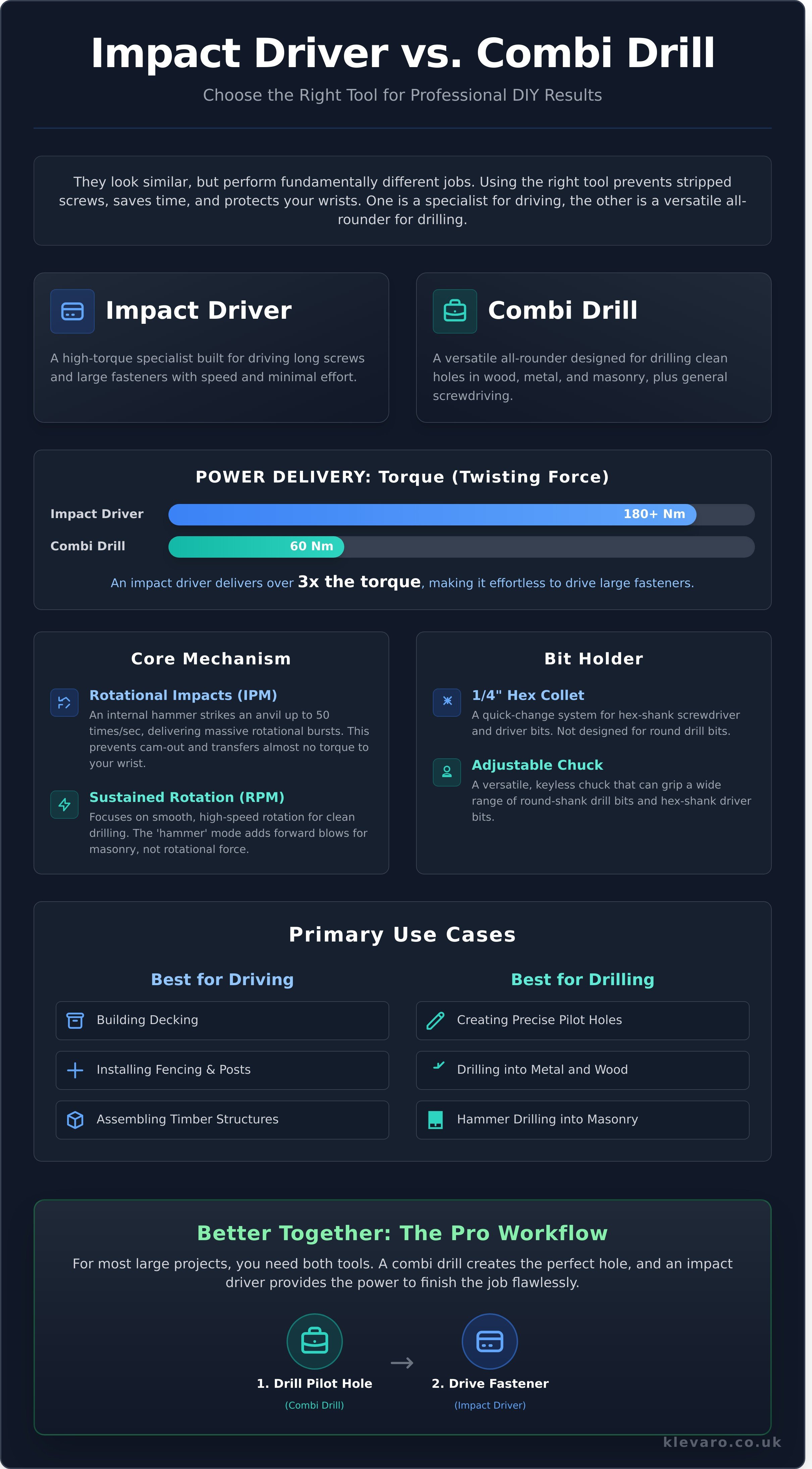
While they look similar, an impact driver and a combi drill perform fundamentally different jobs. A combi drill is your versatile all-rounder, designed for drilling clean holes in wood, metal, and masonry. An impact driver is a specialist tool built for one primary task: driving long screws and large fasteners with incredible rotational force.
The "one-tool" myth often trips up new DIYers. You almost always need both for a single project. Imagine building a garden deck: you'll use the combi drill to create precise pilot holes, then switch to the impact driver to power through hundreds of decking screws without stripping the heads or straining your wrist. One drills, the other drives. Using the wrong tool for the job leads to frustration, damaged materials, and poor results.
Torque and Speed: Understanding the Numbers
The biggest difference lies in how each tool delivers power. Torque, measured in Newton Metres (Nm), is the twisting force a tool can apply. A dependable 18V combi drill might offer 60 Nm of torque. In contrast, a similar 18V impact driver can easily produce over 180 Nm, delivering three times the turning power for stubborn fasteners.
This power comes from two different metrics. Drills focus on Rotations Per Minute (RPM), which measures how fast the chuck spins, essential for clean hole-cutting. An impact driver adds Impacts Per Minute (IPM), where an internal hammer strikes an anvil to create massive bursts of torque. These thousands of concussive blows per minute are what make driving a 100mm screw into oak feel effortless. Both tools feature variable speed triggers, giving you vital control to start screws slowly or work with delicate materials without causing damage.
The Chuck vs. The Collet: Bit Compatibility
The way you attach accessories is another key distinction. A combi drill uses a three-jaw adjustable chuck that can grip a wide range of round-shank drill bits and accessories. An impact driver uses a 1/4-inch quick-release hex collet.
This collet is a game-changer for speed. You can swap bits one-handed in seconds, perfect for when you're up a ladder or need to switch between different screw types quickly. The major limitation is that it only accepts 1/4-inch hex-shank bits. Your standard round drill bits simply won't fit.
You can buy drill bits with a hex shank for occasional light drilling, but they aren't a true substitute for a drill. More importantly, you must use impact-rated screwdriver bits. These special bits feature a flexible "torsion zone" between the tip and the shank, which is designed to absorb the intense force of the impacts. Using a standard bit in an impact driver will likely cause it to shatter. Ensuring you have the right accessories is key, so it’s wise to invest in a durable set of impact-rated power tool accessories designed for the job.
How to Choose the Best Impact Driver for UK Projects
Finding the right impact driver for your home and garden jobs means focusing on three key areas: the battery system, motor technology, and physical design. For most UK DIY tasks, an 18V brushless model offers the perfect balance of power, runtime, and long-term value. While brushed motors are cheaper, the small extra investment for a brushless tool pays off quickly in battery life and tool longevity. Don't forget ergonomics; a lightweight tool with a comfortable grip and a bright LED light makes any project easier.
A smart way to start your toolkit is by purchasing a twin pack. These kits often include both a combi drill and an impact driver, plus two batteries and a charger. Buying a bundle can save you over £80 compared to purchasing the items separately, giving you two essential tools that share the same battery platform from day one.
Motor Technology: Brushed vs. Brushless Explained
The motor is the heart of your impact driver. A brushless motor uses magnets to generate power, eliminating the physical "brushes" found in older designs. This reduces friction and heat, giving you up to 30% more runtime from the same battery and a significantly longer tool lifespan. Because there are no brushes to wear out, they are virtually maintenance-free.
So, is the extra cost worth it? By 2026, with prices becoming more competitive, the answer is a clear yes for almost everyone. While a basic brushed model is a budget-friendly choice for someone who will only assemble one piece of flat-pack furniture a year, the improved efficiency of a brushless tool makes it a much better long-term investment for regular DIYers.
Speed Settings and Control Features
Modern impact drivers offer much more than just raw power; they provide precision control. Look for models with at least three speed and torque settings. A low speed is perfect for driving small, delicate brass screws into pine without damage, while the highest setting will drive a 100mm coach screw into a fence post with ease. This versatility prevents you from needing a different tool for every task.
Many premium models also include specialised "assist" or auto-stop modes. These clever features automatically slow the tool down just before a screw is fully seated, preventing you from stripping the screw head or snapping it off in soft woods. A compact design is also vital. A tool with a short head length (under 120mm) is essential for working in tight UK spaces, like inside kitchen cabinets or between floor joists. You'll be grateful for it when you're not struggling for room. Explore our complete collection of cordless impact drivers to find a model with the right features for you.
Essential Accessories and Safety for Impact Driving
An impact driver is a powerhouse, but its raw strength is only effective and safe when paired with the right accessories. Using the wrong bit isn't just inefficient; it's dangerous. The single most important rule is to only use impact-rated bits. Standard drill bits are made from hardened, brittle steel that can shatter violently under the rapid, high-torque rotational blows of an impact driver, sending sharp metal fragments flying.
Impact-rated bits are engineered differently. Look closely at one, and you'll often see a thinner section between the tip and the hexagonal shank. This is the "torsion zone." It's designed to flex and absorb the peak torque delivered by the tool's hammer and anvil mechanism. This small design feature prevents the energy spike from transferring directly to the bit tip, dramatically reducing the risk of snapping and extending the life of the bit.
Choosing the Right Impact Bit Set
Your bit set is just as important as the tool itself. In the UK, you'll primarily encounter three types of screw heads, and having the right bit for each is key to avoiding frustration and stripped fasteners.
- Pozidriv (PZ): The UK standard for construction and woodworking. Recognisable by the main cross and four smaller "wings," PZ bits offer a superior grip and are designed to resist cam-out (slipping out of the screw head).
- Phillips (PH): Common in electronics, flat-pack furniture, and American products. It looks similar to a Pozidriv but lacks the extra wings, making it more prone to cam-out.
- Torx (TX): A six-pointed star shape that provides excellent torque transfer and is highly resistant to stripping. It's increasingly popular for decking, timber framing, and automotive work.
For versatility, a magnetic bit holder is a fantastic addition, allowing you to quickly swap short bits. However, for maximum stability and access in tight spaces, a longer, direct-fit bit is often the better choice. Having a quality set with a variety of bit types is essential for any DIYer. To get properly kitted out, explore our range of tools and equipment for durable, impact-rated accessories.
Finally, always replace your bits at the first sign of wear. Once the edges become rounded, the bit will struggle to grip the fastener, leading to stripped screws that are a nightmare to remove. A fresh bit is a small investment that saves a huge amount of time and effort.
Safe Handling and Noise Protection
Safety should always be your top priority. An impact driver is significantly louder than a standard drill, often producing noise levels well over 100 decibels (dB). That's comparable to a chainsaw. According to the Health and Safety Executive (HSE), prolonged exposure to noise above 85dB can cause permanent hearing damage, so ear protection is absolutely non-negotiable.
Proper technique is crucial for both safety and performance. Use the "lean-in" method by applying firm, steady pressure directly in line with the screw. Your body weight helps keep the bit securely seated in the fastener, preventing it from slipping and stripping the head, especially when the powerful impact mechanism engages. Let the tool do the work; your job is to guide it and keep it stable.
Be mindful of heat. The intense friction and rapid impacts generate a surprising amount of heat, especially when driving long screws into dense material. The bit and the tool's metal collet can become hot enough to burn. Always allow the tool a moment to cool down or wear protective gloves when changing bits after a period of heavy use.
Getting Started: Your First Projects with Klevaro Gear
You've chosen your tool, and now the real fun begins. An impact driver is a fantastic piece of kit, but its power can be surprising at first. We recommend starting with a simple project to get a feel for its torque and speed. Assembling a flat-pack garden bench or building a raised planter box are perfect first tasks. These projects involve driving multiple screws into wood, letting you experience the tool's efficiency without risking a major renovation.
Once you're comfortable, you can integrate your new tool into a larger home and garden project. Think bigger. That new decking you've been dreaming of? Your impact driver will make sinking hundreds of decking screws almost effortless. It's the perfect companion for building stud walls, fitting kitchen cabinets, or even assembling a garden shed. It transforms repetitive, high-effort tasks into quick, satisfying jobs.
It's also the ideal tool for assembling high-quality garden kits, such as the aluminium structures offered by Pergola2Go, turning a weekend project into a simple afternoon task.
To keep your gear in top condition, focus on simple maintenance. After each use, give the 1/4-inch hex collet a quick wipe to remove dust and debris, ensuring your bits lock in securely every time. For battery care, always store them in a dry place. A typical UK garage can get damp, so consider a sealed storage box or bringing your batteries indoors during colder, wetter months to preserve their lifespan.
Feeling inspired? Don't go it alone. Join the Klevaro community to share your creations and get expert project tips from fellow DIY enthusiasts. It's the best place to find your next great idea.
Perfecting Your Technique
Mastering your impact driver is all about control. Before tackling a finished piece, grab some scrap wood and practice driving a few screws. This lets you feel exactly when the rotational hammering kicks in, so you'll know what to expect. This simple five-minute exercise builds confidence and prevents over-driving screws on your actual project.
- Use a "soft start" for precision. Gently squeeze the variable speed trigger to start the screw slowly. This gives you maximum control, preventing the bit from slipping and scratching finished surfaces like cabinet doors or drywall.
- Unleash torque on stubborn screws. Got a rusted-on screw that won't budge? Switch to reverse, apply firm pressure, and let the high-torque impacts do the work. The tool's power will break the screw free where a standard drill would likely just strip the head.
Building Your Professional DIY Kit
Your power tools are the heart of your workshop, but they work best as part of a team. A high-quality hand tool set is the perfect complement, providing the essentials for measuring, marking, and making fine adjustments that power tools can't handle. A reliable tape measure, spirit level, and square are non-negotiable for achieving a professional finish.
Protect your investment with the right storage. A hard-shell case offers the best protection against drops and moisture, while a durable fabric tool bag provides more flexibility and pockets for organising your driver, bits, and batteries. Choose the one that best fits how and where you work.
You have the knowledge and the confidence. Now it's time to build your toolkit and bring your vision to life. Shop our latest range of DIY tools and drivers to start your next project today.
Power Up Your DIY: Your Next Project Awaits
You're now equipped with the knowledge to tackle bigger, bolder projects with confidence. We've covered why a dedicated impact driver is the go-to tool for driving long screws and bolts, offering rotational power that a standard combi drill just can't match. This understanding is your first step to working smarter, saving you time and effort on everything from building garden decking to assembling sturdy furniture.
Choosing the right model and pairing it with essential accessories isn't just about performance; it's about safety and achieving a professional finish every time. At Klevaro, we're here to back you up on that journey. All our power tools come with a Quality Guarantee, and we offer Fast UK Delivery to get you started on your next project without delay.
Ready to feel the difference that real power makes? Upgrade your workshop with our trusted range of DIY tools and find the perfect partner for your next creation. With our Easy Returns policy and Trusted UK Support just a call away, you can shop with complete peace of mind. Now, go create something amazing.
Frequently Asked Questions
Can I use an impact driver as a regular drill?
Yes, you can use an impact driver for some drilling, but it isn't a perfect substitute for a drill. It excels when using hex-shank spade or auger bits to create large-diameter holes in wood. However, for drilling precise, clean holes, especially in metal, a standard drill-driver provides better control and a smoother finish. The impact mechanism isn't designed for the fine, consistent rotation needed for precision tasks, so it's best to use the right tool for the job.
Why do impact driver bits break so easily?
Bits often break because of the immense torque and rapid concussive blows delivered by an impact driver. Standard screwdriver bits are too brittle and aren't designed to flex under such force. To avoid this, you must use impact-rated bits. These are made from more durable steel engineered to absorb the shock without shattering. Using the wrong type of bit is the primary cause of breakage, so investing in a quality set of impact-rated bits is essential for your projects.
Is an 18V impact driver too powerful for a beginner?
No, an 18V impact driver is a fantastic and manageable tool for a beginner. Nearly all modern models feature a variable speed trigger, which gives you complete control over the power output simply by adjusting your finger pressure. Many also include different power modes, allowing you to select a lower torque setting for delicate jobs like furniture assembly. Just start on a low setting to get a feel for the tool, and you'll tackle bigger projects with confidence.
What is the difference between an impact driver and an impact wrench?
The main difference is their drive type and intended job. An impact driver uses a 1/4-inch hex collet designed to hold screwdriver bits and other hex-shank accessories for driving screws. An impact wrench, on the other hand, has a square anvil drive, typically 1/2-inch, for attaching sockets to loosen and tighten nuts and bolts. An impact wrench delivers significantly more torque, making it the ideal tool for automotive mechanics and heavy construction tasks.
Do I need special screws for an impact driver?
While you don't need special screws, you'll get far better results using modern, high-quality structural or decking screws. Look for screws with a Torx or Pozi drive head, as these provide a much better grip and prevent the bit from slipping out and stripping the head. Using cheap, soft-metal screws can easily lead to stripped heads or snapped screws because of the tool's power. For any load-bearing work, always choose screws specifically rated for structural use.
How long does a typical 2.0Ah battery last in an impact driver?
A 2.0Ah battery's runtime depends entirely on the workload. For light, intermittent use like building flat-pack furniture, it could last for several hours. For a continuous, demanding task like driving 150 75mm screws into softwood, a fully charged 2.0Ah battery should be able to complete the job. For heavy-duty, all-day projects, we recommend having a spare battery or upgrading to a 4.0Ah or 5.0Ah battery to avoid interruptions.
Is brushless really better for home DIY use?
Yes, brushless tools are a significantly better choice, even for home DIY projects. A brushless motor is more efficient, giving you up to 50% more runtime from the same battery. It also delivers more power and generates less heat, which extends the overall life of the tool. While the initial cost can be slightly higher, the improved performance, longer battery life, and durability make a brushless impact driver a smart, long-term investment for any toolkit.
Why is my impact driver making a loud clicking noise?
That loud clicking or hammering sound is completely normal and means your tool is working correctly. The noise is the internal impact mechanism engaging. When the tool senses resistance that the motor can't overcome on its own, an internal hammer begins striking an anvil at over 50 times per second. This action delivers powerful rotational bursts that drive the screw forward. So, when you hear that noise, it's a sign your tool is powering through a tough spot.
Leave a comment