


The Ultimate Guide to Choosing and Using a Socket Set in 2026
What if that massive 200-piece toolkit is actually the worst investment for your garage? For most UK home and garden projects, a quality 3/8-inch drive socket set made from durable chrome vanadium steel is the most practical and versatile choice. This core kit, featuring common metric sizes from 8mm to 19mm, provides the perfect balance of strength and accessibility for everything from assembling flat-pack furniture to basic car repairs, ensuring you have the right tool without the clutter.
We know it’s confusing to stare at a wall of options, worrying about buying a low-quality set that will round off a bolt head. You just want reliable gear that gets the job done. That’s exactly what this guide delivers. You'll learn how to confidently choose the right drive size for any task, understand the value of quality materials, and build a collection of tools that will last a lifetime. Get ready to fix, build, and create with a socket set that's perfectly matched to your projects.
Key Takeaways
- Evaluate your most common DIY projects to choose a set with the right drive size and pieces, rather than just picking the one with the highest count.
- Understand that drive size refers to the square connector on the ratchet, and the metric system (mm) is the standard for most modern UK cars and appliances.
- Extend the life of your tools by always seating the socket fully on a fastener before turning and cleaning away grease and grit after every job.
- A quality socket set speeds up tasks and works in tight spaces where a regular spanner cannot, thanks to its efficient ratcheting mechanism.
What is a socket set and why is it essential for DIY?
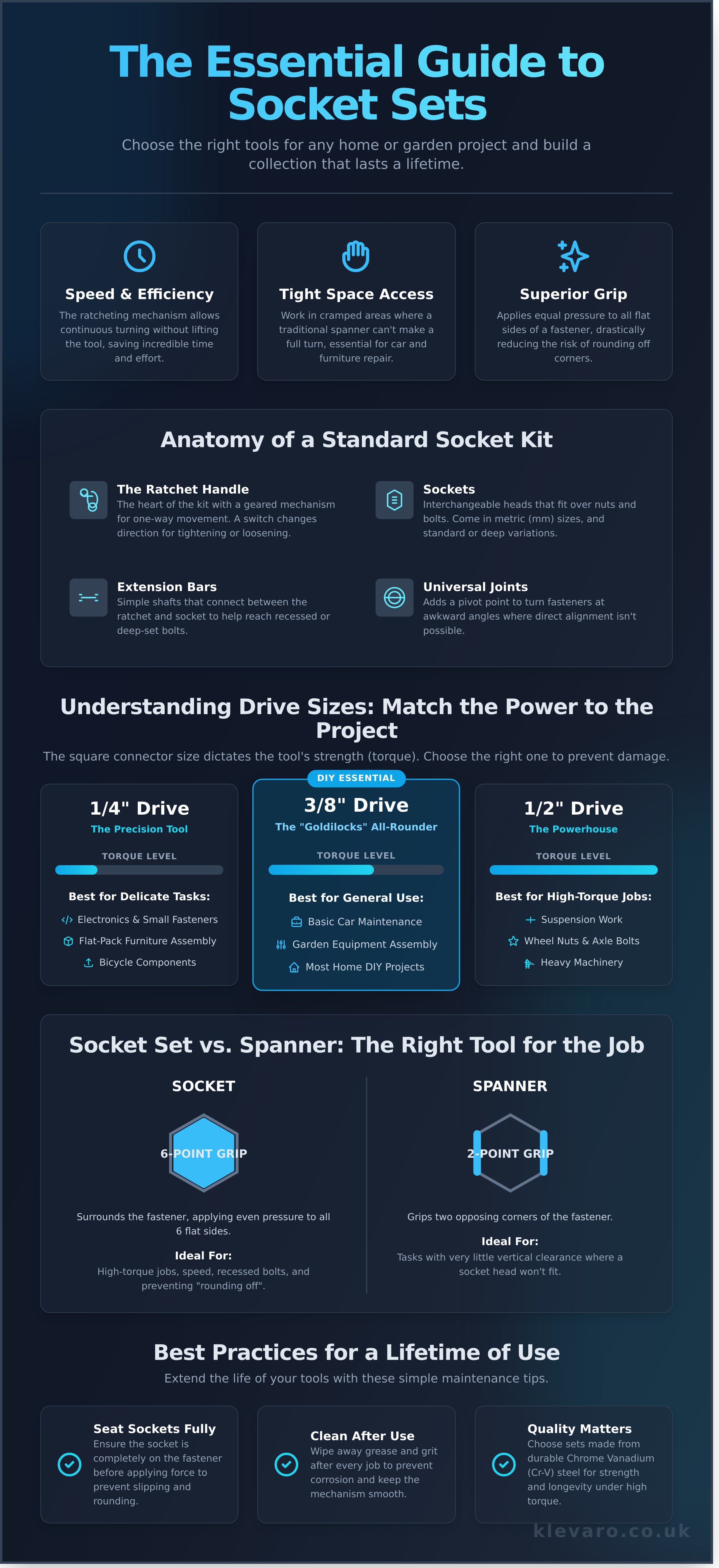
A socket set is a toolkit containing interchangeable heads, called sockets, that attach to a ratcheting handle to tighten or loosen fasteners. It's an essential tool for any DIY enthusiast because its ratcheting mechanism allows you to work quickly and efficiently, even in tight spaces where a traditional spanner can’t make a full turn. This makes it indispensable for a huge range of jobs. You'll find yourself reaching for it for everything from routine car maintenance and building flat-pack furniture to assembling new garden equipment. Modern, high-quality sets are forged from Chrome Vanadium (Cr-V) steel, giving them the strength to handle high torque without breaking.
The real magic is in the speed. The ratchet lets you turn a bolt continuously without ever lifting the tool off the fastener; you simply swing the handle back and forth. This simple action saves an incredible amount of time and effort on any project with multiple fixings. The core of the tool, the socket wrench, has a long history, but its modern design delivers a combination of power and convenience that is hard to beat. A single organised case can replace an entire collection of individual spanners, keeping your workspace tidy and ensuring you always have the right size to hand.
The components of a standard socket kit
A great kit is more than just a handle and some sockets. Understanding each component helps you tackle any job with confidence and get into those hard-to-reach places.
- The Ratchet Handle: This is the heart of the kit. It contains a geared mechanism that allows for one-way movement, creating the 'clicking' sound as you work. A small switch lets you instantly change direction from tightening to loosening.
- Sockets: These are the individual attachments that fit securely over nuts and bolts. They come in a wide range of metric (mm) sizes and in standard or deep variations for accessing nuts on longer threaded bolts.
- Extension Bars: These simple shafts connect between the ratchet and the socket, acting as an extension to help you reach recessed bolts. They are essential for working on car engines or reaching fixings deep inside furniture frames.
- Universal Joints: Often called a knuckle joint, this clever attachment adds a pivot point. It allows you to turn a fastener even when you can't get the ratchet directly in line with it, which is perfect for awkward angles in cramped spaces.
Socket set vs. Spanner: When to use which?
While they often do similar jobs, sockets and spanners have distinct advantages. Choosing the right one makes the task easier and prevents damage to your fixings. The biggest difference is how they grip the fastener.
A socket surrounds a hexagonal nut or bolt head, applying equal pressure to all six flat sides. This superior grip dramatically reduces the risk of "rounding off" the corners, a frustrating problem that can make a fastener impossible to remove. For this reason, you should always reach for a socket for high-torque jobs, like loosening tight wheel nuts, or when working with older, slightly worn fixings.
Use a socket set for speed, power, and access to recessed bolts. However, a spanner still has its place. If you have very little vertical clearance above a nut, the combined height of a socket and ratchet head may be too tall to fit. In these specific situations, a slim combination or ring spanner is the perfect tool for the job.
Understanding drive sizes and measurement systems
Choosing the right socket set starts with two key details: the drive size and the measurement system. The drive size is the square-shaped connector on the ratchet that the socket clicks onto; it determines the tool's power and application. In the UK, you'll encounter two measurement systems for the sockets themselves: Metric (millimetres) and Imperial (inches). For a versatile home toolkit, a mixed set containing both measurement types is often the most practical and reliable choice.
Getting these details right ensures you have the correct tool for the job, preventing damage to both the fastener and your equipment. Think of the drive size as the engine and the measurement system as the key - you need both to match perfectly.
1/4 inch vs. 3/8 inch vs. 1/2 inch drives
The drive size dictates the amount of torque (turning force) you can safely apply. A larger drive size means a stronger ratchet and larger sockets, built for tougher jobs. Each size has a specific purpose in your workshop.
- 1/4" Drive: This is your precision tool. It's perfect for delicate tasks where too much force could cause damage. Think of assembling flat-pack furniture, working on bicycle components, repairing electronics, or accessing small fasteners inside a car's dashboard.
- 3/8" Drive: The ultimate all-rounder. Often called the "Goldilocks" size, the 3/8-inch drive is strong enough for most automotive repairs like brake jobs and oil changes, but nimble enough for general DIY tasks around the house and garden. If you buy just one socket set, this is usually the one to get.
- 1/2" Drive: This is the heavy-duty option for jobs that require maximum torque. It’s the go-to for loosening stubborn wheel nuts, working on vehicle suspension, or tackling large bolts in construction and agricultural machinery.
Metric vs. Imperial: Which do you need in the UK?
Since the 1970s, the UK has predominantly used the metric system. For any home, garden, or automotive projects you're planning through 2026 and beyond, you can expect nearly every new fastener you encounter to be metric. Modern cars, home appliances, and furniture all rely on millimetre (mm) measurements.
However, Imperial (also known as SAE or inches) fasteners haven't disappeared entirely. You'll still find them on classic British cars, American-made vehicles, older industrial machinery, and some specific plumbing fixtures. If you're a classic car enthusiast or work on imported equipment, an Imperial set is essential.
A word of caution: never use a "close enough" size from the wrong system. For example, a 13mm socket might seem to fit a 1/2-inch bolt, but the tiny mismatch will cause the socket to slip under pressure. This will damage and "round off" the corners of the fastener, making it incredibly difficult to remove. Using the correct size every time saves you headaches and money. For most people, a quality 3/8-inch drive set with both metric and imperial sockets provides the best balance. You can explore our complete range of socket sets to find the perfect fit for your toolkit. Experts often agree, and a detailed Popular Mechanics guide to socket sets can help you compare top models for different applications.
How to choose the right socket set for your projects
Choosing the right socket set starts with your projects, not the piece count. A massive 200-piece kit might seem like a great deal, but it's useless if it lacks the specific sizes or types of sockets you need for your tasks. Focus on the jobs you do most often, whether it's building flat-pack furniture or servicing your car, to find a set that offers real value.
A durable, organised case is non-negotiable. Sockets are small and easily lost, turning a quick job into a frustrating hunt for the right size. Look for sets housed in sturdy blow-moulded cases where each piece snaps securely into a labelled spot. This simple feature protects your investment and saves you valuable time on every project.
For maximum grip and power, always prioritise 6-point sockets over 12-point versions. A 6-point socket grips the flat sides of a nut or bolt head, providing more surface contact and significantly reducing the risk of rounding off stubborn or rusted fasteners. While 12-point sockets offer more engagement angles in tight spaces, the superior torque application of 6-point sockets makes them the best choice for most DIY and automotive work. The excellent Popular Mechanics guide to socket sets further explores how socket design impacts performance on tough jobs.
Finally, check for essential accessories that match your needs. If you plan on doing basic car maintenance, a set that includes dedicated spark plug sockets is a must. Extension bars are critical for reaching recessed bolts in engine bays, while a universal joint provides the flexibility needed to work around obstructions.
Project-based selection guide
- Home Maintenance: For everyday tasks like assembling furniture, adjusting bicycles, or general repairs, a compact 40-50 piece set is ideal. Look for one with 1/4" and 3/8" drive ratchets, covering the most common small-to-medium fastener sizes found around the home.
- Automotive Hobbyist: Working on cars requires a more comprehensive 100+ piece kit. This should include 1/2" drive tools for larger bolts, a full range of deep sockets for accessing nuts on long studs, and speciality bits like Torx and Allen keys, which are common in modern vehicles.
- Professional/Trade: Professionals need durable, specialised tools built for daily use. This often means investing in impact-rated sockets designed to be used with high-torque power tools. These sets are built for maximum toughness and safety under extreme loads.
Material quality and finish
The vast majority of quality hand tool sockets are made from Chrome Vanadium steel (Cr-V). This alloy is the industry standard because it provides the perfect combination of strength, durability, and resistance to corrosion and abrasion. A Cr-V stamp on a socket is a reliable indicator of a well-made tool.
The finish on a socket affects both its appearance and handling. A polished chrome finish is smooth, looks professional, and is incredibly easy to wipe clean of grease and oil. A matte or satin finish provides a slightly rougher texture, which some users find offers a better grip, especially when their hands are oily.
You can easily identify impact sockets by their distinct black oxide or manganese phosphate finish. This isn't just for looks; it provides corrosion resistance. More importantly, they are typically made from a tougher, more ductile Chrome Molybdenum (Cr-Mo) steel. Never use a standard chrome socket with an impact wrench. It isn't designed for the sudden, powerful forces and can shatter, creating a serious safety hazard.
Best practices for using and maintaining your tools
A quality socket set is a true investment for any DIY enthusiast. With just a little care, it will deliver reliable performance for decades. Following a few simple best practices for use and maintenance ensures your tools are always ready for the job, safe to use, and protected from the classic dampness of a UK garage.
Proper care starts with proper use. Always make sure the socket is fully seated over the nut or bolt head before you apply any force. A partially seated socket is the number one cause of "rounding off" a fastener, which can turn a five-minute job into a frustrating ordeal. You should feel a solid connection with no wobble.
After each use, give your tools a quick wipe-down with a clean rag. This simple step prevents grease, oil, and grit from building up. Caked-on grime can make sockets slippery and can work its way into the ratchet mechanism, causing it to jam or skip under load.
Finally, think about storage. The plastic case your socket set came in is its best home. Store it in a dry environment, like a cabinet or a sealed toolbox, to prevent surface corrosion. Once a year, put two or three drops of light machine oil into the ratchet’s drive mechanism and work it back and forth to keep the action smooth and precise.
Safety tips for high-torque applications
When you're dealing with stubborn, high-torque fasteners, safety is paramount. Keep these essential tips in mind to protect yourself and your tools:
- Use the right tool for leverage. Never slide a pipe or "cheater bar" over a standard ratchet handle. The ratchet's internal gear mechanism isn't designed for that level of force and can shatter. Instead, use a dedicated breaker bar, which is a solid steel bar built to handle extreme torque safely.
- Position your body correctly. Always plan for the tool to slip or the fastener to suddenly break free. Brace yourself and position your body so you won't fall or hit your hand on a sharp engine component if it gives way. Pushing a wrench is often more stable than pulling it.
- Protect your eyes. When working under a vehicle or on heavily rusted parts, always wear eye protection. Applying force can send flakes of rust, dirt, or even metal shards flying unexpectedly.
Long-term care and rust prevention
A little preventative maintenance goes a long way. If you spot light surface rust, it's easy to handle. Simply spray the area with a penetrant oil like WD-40, let it sit for about 10 minutes, and then gently scrub it away with a piece of fine-grade wire wool. Wipe it clean, and your tool will look as good as new.
Pay attention to the sounds your ratchet makes. That crisp, satisfying "click" as you tighten or loosen is the sound of the internal pawls engaging correctly with the gear. If the sound becomes muffled, gritty, or the mechanism starts to slip, it’s a clear sign it needs a deep clean and lubrication.
Good organisation is key to long-term care. Keeping your tools in their designated case helps you spot a missing piece immediately, so you don't leave a 10mm socket in an engine bay. A complete toolkit is a safe and efficient toolkit. By organising all your essential hand tools, you ensure you always have what you need, right when you need it. If your set has gaps, it might be time to invest in a new one that can handle any project you throw at it.
Find your next high-quality socket set at Klevaro
Now that you understand the power and versatility of a socket set, it’s time to find the right one for your toolbox. At Klevaro, we’ve taken the guesswork out of the equation. We offer a carefully curated range of reliable socket sets specifically chosen for UK homes, gardens, and garages. It's the satisfaction of having the exact tool you need, right when you need it.
You don’t need to be a professional mechanic to deserve professional-grade gear. That’s why we champion trusted brands like Rolson, which deliver exceptional durability and performance at prices perfect for the DIY enthusiast. Our sets come in sturdy, organised cases, so you’ll never waste time searching for the right size again. Whether you're assembling flat-pack furniture, tuning up the lawnmower, or tackling a car repair, our collection has you covered.
With our fast UK delivery, you can order today and have the right tools in hand for your next weekend project. Stop improvising and start fixing things the right way. Explore our complete tools and equipment collection and get ready to build, fix, and create with confidence.
Why Klevaro is the preferred choice for UK DIYers
We believe everyone deserves tools that work as hard as they do. Our team hand-selects every product based on its durability, ergonomic design, and ease of use, ensuring that even non-professionals can achieve a flawless finish. We look for chrome vanadium steel construction, comfortable grips, and clear markings because we know these details make a big difference.
This commitment is backed by our "Quality Guaranteed" promise. It’s more than a slogan; it’s our pledge that you’re investing in reliable equipment that we stand behind. It means confidence in every build, every fix, and every purchase. When you combine your new tools with items from our full home and garden range, you have a complete solution for transforming your space.
The perfect gift for any occasion
A high-quality socket set is more than just a box of tools; it's a gift of empowerment, practicality, and longevity. It’s the perfect present for the hands-on person in your life, providing years of reliable use for countless projects. You’re giving a foundational piece of kit for hobbies and home maintenance that lasts for years.
It's a thoughtful, practical choice for any celebration:
- For the Dad Who Has Everything: Stop the search for the perfect Fathers Day gift. A comprehensive toolset is a classic choice that’s genuinely useful. It’s an invitation to spend time together on a project or a way to support his passion for fixing things around the house and garage.
- For the New Homeowner: Give a "gift that lasts" and helps turn a new house into a home. After navigating the move—a challenge where understanding your options is key (check vpsmart.co.uk for a helpful breakdown)—a reliable set of sockets is essential for everything from assembling furniture to tightening leaky taps, saving them hundreds of pounds on handyman call-outs. It's a truly practical start to their homeownership journey.
- For the Next Generation of Creators: Encourage a young enthusiast or apprentice with a dependable starter kit. Giving them safe, quality tools fosters independence, teaches them valuable life skills, and builds the confidence to bring their creative ideas to life. It’s an investment in their future capabilities.
Your next project is waiting. Don't let the wrong tools hold you back. At Klevaro, we're here to be your partner in every DIY success. Choose a socket set from our collection today and feel the difference that quality equipment makes. Gear up, get inspired, and get it done.
Build, Fix, and Create with the Right Socket Set
You're now equipped to choose the perfect tools for any task. Understanding the difference between a 1/4-inch drive for delicate jobs and a 1/2-inch drive for heavy-duty work is your first step. Proper care and knowing whether you need a metric or imperial system will ensure your new socket set is an investment that lasts for years of successful projects.
Your next project is waiting. It's time to put your expertise into action. At Klevaro, we're here to help you get the job done right with durable and practical gear.
Explore our carefully selected collection of high-quality equipment. Shop our reliable range of socket sets and hand tools and enjoy Fast UK Delivery on every order. As a Trusted UK Store for home and garden essentials, we offer a Quality Guaranteed promise on all our DIY tools.
Go on, tackle that to-do list with confidence.
Frequently Asked Questions
What size socket set is best for most cars?
A 3/8-inch drive socket set is the most versatile and practical choice for most car maintenance tasks in the UK. This size provides an excellent balance of strength for stubborn bolts and a compact profile for accessing tight spaces. For a great starter kit, look for one that includes common metric sizes like 8mm, 10mm, 13mm, 17mm, and 19mm, which will fit over 90% of the fasteners on modern cars. For those looking to go beyond mechanical fixes and into electronic diagnostics, you can read more on the topic.
Can I use regular sockets with an impact driver?
No, you should never use standard chrome sockets with an impact driver. Regular sockets are made from a hard, brittle steel that can shatter under the intense, rapid force of an impact tool, creating a serious safety risk. Always use designated impact sockets, which are made from a tougher, more ductile steel (like Cr-Mo) designed to absorb the force without breaking.
What is the difference between 6-point and 12-point sockets?
The key difference is the interior shape; a 6-point socket has a hexagonal profile, while a 12-point has a double-hexagon profile. 6-point sockets offer a better, more secure grip on fasteners and are far less likely to slip and round off the corners of a tight bolt. While 12-point sockets can be easier to position in confined spaces, the 6-point design is the stronger and more reliable choice for most jobs.
Why does my ratchet keep slipping or getting stuck?
Your ratchet is most likely slipping due to worn-out gears or pawls inside the head, often caused by applying excessive force or accumulated dirt. The fine teeth that allow the mechanism to grip can wear down over time, especially if used to break loose very tight nuts. Regularly cleaning your tools and using a breaker bar for tough jobs will help preserve your ratchet's mechanism.
What are deep sockets used for?
Deep sockets are designed specifically to reach nuts on long, protruding bolts where a standard-depth socket won't fit. They are essential for tasks like removing spark plugs that are recessed deep in an engine or accessing nuts on long threaded rods. Their extra length allows them to slide over the excess bolt and engage securely with the nut, making certain jobs possible.
Is it worth buying a combined metric and imperial set?
For most people in the UK, a dedicated metric socket set is the more practical investment. Nearly all modern cars, electronics, and flat-pack furniture use metric (millimetre) fasteners. Imperial (inch) sizes are generally only needed for working on classic British vehicles, American imports, or some older machinery. A quality metric-only set will cover almost all your household and automotive DIY needs.
How do I know if my socket set is made of good quality steel?
Look for sockets clearly marked as being made from Chrome Vanadium (Cr-V) steel for standard use, or Chrome Molybdenum (Cr-Mo) for impact sockets. These alloys are the industry standard for durable, long-lasting tools. High-quality tools also feature a smooth, uniform chrome finish with no flaking and have size markings that are laser-etched or stamped into the metal, not just printed on.
What accessories should I look for in a starter socket set?
A great starter socket set should always include a few essential accessories to maximise its usefulness. Look for a kit that contains at least two extension bars (a short and a long one, e.g., 75mm and 150mm) to help you reach awkward bolts. A universal joint is also incredibly helpful, as it allows you to turn fasteners from an angle when direct access is blocked. These simple additions make a huge difference.
Leave a comment