


How to Choose a Socket Set for Car Maintenance: The 2026 Buyer’s Guide
The most expensive socket set on the shelf is often the worst choice for your home garage. To master how to choose a socket set for car maintenance, you must prioritize a 3/8-inch drive set containing 6-point metric sockets from 8mm to 22mm. This specific configuration covers roughly 90% of tasks on modern UK vehicles while significantly reducing the risk of rounding off stubborn bolts. Look for durable chrome vanadium steel construction and a ratchet with at least 72 teeth to ensure your tools last a lifetime and work easily in tight engine bays.
It's completely normal to feel overwhelmed by rows of shiny chrome and confusing drive sizes. We know you want high-quality tools that solve problems rather than taking up space or damaging your car. This guide promises to clear the confusion by showing you exactly which pieces are essential and which ones are just filler. We'll explore the critical differences between socket points, drive sizes, and why metric measurements are your best friend for reliable automotive repairs.
Key Takeaways
- Discover why a 3/8-inch drive metric set is the essential "gold standard" for maintaining modern UK vehicles.
- Learn how to choose a socket set for car maintenance by matching drive sizes to specific tasks for better torque and accessibility.
- Understand the vital difference between 6-point and 12-point sockets to ensure a secure grip and prevent rounding off stubborn bolts.
- Identify the must-have accessories, such as extension bars and breaker bars, needed to navigate cramped engine bays with ease.
- Find out how to spot high-quality tools by looking for Chrome Vanadium steel and high-tooth-count ratchets for professional results.
A 3/8-inch drive metric socket set is the best choice for modern car maintenance.
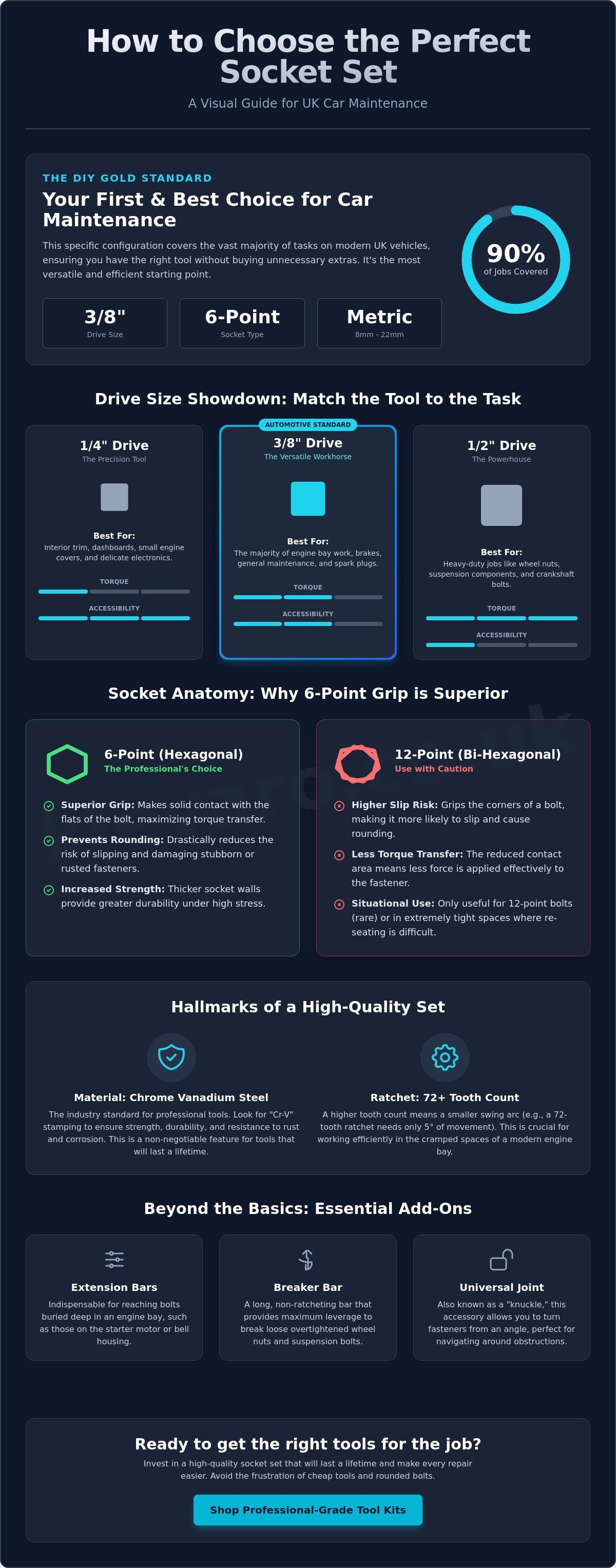
A 3/8-inch drive metric socket set covering 8mm to 19mm is the absolute standard for modern car maintenance. This specific configuration handles nearly every routine task on a UK vehicle, from changing oil to replacing a battery. Most cars manufactured for the British market over the last 50 years use metric fasteners exclusively, so a metric set is your primary requirement. Choosing this size ensures you have enough torque for stubborn bolts without the bulk of larger tools. It is the most efficient starting point when learning how to choose a socket set for car maintenance.
A socket set consists of a collection of interchangeable heads and a ratcheting handle designed to loosen or tighten fasteners. The socket wrench mechanism allows you to turn a bolt in cramped spaces without removing the tool from the fastener. This saves significant time during complex repairs. For most DIYers, a high-quality set from our hand and general tools collection provides the reliability needed for years of weekend repairs. These kits are designed to be durable and simple to use for beginners and pros alike.
Why metric measurements are essential for UK vehicles
British car manufacturing transitioned to the ISO metric standard in the 1970s. This means almost every car on UK roads today, from Fords to Volkswagens, uses millimetre-based fasteners. You'll find that 10mm and 13mm sockets are the most frequently used sizes for engine covers, battery terminals, and sensor brackets. Having a complete run of sizes from 8mm to 19mm ensures you aren't left stranded halfway through a job. If you're working on a vintage Mini or an older Jaguar, you might need a different kit. You can check out this Metric vs Imperial guide to see if your classic car requires specialized tools.
The versatility of the 3/8-inch drive
The drive size refers to the square connector on the ratchet handle that snaps into the socket. A 3/8-inch drive is the ideal middle ground for automotive work. It is stronger than a 1/4-inch drive, which often lacks the leverage for suspension components or rusted bolts. Conversely, it is much more compact than a 1/2-inch drive, which is often too bulky to fit into modern, crowded engine bays. Most specialized automotive tools, including spark plug sockets, are designed specifically for 3/8-inch drives. This makes it the most adaptable choice for anyone learning how to choose a socket set for car maintenance in 2026. It balances physical size with the ability to apply necessary force safely.
- 1/4-inch drive: Best for interior trim and small electrical components.
- 3/8-inch drive: The automotive standard for engines and general maintenance.
- 1/2-inch drive: Necessary for heavy-duty work like wheel nuts and hub bolts.
By focusing on a 3/8-inch metric set, you cover about 85% of all potential jobs on a modern vehicle. This keeps your toolbox organised and prevents you from spending money on tools you'll rarely use. It's a practical, high-value investment for any UK garage.
Drive sizes determine the torque and accessibility of your automotive tools.
Selecting the correct drive size is the most critical step when learning how to choose a socket set for car maintenance. Larger 1/2-inch drives provide the necessary leverage for heavy-duty components like wheel nuts, while smaller 1/4-inch drives offer the precision needed for delicate interior trim. Middle-ground 3/8-inch drives handle most engine bay tasks. You need a variety of drive sizes because the drive square's dimensions dictate the maximum torque the tool can handle and the physical size of the sockets available. Using the wrong size risks snapping the tool or stripping a fastener.
The drive size refers to the square connector on the ratchet that fits into the back of the socket. As you progress in your mechanical journey, you'll find that a single drive size isn't enough for a full vehicle. The relationship between the drive size and the socket range is fixed to prevent tool failure. For instance, you won't find a 32mm socket on a 1/4-inch drive because the small metal square would shear off long before the bolt moved. Research from The Best Socket Sets guides highlights that matching the tool's scale to the fastener's torque requirement is essential for both safety and tool longevity.
- 1/4-inch: Best for low-torque, tight-space jobs like dashboard screws and small sensors.
- 3/8-inch: The versatile "all-rounder" for spark plugs, water pumps, and general engine work.
- 1/2-inch: Reserved for high-torque applications where you need a long breaker bar for extra leverage.
1/4-inch drives for delicate engine and interior work
Precision is the priority for 1/4-inch drives. These sets usually range from 4mm to 14mm and are designed for fasteners that require less than 25 Nm of torque. They're perfect for dashboard removal, electrical sensor replacement, or fixing plastic engine covers. Because the tools are small, they allow you to feel exactly how much resistance the bolt is giving, which helps you avoid over-tightening and snapping fragile threads. It's a vital part of your kit for any job that requires a light touch.
1/2-inch drives for heavy-duty suspension and wheel tasks
When you're dealing with wheel nuts, hub bolts, or subframe components, you need the brute strength of a 1/2-inch drive. These tools are physically larger and require more space to operate, but they can safely handle torque loads exceeding 300 Nm. This drive size is where you'll find sockets ranging from 15mm up to 32mm or larger. If you're building a comprehensive workshop, check out our essential tools guide to see how these heavy-duty drives complement a full DIY setup. They're indispensable for any task involving the car's chassis or drivetrain.
Owning a multi-drive set ensures you're never stuck trying to fit a bulky tool into a tiny gap or using a weak tool on a stuck bolt. If you're ready to upgrade your garage, you can explore our range of hand tools to find the perfect match for your next project.
Six-point sockets provide superior grip for stubborn car bolts compared to 12-point versions.
Six-point sockets are the best choice for car maintenance because they apply force to the flat sides of a bolt rather than the corners. This design significantly reduces the risk of rounding off fasteners, which is a common issue on older UK vehicles affected by road salt and rust. A 12-point socket features a bi-hexagonal internal shape that allows for easier placement in cramped engine bays. However, it only contacts the tips of the bolt head, making it prone to slipping under high torque. For most mechanical tasks, a 6-point socket set is the reliable standard you need to avoid damaging your vehicle.
The physical difference lies in the internal geometry. A 6-point socket has a thick wall and a clear hexagonal shape that matches the bolt head perfectly. In contrast, 12-point sockets are designed for specific multi-point fasteners or situations where you have very limited handle swing. When you are learning how to choose a socket set for car maintenance, prioritize 6-point options for 90 percent of your work. Save the 12-point versions for low-torque interior trim or specialized engine components that specifically require a bi-hex fit.
Socket depth is another critical factor for your toolkit. Standard sockets work well for most accessible nuts, but they won't reach a nut sitting deep on a long threaded stud. You will often encounter these on exhaust hangers or bumper mounts. Having a set that includes both depths ensures you aren't halted mid-job by a fastener your shallow socket cannot reach.
Standard vs deep sockets in automotive repair
Standard sockets are the default choice for most visible bolts on your car. They are compact and easy to control in open spaces. Deep sockets are essential for reaching spark plugs or recessed nuts located inside engine components. A comprehensive car maintenance kit should include a mix of both depths to handle everything from battery terminals to deep-set suspension bolts. This variety allows you to work efficiently without needing to buy extra tools halfway through a repair.
Impact sockets vs chrome sockets are not interchangeable
Never use standard chrome sockets with power tools or impact wrenches. Chrome sockets are made from hard, brittle steel that can shatter under the high-frequency vibrations of an impact gun. Impact sockets are constructed from a softer, thicker chrome molybdenum steel. This material absorbs the energy from the tool without cracking. If you plan on using an electric rattle gun for wheel nuts, explore the tools and equipment collection for heavy-duty impact options. Choosing the right material keeps you safe and protects your tools from premature failure.
Extensions and breaker bars are necessary additions for effective car repair.
To choose a socket set for car maintenance effectively, you must look for kits that include extension bars, breaker bars, and a torque wrench. These accessories are essential because a standard ratchet cannot reach every bolt in a modern, cramped engine bay. Extension bars provide the reach needed for deep-set fasteners, while breaker bars provide the leverage to loosen seized bolts without breaking your tools. A torque wrench is the only way to ensure bolts are tightened to the exact manufacturer specifications for safety. Including these items ensures you have a complete kit capable of handling 90% of common automotive repairs.
A standard ratchet is a versatile tool, but its physical size often limits its use in tight spaces. Modern vehicles are designed with compact engine layouts, leaving very little room for a hand and a tool handle to move together. Extension bars act as a bridge, allowing you to position your ratchet handle in an open area while the socket sits firmly on a distant bolt. Most DIY enthusiasts find that a 3-inch, 6-inch, and 10-inch extension cover almost every scenario under the bonnet.
Breaker bars are equally vital for any serious car project. You should never use a standard ratchet to "crack" a seized or rusted bolt, as the high force can strip the delicate internal gears of the ratcheting mechanism. A breaker bar is a long, solid handle with a swivelling head and no ratcheting gears. This simple design allows you to apply significant force safely. When you're learning how to choose a socket set for car maintenance, prioritise sets that include a 1/2-inch drive breaker bar for heavy-duty tasks like wheel nut removal.
Wobble extensions and universal joints
Wobble extensions are a smart upgrade for any toolkit. These bars have a specially shaped drive end that allows the socket to pivot by about 15 degrees while still turning. This slight angle is often all you need to clear a hose or a bracket that is blocking a straight path to the fastener. For even tighter spots, a universal joint (U-joint) provides a full range of motion. If your U-joint feels too loose to guide onto a bolt, wrap a single layer of electrical tape around the pivot point. This provides enough stiffness to keep the tool upright while you position it in a dark corner of the engine bay.
The importance of a high-quality torque wrench
Precision is the difference between a successful repair and a dangerous failure. Over-tightening a bolt can stretch the metal or strip the threads, while under-tightening allows parts to vibrate loose during travel. Critical components such as wheel nuts, suspension arms, and engine head bolts always require specific torque settings measured in Newton-metres (Nm). A high-quality torque wrench clicks or vibrates when you reach the desired tension, ensuring your work meets factory standards. To keep your torque wrench accurate, always dial it back to its lowest setting before putting it away. Leaving the internal spring under tension for long periods will eventually ruin the tool's calibration.
Ready to upgrade your workshop with professional-grade gear? Explore our range of hand and general tools to find the perfect additions for your next car project.
Investing in a high-quality socket set ensures tool longevity and prevents damage.
To ensure longevity and prevent vehicle damage, you should prioritise socket sets made from Chrome Vanadium (Cr-V) steel with a 72-tooth ratchet mechanism. These materials provide the structural integrity needed for high-torque tasks while the high tooth count allows for precision in cramped engine bays. A well-constructed set also includes a blow-moulded carrying case to keep your tools organised and protected from moisture. Understanding these material and mechanical standards is a vital part of learning how to choose a socket set for car maintenance.
Chrome Vanadium steel is the preferred choice for UK mechanics because it offers a high strength-to-weight ratio and excellent resistance to rust. Most premium sets feature a chrome-plated finish that resists the corrosive effects of brake fluid and road salt. Durable tools don't just last longer; they also protect your car by fitting snugly onto fasteners, which prevents rounded bolt heads. A sturdy case with dedicated slots ensures you never lose a 10mm socket again.
Ratchet handle ergonomics and tooth count
The ratchet is the heart of your kit. A 72-tooth ratchet is a significant upgrade over standard models because it only needs a 5-degree swing arc to engage the gear. This small movement is crucial when you're reaching into tight spots near the firewall or under the chassis. Look for "comfort grip" handles made from oil-resistant rubber to maintain control when your hands are greasy. Quick-release buttons are also a must-have feature, as they allow for rapid socket changes with one hand.
Maintenance and cleaning of your socket set
Proper maintenance keeps your tools in peak condition for decades. After every repair, wipe each socket and extension bar with a clean, oily rag to remove grit and prevent oxidation. If the ratchet head begins to feel gritty or stiff, apply a small amount of light lubricant to the internal mechanism. This keeps the pawls moving freely and prevents the tool from slipping under load. You can find everything you need to fix, build, and maintain your vehicle in the Klevaro collection of hand and general tools.
Investing in quality gear transforms car maintenance from a chore into a rewarding hobby. Having the right tools at your side means you can approach every bolt with confidence and precision. Whether you're performing a simple service or a major repair, reliable equipment ensures the job gets done right the first time. It's time to join the Klevaro community and equip yourself with the gear needed to keep your car on the road for years to come.
Equip Your Garage for Professional Results
Mastering how to choose a socket set for car maintenance transforms your repair experience from frustrating to efficient. Focus on a versatile 3/8-inch drive metric set and always opt for 6-point sockets to prevent rounded bolts. Don't forget to add a breaker bar and extensions to your kit for those hard-to-reach areas and stubborn fasteners. High-quality tools are a long-term investment in your vehicle's health and your own safety.
Professional-grade gear resists wear and provides the precise fit needed for modern automotive engineering. Whether you're performing a simple oil change or a complex brake job, the right equipment makes all the difference. As a Trusted UK Store, we help DIY enthusiasts across the country build the perfect toolkit with Quality Guaranteed. You'll enjoy Fast UK Delivery on all tool orders to get your project moving quickly.
Explore our range of high-quality socket sets and hand tools and start your next project today. It's time to fix, build, and create with total confidence.
Frequently Asked Questions
What is the most common socket size for cars?
The 10mm socket is the most common size for UK car maintenance, frequently used for battery terminals, trim, and small engine parts. You'll also find that 13mm and 17mm sizes are essential for many automotive tasks. Since these three sizes handle the bulk of light mechanical work, they're often the first pieces to get lost from a set. Ensure your kit has duplicates of these to keep your projects moving without delay.
Can I use a metric socket on an imperial bolt?
You shouldn't use metric sockets on imperial (AF) bolts because the fit isn't precise enough for safe work. Even a tiny gap allows the socket to slip, which quickly rounds off the corners of the bolt head. Always match your tools to the specific measurement system of the fastener. When learning how to choose a socket set for car maintenance, prioritize sets that match your vehicle's specific regional manufacturing standards to avoid damage.
What does "drive size" actually mean?
Drive size refers to the square fitting on your ratchet handle that connects to the socket. The three industry standard sizes are 1/4-inch, 3/8-inch, and 1/2-inch. This measurement determines the amount of torque the tool can safely apply and dictates which sockets will fit the handle. Smaller drives work best for tight spaces, while larger drives handle heavy duty tasks like suspension work or engine mounts where more leverage is required.
Do I need a 6-point or 12-point socket set for car DIY?
A 6-point socket set is the superior choice for car DIY because it makes maximum surface contact with the fastener. This design significantly lowers the risk of rounding off rusted or stubborn bolts found on older UK cars. While 12-point sockets are easier to slide onto a bolt quickly, they're much more likely to slip when you apply high pressure. Stick with 6-point options for reliable grip on every tough job you tackle.
What is a deep socket used for?
Deep sockets are elongated tools designed to reach nuts that sit on long threaded studs or are recessed deep within a component. You'll find them essential for specific tasks like changing spark plugs or removing nuts from exhaust manifolds. Most experienced mechanics recommend having a selection of deep sockets in 10mm and 12mm sizes. These specialized tools ensure you can reach fasteners that standard, shallow sockets simply can't touch during complex repairs.
Is a 3/8-inch drive enough for wheel nuts?
A 3/8-inch drive isn't the right tool for loosening wheel nuts because it can't safely handle the necessary torque. Wheel nuts are typically tightened to high specifications that require a 1/2-inch drive breaker bar or impact wrench. Using a smaller 3/8-inch drive for these high-torque tasks can snap the tool or cause a sudden slip. Investing in a larger drive ensures you have the right gear for heavy duty wheel maintenance and safety.
Leave a comment