


Fear of Starting a DIY Project: How to Overcome Anxiety and Start Today
What if the biggest barrier to your dream home isn't a lack of budget, but the fear of starting a diy project? You can overcome this anxiety by selecting a low-risk task that requires minimal investment and basic hand tools. Breaking a large renovation into micro-tasks prevents analysis paralysis and builds immediate confidence. Most beginners find success by starting with projects that cost under £50 and have no structural impact on the home. This approach allows you to learn through doing while keeping the stakes low and the rewards high.
It's completely normal to feel intimidated by complex tool aisles or the risk of making an expensive mistake. We know that watching too many tutorials can often lead to more confusion than clarity. This guide will show you how to dismantle those psychological barriers, select the right starter projects, and save money on professional tradespeople. You'll gain the practical skills and confidence needed to pick up a drill and transform your living space today.
Key Takeaways
- Shift your mindset from perfection to progress by adopting a "Start Small" methodology to overcome initial home improvement anxiety.
- Conquer the fear of starting a diy project by learning how to categorise tasks into low-risk reversible fixes and permanent structural changes.
- Build immediate confidence with simple "gateway projects," such as hanging pictures or updating hardware, before moving on to complex renovations.
- Remove the intimidation factor of new equipment by mastering a 5-step safety protocol and understanding basic tool functions.
- Discover how choosing curated tool collections and ensuring fast UK delivery can help you maintain momentum and achieve professional-looking results.
Overcoming the Fear of Starting a DIY Project Requires a Shift from Perfection to Process
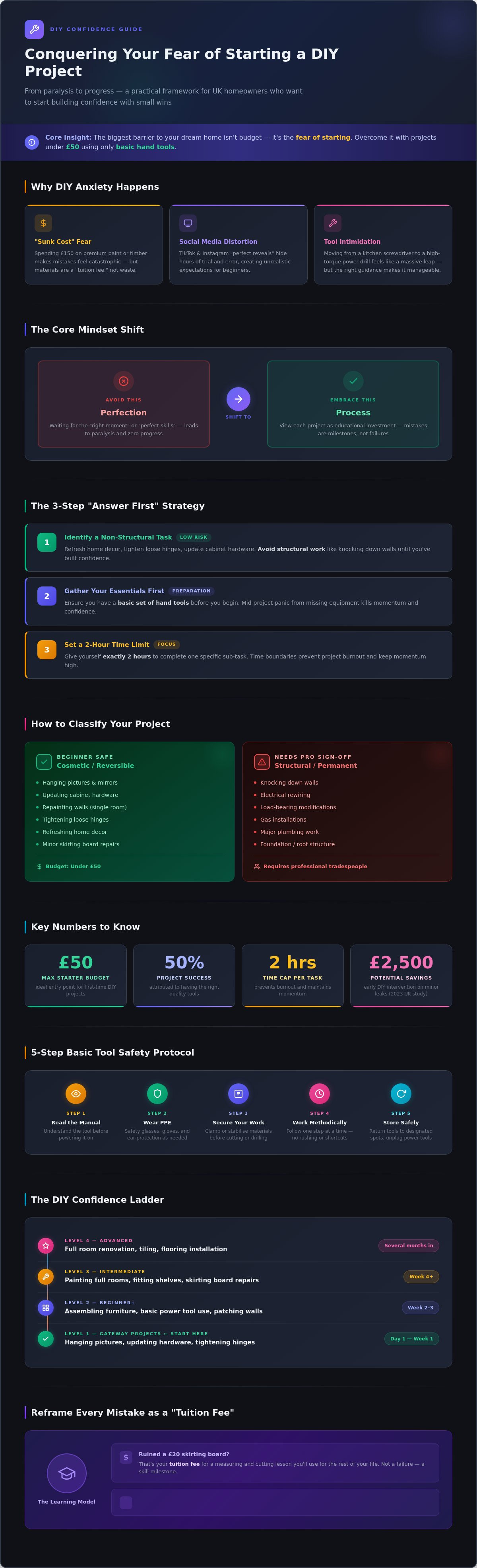
Overcoming the fear of starting a diy project is achieved by prioritising incremental progress over flawless results. Most DIY anxiety stems from a rational awareness of limited experience rather than a lack of capability. You can eliminate this stress by adopting a "start small" methodology on non-structural tasks. Having access to the right quality tools and equipment accounts for 50% of project success. Mistakes are rarely permanent and serve as essential learning milestones for every homeowner. By viewing early projects as educational investments, you remove the pressure of high-stakes renovation.
Your initial hesitation is a natural response to the unknown. It's not a personal failing or a sign that you aren't "handy." Every expert started with a single, uncertain step. By focusing on the process of learning how to use your gear correctly, you shift the goal from a perfect home to a growing skill set. This mindset change is the most effective way to lower your heart rate before you pick up a drill.
Why We Feel Anxious Before Starting Home Improvements
Many homeowners experience a "sunk cost" fear where they worry about wasting expensive materials. If you spend £150 on premium paint or timber, the thought of a mistake feels like throwing money away. This financial pressure is often amplified by the intimidation factor of professional-grade tools. Moving from a basic kitchen screwdriver to a high-torque power drill can feel like a massive leap in complexity and risk.
Social media also plays a significant role in creating unrealistic expectations. The "perfect reveals" seen on TikTok or Instagram often hide the hours of trial, error, and frustration that occur behind the scenes. The concept of Do it yourself (DIY) is historically about self-reliance and learning, but digital trends have rebranded it as instant perfection. Recognising that these videos are edited highlights helps reduce the pressure to perform perfectly on your first attempt.
The "Answer First" Strategy for DIY Success
DIY confidence is the direct result of repeated, small-scale successes. To build this momentum, you need an immediate plan that guarantees a win. Start by following these three steps:
- Identify a non-structural task: Choose something like refreshing home decor or tightening loose hinges rather than knocking down walls.
- Gather your essentials: Ensure you have a basic set of hand and general tools before you begin to avoid mid-project panic.
- Set a time limit: Give yourself exactly two hours to finish a specific sub-task to prevent project burnout.
It's helpful to view your first few projects as an educational expense. If you ruin a £20 piece of skirting board, don't see it as a failure. Treat that £20 as the "tuition fee" for a lesson in measuring and cutting that you'll use for the rest of your life. This perspective turns every mistake into a valuable asset for your next home improvement task.
Common DIY Fears Are Often Based on Misunderstandings of Home Maintenance
Overcoming the fear of starting a diy project involves recognising that most home maintenance tasks are low-risk and reversible. You can manage anxiety by distinguishing between cosmetic updates, like painting, and structural changes that require professional sign-off. Most beginner mistakes are easily corrected with a second coat of paint or a minor adjustment. Learning to use tools is a temporary hurdle that you can overcome by following essential equipment guides. Starting with a small budget and simple hand tools builds the confidence needed for larger renovations. Discovering hidden issues during a project is actually a benefit, as early detection prevents expensive long-term damage to your property.
Many people delay projects because they worry about finding rot or damp. A 2023 study of UK property maintenance suggests that early intervention in minor leaks can save homeowners over £2,500 in structural repair costs. DIY acts as an early warning system. It allows you to spot small issues before they become emergencies. You don't need a huge budget to begin improving your living space. Many high-impact projects, such as replacing cabinet handles or refreshing tile grout, often cost less than £40.
Fear of Damaging Your Property
The anxiety of "ruining" a house usually stems from a lack of distinction between cosmetic and structural work. Painting a room or installing a floating shelf are cosmetic tasks. If you dislike the colour, you can repaint the wall for the price of a £25 tin of emulsion. Structural work, such as removing walls or rewiring a consumer unit, should be left to pros. For beginners, sticking to "safe zones" ensures you build skills without risk.
- Furniture upcycling: Sanding and staining an old wooden chair.
- Garden maintenance: Pruning shrubs or installing decorative border edging.
- Wall decor: Hanging pictures or mirrors using appropriate wall plugs.
- Soft furnishings: Replacing old curtains or fitting new blinds.
Accuracy is the best cure for visual anxiety. Using a spirit level is the easiest way to prevent crooked shelves or lopsided frames. This simple tool ensures your work looks professional and polished every time. To succeed, you must shift from perfection to process and accept that learning involves minor adjustments along the way.
Fear of Power Tools and Personal Injury
Respecting power tools is a sign of a sensible DIYer, but modern safety features have made them more accessible than ever. Most contemporary drills and saws include electronic brakes and blade guards that engage instantly. Cordless technology has also revolutionised tool handling. Modern lithium-ion batteries make drills up to 40% lighter than their corded predecessors, making them much easier to control for those with smaller hands.
If you feel intimidated by the noise or speed of power tools, start with manual versions. Using hand and general tools allows you to understand how different materials react to pressure. You can build muscle memory with a manual screwdriver or a hand saw before graduating to an impact driver or a mitre saw. This gradual approach builds confidence and ensures you always feel in control of the equipment. You can explore our full range of reliable DIY gear to find the right starting point for your next project.
Choosing a Low-Risk Starter Project Guarantees an Early Win
Overcoming the fear of starting a diy project begins with choosing a "gateway project" that offers high visual impact with low technical risk. Small tasks like hanging a picture frame or swapping outdated cabinet handles build the necessary muscle memory for larger renovations. These early wins provide immediate psychological rewards and prove that home improvement is manageable. Starting with home and garden accessories that require minimal assembly allows you to see results within 30 minutes. By focusing on one room at a time, you prevent the paralysis that comes from looking at the entire house as a single project.
Gateway projects are vital because they remove the high stakes of structural changes. If you misplace a screw while hanging a mirror, the wall is easily patched with a tiny amount of filler. This low-risk environment creates a safe space to practice using basic tools like screwdrivers and spirit levels. You'll find that once you've successfully completed three or four of these minor tasks, your confidence to tackle a larger room transformation increases significantly.
The "One-Room Rule" is a strategic way to manage your home improvement schedule. Focusing on a single space, such as a small cloakroom or a hallway, prevents the mental fatigue caused by seeing a whole house of unfinished tasks. You can close the door on the project at the end of the day; this keeps your living environment peaceful while you learn new skills. It's much easier to stay motivated when you have one completed room to enjoy while the rest of the house waits its turn.
Indoor Projects for Absolute Beginners
Upcycling is a perfect entry point for anyone nervous about making permanent changes to their home. You can transform a tired wooden chair or side table by simply sanding it down and applying fresh paint to match your current decor. Installing basic floating shelves is another excellent skill-builder. It teaches you how to use a drill and a spirit level without the complexity of building full furniture units. These "quick fix" decorating tasks provide immediate visual satisfaction that fuels your momentum.
Garden DIY as a Stress-Free Entry Point
The garden is often a more forgiving environment for mistakes than your living room. Outdoor projects allow for a higher margin of error with measurements and alignment because natural textures and foliage hide imperfections well. Start by performing basic gardening tool maintenance to understand how your gear functions. Assembling a pre-cut raised bed is a great way to practice using a cordless driver in an environment where a slightly crooked screw won't ruin your floorboards. This trial and error approach helps you master your tools before you bring them inside to your main living spaces.
Mastering Basic Tool Safety Removes the Intimidation Factor
Mastering tool safety is the most effective way to eliminate the fear of starting a DIY project. By following a structured safety protocol, you replace uncertainty with predictable outcomes and controlled movements. Most DIY accidents are preventable through preparation and the correct use of protective gear. Confidence grows once you understand exactly how your tools function and how to protect yourself while using them.
Before you pick up any equipment, adopt this five-step safety protocol. First, inspect the tool and its power cord or battery for any visible damage. Second, clear your workspace of tripping hazards or clutter. Third, put on your personal protective equipment (PPE). Fourth, ensure you have adequate lighting to see your markings clearly. Finally, perform a mental walkthrough of the task before engaging the power.
Reading the manufacturer manual is your best defence against tool-related anxiety. Manuals explain the specific limitations and safety features of your exact model, which prevents guesswork. A well-lit, organised workspace also reduces stress. When your environment is tidy, you can focus entirely on the task at hand rather than worrying about knocking over a tin of paint or tripping on a cable.
Think of PPE as your professional DIY uniform rather than an optional extra. Standard gear includes impact-resistant safety glasses, sturdy work gloves, and ear protection if you're using loud machinery. Wearing the right gear prepares your mind for work and provides a physical layer of security that makes the process feel much safer.
How to Safely Handle Your First Power Drill
Your power drill is a versatile tool that becomes less intimidating once you understand its anatomy. The chuck is the front part that holds the bit; you rotate it to tighten or loosen the grip. The trigger controls the speed, while the torque settings allow you to adjust the twisting force to avoid stripping screws. Practice holding the drill with a firm, two-handed grip to maintain steady control.
Selecting the right bit is essential for success and safety. Use a masonry bit for brick or stone walls, and a standard high-speed steel (HSS) bit for wood or plasterboard. Before you start drilling into a wall, perform a dry run. Hold the drill against the surface without the battery engaged or the trigger pulled. This helps you practice the pushing motion and ensures your stance is balanced before you apply power.
Hand Tool Fundamentals for Precise Results
Investing in quality hand tools is safer than using cheap, flimsy alternatives. High-quality tools are less likely to slip, break, or cause blisters during extended use. They provide the weight and balance needed for accurate work, which reduces the physical effort required for every task.
The "measure twice, cut once" mantra is a DIY staple for a reason. Use a tape measure with a locking mechanism to ensure your readings are accurate to the millimetre. When using saws or hammers, grip the handle towards the end rather than near the head. This positioning uses leverage to maximise your control and minimises hand fatigue, allowing you to work longer and more safely.
Ready to build your confidence with the right equipment? Explore our full range of DIY tools and equipment to find everything you need for your next project.
Building Your Confidence with the Right DIY Equipment from Klevaro
You can overcome the fear of starting a DIY project by equipping yourself with high-quality, reliable tools that remove technical uncertainty. Using a curated tools and equipment collection ensures you have the exact gear needed for home repairs without the stress of over-buying. Selecting reputable brands like Stanley or Rolson provides the durability required for safe, successful results. Fast UK delivery helps you maintain your initial motivation, allowing you to start while your inspiration is still fresh. Joining a community of fellow makers offers the support and tips needed to turn anxiety into a finished project.
Anxiety often stems from a lack of proper resources. Klevaro simplifies the shopping process by offering a hand-picked range of essentials. You don't need to spend hours researching technical specifications when you choose from a list of proven products. This curated approach removes the guesswork that often leads to procrastination.
Momentum is a vital part of beating the fear of starting a DIY project. When you decide to tackle a task, waiting weeks for a delivery can cause your confidence to fade. Klevaro offers fast UK delivery so your gear arrives exactly when you're ready to work. This speed ensures you don't lose that vital spark of creativity or the drive to improve your living space.
Safety is another common concern for beginners. Brands like Rolson and Stanley are industry leaders for a reason. Their tools are designed for ergonomic use and long-term reliability. Using professional-grade equipment makes every cut, measurement, and assembly feel more secure, which directly reduces project-related stress.
Curating Your First Essential Tool Kit
Building your first kit doesn't require a massive investment. Start with five core items: a 5-metre tape measure, a 16oz claw hammer, a multi-bit screwdriver set, a 600mm spirit level, and a retractable utility knife. These basics cover 80% of common household tasks and provide a solid foundation for your skills.
If storage space is tight, multi-tools provide a compact solution. They combine several functions into one device, which reduces the feeling of being overwhelmed by a heavy, cluttered toolbox. For those looking to start outside, you can explore garden accessories to find the perfect entry-level outdoor projects that build your confidence in the fresh air.
The Klevaro Promise: Support for Every Project
Klevaro acts as your practical partner in every home improvement journey. We believe everyone has the ability to fix, build, and create with the right guidance. Every expert you see today once felt the same hesitation before their very first task. Our mission is to provide the gear that makes those first steps feel manageable and exciting.
Confidence grows through action rather than perfection. We encourage you to share your progress and celebrate small victories with our community of DIYers. Engaging with others helps you pick up expert tips and realise that every mistake is just a part of the learning process. Your home transformation begins with a single, confident step.
Take the First Step Toward Your Home Transformation Today
You can overcome the fear of starting a diy project by shifting your focus from a perfect final result to the learning process itself. Most home maintenance tasks are far less intimidating once you understand basic tool safety and choose a low-risk starter task for an early win. Building confidence is about taking that first small action and seeing what you can achieve with your own hands.
Having the right equipment is essential for staying safe and getting the job done properly. We provide high-quality tools from trusted brands like Rolson and Stanley so you can work with total peace of mind. Our fast UK delivery means you won't be waiting around to start, and our easy returns policy ensures you always get the right fit for your project needs.
Explore our range of beginner-friendly DIY tools and equipment and join the Klevaro community of creators. It's time to turn your house into the stylish, comfortable home you've always wanted. You've got the skills; now get the gear and start building something great today.
Frequently Asked Questions
What is the easiest DIY project for a complete beginner to start with?
Painting a single feature wall is the simplest project for beginners because it requires very few tools and gives you immediate results. You only need a roller, a tray, and some masking tape to transform a room in less than four hours. Swapping out old kitchen cabinet handles for modern ones is another great way to overcome the fear of starting a diy project. This task usually takes under 30 minutes and only requires a standard screwdriver.
How do I know if a DIY project is too dangerous for me to do alone?
A project is too dangerous if it involves gas appliances, main electrical boards, or removing load-bearing walls. UK law requires a Gas Safe registered engineer for any work involving gas pipes or boilers to ensure your home stays safe and legal. You should also hire a professional for any tasks involving heights above two metres without proper scaffolding. If you feel physically strained or unsure about a power tool's safety guard, stop immediately and seek expert advice.
Will I decrease my home value if I make a mistake during a DIY project?
Minor cosmetic errors like uneven paint or slightly wonky shelves won't decrease your home value because they're easy to fix. However, botched structural changes or electrical "cowboy" fixes can lead to failed surveys and a price reduction of up to 5% when you sell. Professional surveyors look for repairs that don't meet building regulations. Always use high-quality materials and follow manufacturer instructions to ensure your improvements add genuine value to your property.
What are the most essential tools I need to buy before starting my first project?
You need a basic toolkit consisting of an 18V cordless combi drill, a five-metre tape measure, a spirit level, and a multi-bit screwdriver set. These four items allow you to tackle 80% of common household tasks, from hanging pictures to assembling flat-pack furniture. Adding a claw hammer and a utility knife will round out your kit for most garden and home repairs. You can explore our range of spirit levels to find a reliable tool for your first project.
How can I practice using power tools without ruining my furniture or walls?
Practice using power tools on scrap timber or MDF offcuts before you touch your actual project materials. Most local timber yards sell "offcut bags" for less than £10, which provides plenty of material for drilling and sawing practice. Clamp your practice piece to a sturdy workbench to keep it steady while you learn the tool's weight and trigger sensitivity. This hands-on experience builds muscle memory and reduces the fear of starting a diy project on your real furniture.
Is it cheaper to DIY or hire a professional for small home repairs?
DIY is usually 60% cheaper for labour-intensive tasks like tiling a splashback or painting a room because you avoid the average £150 to £250 daily rate for a tradesperson. You only pay for materials and the initial cost of tools, which you can reuse for years. For complex tasks like plumbing, hiring a pro can save money in the long run by preventing water damage that often costs thousands to repair. Always weigh the cost of tool hire against a professional's fixed quote.
What should I do if I start a project and realise I am out of my depth?
Stop working immediately and make the area safe by turning off the water or electricity if the project involves those utilities. Don't try to force a solution, as this often leads to more expensive damage or personal injury. Take clear photos of the current state of the project and contact a local tradesperson through a trusted platform like Checkatrade. Most professionals are happy to take over a partially finished job and can provide an accurate quote based on your photos.
Leave a comment