


Extension Leads: A Complete Guide to Choosing the Right Power Solution
What if the most dangerous item in your workshop isn't a power tool, but the humble extension lead you're using to run it?
It’s a common mistake to just grab the nearest cable for extra reach. But according to UK charity Electrical Safety First, around half of all accidental house fires are caused by electricity, with overloaded sockets being a major culprit. That tangled mess of wires isn't just a trip hazard; it's a serious safety risk waiting to happen.
Choosing the right power solution is simple when you know what to look for. You must match your lead's amperage rating, length, and features to the specific devices you're powering. This guide will give you the confidence to select the safest, most efficient extension leads for your home, garden, and DIY projects, so you can fix, build, and create without worry.
We’ll show you exactly how to calculate load limits, explain the vital difference between standard and surge-protected models, and help you find the perfect, durable fit for every job.
Key Takeaways
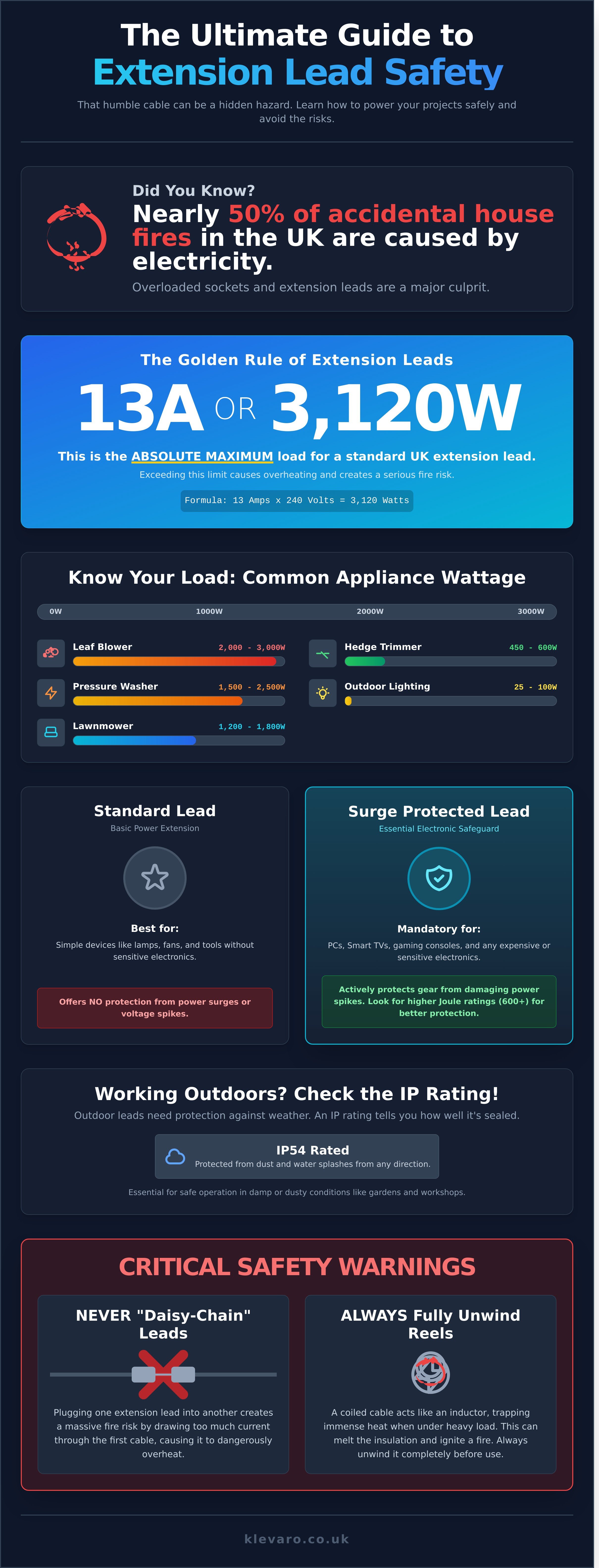
- Always check that the total wattage of your appliances does not exceed your lead's maximum rating, which is typically 13 Amps (3,120 Watts) in the UK.
- Use surge-protected leads for sensitive electronics like PCs, smart TVs, and gaming consoles to shield them from damaging power spikes.
- When working outdoors, choose extension leads with an appropriate IP rating (e.g., IP54) to ensure safe operation in damp or dusty conditions.
- Avoid the dangerous practice of "daisy-chaining"-plugging one extension lead into another-as it creates a serious fire risk from overheating.
Extension leads provide flexible power but must match your device wattage
An extension lead is your go-to solution for powering devices far from a wall socket. However, its convenience comes with a critical safety limit. Most standard UK extension leads are rated for a maximum load of 13 Amps, which translates to approximately 3,120 Watts of power. You must calculate the total wattage of every device you plug in to ensure you don't exceed this rating. Overloading the lead causes the cable to overheat, creating a significant fire risk, especially when used with high-power garden tools or multiple appliances at once. An extension cord is a simple tool, but understanding its limits is essential for safe use.
Think of the 3,120 Watt limit as a strict power budget. Every appliance you connect uses a portion of that budget. A single high-power device like a 3,000W kettle or a pressure washer can use almost the entire capacity on its own, leaving little room for anything else. Always check the wattage on your device's label or manual before plugging it in. This simple check is the most important step in using extension leads safely around your home and garden.
Understanding UK power ratings and fuse limits
Nearly every plug in the UK is fitted with a fuse, most commonly a 13 Amp fuse. This is a safety feature designed to protect the appliance and prevent overheating. The power an extension lead can handle is directly tied to this rating. You can calculate the maximum wattage with a simple formula: Amps x Voltage = Watts. In the UK, with a standard voltage of 240V, the calculation is 13A x 240V = 3,120W. This figure is the absolute maximum your lead can support.
To put this into perspective, here are the typical power demands of common household and garden items:
- Lawnmower: 1,200 - 1,800 Watts
- Hedge Trimmer: 450 - 600 Watts
- Pressure Washer: 1,500 - 2,500 Watts
- Leaf Blower: 2,000 - 3,000 Watts
- Outdoor Lighting (String): 25 - 100 Watts
As you can see, running a pressure washer and a leaf blower from the same lead would instantly overload it, creating a dangerous situation.
The difference between cable length and power drop
While the power rating (13A / 3,120W) remains the same regardless of length, very long cables can cause a slight voltage drop. For most DIY and garden tasks using cables under 20 metres, this drop is negligible. A more pressing safety concern is heat buildup. You must always fully unwind a coiled cable reel before use, even if you only need a few metres of length. A coiled cable traps heat, and when drawing a high current, it can melt the insulation and cause a fire. The shorter the cable, the less excess you have to manage.
Choose your cable length based on your workspace. A 5m lead is perfect for small patios or balconies, while a 10m or 15m lead provides the flexibility needed for most medium-sized gardens. Avoid using a 25m cable for a job that’s only 5m away; it’s safer and easier to use a lead that properly matches the task at hand.
Use surge protected extension leads for sensitive home electronics
Surge protected extension leads are essential for safeguarding sensitive electronics from sudden power spikes. They actively monitor the flow of electricity and divert any excess voltage safely to the ground, protecting devices like PCs, smart TVs, and gaming consoles from permanent damage. A standard extension lead offers no such defence, leaving your expensive equipment completely vulnerable to grid fluctuations or electrical surges from events like nearby lightning strikes.
The level of protection an extension lead offers is measured in Joules. A higher Joule rating indicates a greater capacity to absorb energy spikes before failing. For a basic setup with a lamp and a phone charger, a rating of 200-400 Joules might suffice. For a comprehensive home office or entertainment centre with equipment costing over £1,000, you should look for a rating of 600 Joules or more to ensure robust protection.
Think of it as an insurance policy for your electronics. While a standard lead simply extends the reach of a wall socket, it does nothing to clean or regulate the power. This lack of defence is one of the common safety risks associated with improper cord use. A surge protector acts as a gatekeeper, stopping damaging voltage from ever reaching your gear.
When is surge protection mandatory?
Your home office is the number one candidate for surge protection. The complex microprocessors in computers, monitors, and network-attached storage (NAS) drives are extremely sensitive to "dirty" power, or voltage fluctuations. A single, powerful surge can fry a motherboard instantly, while smaller, frequent spikes can degrade components over time, leading to data corruption and premature hardware failure.
Beyond protecting your hardware, check your home insurance policy. Many UK insurers require that high-value electronics be connected to a surge protector for a claim to be valid. If a power surge destroys your £2,000 gaming PC and it wasn't protected, your claim for damages could be rejected.
Identifying a surge protected lead
The easiest way to spot a surge protected model is to look for an indicator light on the socket housing. This light, usually green or red, confirms that the protective features are active and working correctly. You should also check for "Surge Protected" or "Surge Arrest" printed clearly on the product's body or its packaging.
It's crucial to understand that this protection is finite. The internal components, called Metal Oxide Varistors (MOVs), absorb the excess voltage and degrade slightly with every surge they stop. Eventually, they wear out completely. When the indicator light goes out, the unit will still function as a power strip, but it no longer offers any protection. At that point, it’s time for a replacement. To maintain full protection for your valuable electronics, explore our full range of durable surge protected extension leads to find a reliable replacement.
Outdoor extension leads require specific IP ratings for weather safety
Using electricity in the garden demands specific safety measures that indoor equipment simply can't provide. Outdoor extension leads must have an official Ingress Protection (IP) rating to confirm they can resist dust and water. For temporary garden tasks like mowing the lawn or trimming hedges in damp British weather, a rating of IP54 is the standard minimum you should look for. This ensures the equipment is protected against water splashes from any direction.
Safety is also about visibility. Garden tool cables are almost always bright orange or yellow for a critical reason: so you can easily see them against grass and soil. This simple colour-coding helps prevent you from accidentally tripping over the cable or, even worse, cutting through it with a lawnmower or strimmer. Never be tempted to use a standard white or black indoor lead outdoors; it isn't built for the conditions and poses a serious electrical risk.
Understanding IP ratings for your garden
An IP rating might sound technical, but it’s a straightforward system that tells you exactly how protected your electrical gear is. The rating is made of two numbers. The first digit rates protection against solids like dust and dirt, while the second rates protection against liquids like rain.
- First Digit (Solids): A rating of '5' (as in IP54) means the casing offers good protection against dust, preventing enough from entering to interfere with its operation.
- Second Digit (Liquids): A rating of '4' means it’s protected from water splashes from all directions, making it safe for use during a light shower.
While IP54-rated extension leads are perfect for temporary jobs, permanent outdoor power requires a more robust solution. For year-round power to a shed or garden lights, a professionally installed weatherproof socket box is the safest option. For a complete and reliable setup, you can explore our garden accessories collection for durable outdoor power solutions.
Essential safety features for high-power garden tools
When you're using powerful tools like pressure washers or chainsaws, an IP rating is just the start. Your first line of defence against electric shock is a Residual Current Device (RCD). This life-saving device plugs in between the mains socket and your extension lead. It constantly monitors the electrical current and cuts the power in under 40 milliseconds if it detects a fault, such as you accidentally cutting the cable.
The cable itself also matters. Look for extension leads with heavy-duty rubber sheathing (often designated as H07RN-F). Unlike the standard PVC on indoor leads, rubber is far more durable. It resists oil, chemicals, and the general wear and tear of being dragged across patios and gravel, reducing the risk of splits and cracks.
Proper care extends the life of your equipment and keeps you safe. Always store your outdoor leads in a dry place like a shed or garage, loosely coiled to avoid kinking the wires. Prolonged exposure to direct sunlight can cause the outer casing to become brittle from UV degradation. A quick visual inspection for damage before each use is a simple habit that prevents accidents, and following established extension cord safety guidelines is crucial for protecting your home and family.
Avoid common safety risks like daisy-chaining and overloading
Choosing the right outdoor extension lead is half the battle; using it safely is the other. Two of the most common and dangerous mistakes are "daisy-chaining" and overloading the circuit. These simple errors can lead to overheating, electrical fires, and serious damage to your tools and home. Before you plug anything in, always give your cables a quick inspection for fraying, exposed wires, or burn marks. A damaged cable is an immediate hazard and should never be used.
This principle of proactive safety applies to all household systems. While you can manage many DIY electrical tasks, other areas like plumbing often require professional attention to prevent serious damage from leaks or blockages. For example, a reliable local company like Viktor's Plumbing Services can handle repairs that are best left to the experts.
Getting your setup right from the start prevents these risks. Ensure you have enough sockets for the job by selecting a lead with the correct number of "gangs" (outlets). This simple step eliminates the temptation to create unsafe connections.
The dangers of "daisy-chaining" extension cords
Daisy-chaining is the practice of plugging one extension lead into another to gain extra length or more sockets. While it might seem like a quick fix, it creates a serious fire risk. Each connection point adds electrical resistance, which generates heat. When you chain leads together, this heat can build up to dangerous levels, melting the plastic casing and potentially igniting nearby materials.
Wall sockets in the UK are designed to handle a maximum load of 13 amps (approximately 3,000 watts). By daisy-chaining, you can easily bypass this built-in safety limit, drawing a huge amount of current through that single socket. The 13A fuse in the first plug is only rated to protect the first lead. It cannot detect an overload happening in a second or third lead down the chain, leaving your entire setup dangerously unprotected.
For your safety, always follow this simple rule: one extension lead per wall socket. No exceptions.
Signs your extension lead is overloaded
Even a single, high-quality lead can become a hazard if you ask it to do too much work. Overloading happens when you plug in appliances that together draw more power than the lead is designed for. Your senses are often the first line of defence in spotting a dangerously overloaded circuit.
Be alert for these clear warning signs:
- A strange smell: A distinct "fishy" or acrid plastic smell near the plug or sockets is a major red flag that components are overheating.
- Hot to the touch: The plug, cable, or socket area should never feel noticeably warm or hot. Heat is a direct sign of overloading and excessive resistance.
- Flickering power: If lights flicker or connected tools seem to lose power intermittently, the circuit is likely struggling to cope with the demand.
- Visible damage: Look for any scorch marks, discolouration, or melting around the socket outlets.
Some household and garden appliances are incredibly power-hungry and should never share an extension lead with other high-wattage items. Plugging just two of the following into a standard 13A lead can easily exceed its maximum load:
- Portable Heaters (2,000-3,000W)
- Kettles (up to 3,000W)
- Tumble Dryers (2,000-3,000W)
- Pressure Washers (1,800-2,500W)
- Lawnmowers (up to 1,800W)
Planning ahead is the key to electrical safety. Instead of risking a dangerous setup, explore our range of durable, multi-gang extension leads to find the perfect, safe fit for your project.
Find the perfect extension lead for your DIY and garden projects at Klevaro
Now that you know exactly what to look for in an outdoor extension lead, it’s time to find the perfect one for your next project. At Klevaro, we stock a comprehensive range of durable, reliable leads designed to handle the demands of any workshop, garden, or home improvement task. You can match your new power tools with the right heavy-duty cable reels and get everything delivered quickly. Our fast UK delivery ensures your project stays on schedule, so you're never left waiting for essential gear.
We understand that calculating power loads can be tricky. That’s why our friendly, UK-based customer support team is always ready to help you work out your power needs. Just give us a call, and we'll make sure you choose an extension lead that's both safe and perfectly suited to your tools. Your project's success is our priority, and it all starts with safe, reliable power.
Heavy-duty leads for the workshop
Your workshop is a demanding environment, and a standard indoor extension cable just won't cut it. When you're running high-draw tools and equipment like a 2kW mitre saw, a bench grinder, or a powerful wet-and-dry vacuum, you need a power source that can keep up. Our heavy-duty extension leads are built for exactly this purpose, featuring thicker cabling and robust construction to deliver consistent power without overheating.
Safety is paramount in any DIY space. That’s why many of our workshop-ready cable reels feature impact-resistant socket housings. These tough casings protect the sockets from accidental drops, knocks, and the general wear and tear of a busy workspace, preventing damage that could lead to electrical faults. For trusted performance, we stock reliable brands like Rolson, known for creating tough, dependable power solutions that let you fix, build, and create with complete confidence.
Complete your home setup with Klevaro
Getting your power sorted is the first step. Once you have a reliable flow of electricity, you can build out your entire toolkit. To go with your new power setup, you can explore our range of hand and general tools, from precision screwdriver sets to durable socket wrenches. We believe in being a one-stop shop for everything you need to transform your home and garden.
Every product we sell, from a simple hand trowel to a complex power tool, comes with the Klevaro "Quality Guaranteed" promise. This isn't just a slogan; it's our commitment to providing you with gear that is durable, effective, and ready for the job. It means you can invest in your tools knowing they are built to last, project after project. Stop searching and start building. Get everything you need from a single, trusted UK store.
Ready to power up your potential? Shop our full range of extension leads and power accessories today and get the reliable energy you need to bring your vision to life.
Power Your Projects with Confidence
You're now equipped with the knowledge to choose the right power solution safely and effectively. The key is matching the lead's wattage to your device's needs and protecting sensitive electronics with surge protection. For garden tasks, always check for a suitable IP rating to ensure total weather safety.
Getting power where you need it shouldn't be a challenge. Whether you're tackling a big DIY job, setting up your home office, or tidying the garden, the right extension leads make all the difference in getting the job done right.
Ready to bring your next project to life? Shop our reliable range of extension leads and DIY tools and get everything you need with confidence. As a Trusted UK Store, we offer Fast UK Delivery and Easy Returns on all our electrical accessories, so you can get powered up and start creating.
Frequently Asked Questions
Can I plug a heater into an extension lead?
No, you should avoid plugging high-power appliances like electric heaters into an extension lead. Heaters can draw up to 3,000 watts, which can easily overload a standard 13-amp lead and create a serious fire hazard. It's always safest to plug items with high-power consumption directly into a mains wall socket.
What does "surge protected" actually mean?
Surge protection defends your sensitive electronics from sudden voltage spikes in the power supply. These spikes, often caused by lightning or grid issues, can permanently damage devices like TVs and computers. A surge-protected lead detects this excess voltage and safely diverts it away, acting as a crucial safety net for your valuable gear.
Is it safe to leave an extension lead plugged in all the time?
Yes, it's generally safe to leave an extension lead plugged in, provided it is in good condition and not overloaded. For safety and energy efficiency, it's good practice to switch it off at the wall when the connected appliances aren't in use. Always ensure the cable is not a trip hazard or covered by rugs, which can cause it to overheat.
How do I know if I have overloaded my extension lead?
The most obvious signs of an overload are the plug feeling hot to the touch, a faint smell of burning plastic, or fuses repeatedly blowing. To prevent this, check the total wattage of all appliances you're plugging in. A standard UK 13-amp extension lead can handle a maximum of 3,120 watts, so be sure your total doesn't exceed this limit.
What is the difference between a cable reel and a standard extension lead?
The main differences are length and storage. A cable reel holds a much longer cable, often 25 metres or more, and winds it neatly for easy storage, making it ideal for large gardens or workshops. Standard extension leads are shorter and best for powering items closer to a socket. Crucially, you must always fully unwind a cable reel before use with powerful tools to prevent overheating.
Can I use an indoor extension lead in a garage or shed?
It’s not recommended to use an indoor extension lead in a garage, shed, or any outdoor building. These areas can be damp or dusty, and indoor leads lack the required IP (Ingress Protection) rating to safely protect against moisture and particle entry. Always choose a lead specifically rated for outdoor use to ensure safety and durability.
How long do extension leads typically last before they need replacing?
An extension lead doesn't have a strict expiry date; its lifespan depends entirely on usage and care. A high-quality, well-looked-after lead can last for many years. You should regularly inspect it for damage like frayed wires, cracked casings, or loose pins. If you spot any signs of wear and tear, you must replace it immediately for your safety.
Leave a comment