


Corded vs Cordless Drill for DIY: Which Power Tool Should You Choose in 2026?
The most expensive cordless model on the shelf might actually be the wrong choice for your specific home renovation. For 85% of UK homeowners, an 18V cordless brushless drill is the superior choice because it offers the best balance of portability and power for modern DIY. However, a corded 750W hammer drill remains the better option for heavy-duty masonry work where you need consistent torque without the £100 price tag of high-capacity batteries. Choosing between a corded vs cordless drill for diy comes down to whether you prefer the freedom of a battery or the reliability of a mains plug.
It is common to feel torn between the convenience of going wireless and the fear of a battery dying mid-project. You need a tool that handles everything from flat-pack furniture to solid brick walls without causing a trip hazard in your workspace. This guide provides the definitive answer to the corded versus cordless debate so you can select the perfect drill for your home projects with total confidence.
We will explore the latest 2026 tool specifications, compare running costs, and help you find a reliable partner for your next creative build.
Key Takeaways
- Understand the essential differences in the corded vs cordless drill for diy debate to select the most effective tool for your specific home projects.
- Learn why an 18V cordless combi drill is often the most versatile and practical investment for a standard UK household toolkit.
- Discover the specific scenarios where a corded drill’s unlimited run-time and high torque are necessary for heavy-duty masonry work.
- Identify how your workspace layout and DIY frequency should influence your choice between battery portability and mains-powered reliability.
- Gain expert tips on maintaining your power tools to ensure they remain durable and ready for any future home transformation.
Cordless drills offer the best balance of mobility and power for most UK DIY projects.
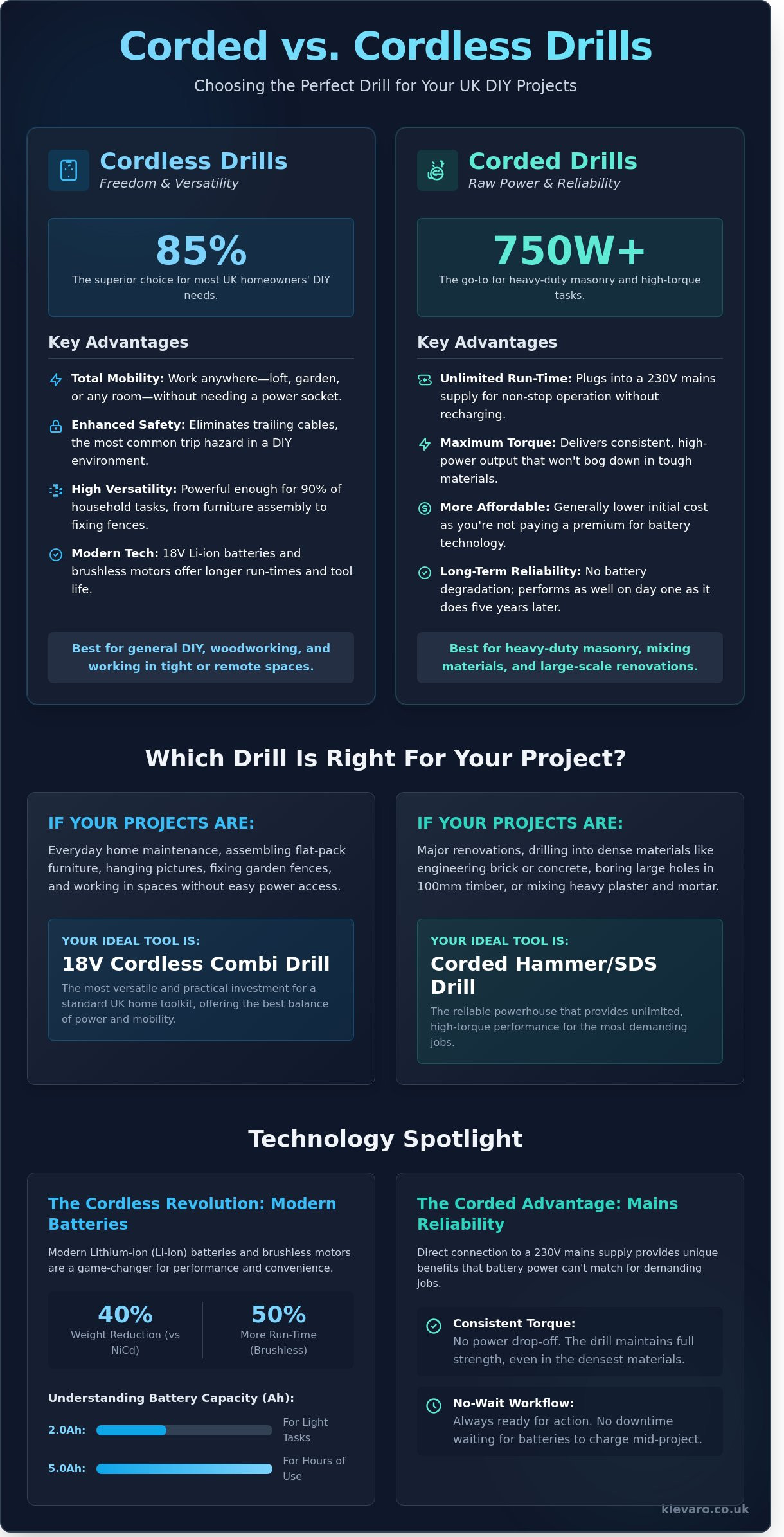
Cordless drills are the superior choice for the vast majority of UK homeowners because they provide enough power for 90% of household tasks without the restriction of a power cord. These battery-operated tools allow you to work in any room, garden shed, or loft without searching for a mains socket. Modern 18V Lithium-ion batteries deliver consistent torque, which means the tool maintains full power until the battery is empty. When deciding between a corded vs cordless drill for diy, the cordless model is more versatile for assembling furniture, hanging pictures, and fixing fences. Removing trailing cables also eliminates the most common trip hazard in a DIY environment, making your workspace much safer.
The evolution of cordless battery technology
Older cordless tools used Nickel-Cadmium (NiCd) batteries, which were heavy and suffered from memory effect where they lost capacity if not fully discharged. Modern Lithium-ion (Li-ion) technology has changed this by offering a 40% weight reduction and holding a charge for months while sitting in a drawer. The history of drills shows a constant move toward efficiency, and the latest brushless motors are the peak of this trend. These motors reduce friction, providing up to 50% more run-time per charge and extending the overall life of the tool. When browsing for your next project, look at the Amp-hour (Ah) rating. A 2.0Ah battery is perfect for light tasks, while a 5.0Ah battery allows for hours of continuous drilling.
Why mobility is the primary advantage for homeowners
Working in tight spaces like lofts or under stairs is much easier without an extension lead tangling around your feet. Cordless tools allow for natural movement at awkward angles, which is essential when you're balancing on a ladder to fix a curtain rail. Many modern models feature lightweight designs, often weighing under 1.5kg, to reduce arm fatigue during long sessions. You can explore our range of tools and equipment to find ergonomic options that make home improvement feel less like a chore. Quick-change chucks and built-in LED lights further improve the experience, allowing you to swap bits in seconds and see clearly in dark corners. This flexibility makes the corded vs cordless drill for diy debate an easy win for cordless models in the average home.
Corded drills provide unlimited run-time and higher torque for heavy-duty masonry work.
Corded drills are the superior option for demanding DIY projects that require constant, high-torque output over long periods. They plug directly into a 230V mains supply, ensuring the motor receives an uninterrupted flow of energy without the power drop-off common in battery tools. These machines are generally more affordable than cordless alternatives because you aren't paying a premium for complex battery technology. A corded drill is a reliable investment that avoids the frustration of battery degradation, meaning it performs just as well after five years in the shed as it did on day one. When weighing up a corded vs cordless drill for DIY, choose the corded model for tasks like mixing heavy plaster or boring large holes into solid concrete.
When raw power becomes a necessity
Specific tasks like drilling into engineering brick or 100mm timber beams demand the sustained muscle only a mains-powered motor provides. Corded drills are the preferred choice for SDS (Self-Directing System) masonry work because they can maintain high impact rates without overheating. You benefit from a "no-wait" workflow; the tool is ready for action as soon as it's plugged in. This makes them perfect for weekend warriors who want to get straight to work without hunting for a charger. If you're planning a major renovation, you can find essential project gear in our collection to help you get the job done right.
- Consistent Torque: Mains power ensures the drill doesn't bog down when hitting tough knots in wood or dense stone.
- Sustained Use: Ideal for mixing buckets of mortar or plaster where the motor must run continuously for several minutes.
- Longevity: Without a battery to fail, these tools often last decades with basic carbon brush maintenance.
The drawbacks of being tethered to the wall
The main trade-off for this power is the physical cable. You're limited by the length of the lead, which usually necessitates a heavy-duty extension cable for outdoor or high-reach tasks. Trailing wires are a genuine safety risk, particularly when you're balancing on a ladder or moving between rooms. It's easy to accidentally trip or even snag the wire on a workpiece, which can lead to accidents in a busy workspace.
Additionally, many high-power corded models lack the refined speed control found in cordless drivers. This makes them a bit "all or nothing," which isn't ideal for delicate tasks like assembling kitchen cabinets or driving small screws. Understanding the cordless vs corded drills debate involves balancing this raw strength against the freedom of movement you might need for lighter jobs. For a versatile corded vs cordless drill for DIY setup, many homeowners keep a corded drill for the heavy stuff and a smaller cordless driver for everything else.
The choice between corded and cordless depends on your specific project type and workspace layout.
The best choice for corded vs cordless drill for diy depends on your workspace layout and the density of the materials you use. Cordless drills are the ideal option for 85% of UK DIYers because they offer portability in small flats and ease of use for quick repairs. Corded drills are better for heavy-duty renovations where you need constant power to drill through solid stone or brick. A cordless drill provides versatility for tasks like assembling furniture, while a corded drill offers more power-per-pound for intensive construction. Most homeowners find that a high-quality 18V cordless drill handles almost every household task efficiently.
Your DIY frequency dictates your investment. Occasional users often find that cordless batteries lose charge if left in a drawer for six months, though modern Lithium-Ion tech has improved this. For intensive projects, having a corded backup ensures you never stop working to wait for a charger. This prevents the frustration of a flat battery halfway through a job.
Workspace layout is a deciding factor. Dragging an extension lead through a narrow hallway or up a ladder is a safety hazard and a nuisance. According to Pro Tool Reviews on corded vs. cordless drills, the convenience of a battery-powered tool often outweighs the raw power of a corded one for general home maintenance. If your home has few sockets, cordless tools are a practical necessity.
Material choice also matters. Drilling into soft timber or plasterboard is easy for any 18V cordless driver. If you're mounting a TV onto a solid brick chimney breast, the consistent power of a corded hammer drill prevents the motor from overheating during the struggle. Corded tools offer more "grunt" for these demanding surfaces.
Matching the tool to the task
Different projects require different mechanics. Building a garden deck involves driving hundreds of screws, making a lightweight cordless impact driver your best friend. Hanging a mirror simply requires a few precise holes, where a standard drill/driver excels. If you're working with masonry, you'll need a hammer drill function to pulse the bit through the stone. You can explore our range of tools and equipment to find the exact specifications for your next project.
Ergonomics and physical comfort
Weight distribution changes how a tool feels in your hand. Corded drills are often top-heavy because the motor sits directly above the grip. Cordless drills balance this weight with a heavy battery at the base, which can reduce wrist strain during long sessions. This balance makes them feel more stable when you're working at awkward angles.
Look for over-moulded rubber grips that absorb vibration and provide a secure hold. If you have smaller hands, a compact 12V cordless drill offers better control than a bulky 18V model. Choose a tool size that matches your hand size and strength to ensure you can work safely. A tool that feels balanced helps you fix, build, and create with total confidence.
An 18V cordless combi drill is the most versatile investment for a standard UK home toolkit.
An 18V cordless combi drill is the definitive choice for most homeowners weighing up a corded vs cordless drill for diy. This specific voltage provides the torque necessary to drive 100mm screws into timber and the impact power to drill 10mm holes into masonry walls. Modern brushless motors allow these cordless units to match the 500W to 700W performance of entry-level corded drills. By choosing a combi model, you get a hammer function, a standard drill, and a clutch-controlled screwdriver in one compact body. It's the only power tool many households will ever truly need.
The 18V system has become the industry standard for a reason. It balances weight and power perfectly for overhead tasks or tight spaces under the sink. You won't find yourself tethered to a wall socket or hunting for an extension lead when working in the garden or attic. These drills handle everything from hanging a heavy mirror on a brick wall to assembling flat-pack furniture with precision.
One battery platform powers your entire home and garden
Sticking to a single brand allows you to build a comprehensive toolkit without paying for a new battery every time. You can save up to 45% on future purchases by buying "body only" tools once you own a charger and two batteries. This ecosystem often extends beyond the workshop. The same 18V battery that powers your drill can usually run your hedge trimmer, leaf blower, or even a handheld vacuum. Keeping two batteries is the most efficient setup; one stays in the tool while the other remains on the charger to prevent any project downtime.
Essential accessories for your new drill
Your drill is only as effective as the bits you put in it. You should invest in a high-quality set of high-speed steel (HSS) bits for metal, brad-point bits for clean wood holes, and tungsten carbide-tipped bits for brickwork. Using low-grade screwdriver bits often leads to stripped screw heads and damaged fixings. It's also wise to pair your power tools with reliable hand and general tools like a 5-metre tape measure and a torpedo spirit level. These basics ensure your DIY projects are straight, level, and built to last.
Quality power tools and reliable equipment are the foundation of any successful home transformation.
Choosing the right drill builds the confidence needed to tackle more ambitious home improvement projects. When you settle the corded vs cordless drill for diy debate for your own workshop, you're investing in the quality of your future results. Reliable equipment allows you to achieve professional standards without the high cost of hiring contractors, who often charge between £20 and £40 per hour for basic tasks.
Proper maintenance ensures your tools remain dependable for years of service. Keep your drill bits sharp and your batteries charged to avoid stalling mid-project. A well-organised toolkit makes every job faster, safer, and more enjoyable for the hobbyist. It transforms a daunting task into a manageable process where every component is exactly where it should be.
- Sharpen bits regularly: Dull bits put unnecessary strain on your drill motor and produce messy holes.
- Battery health: Charge Lithium-ion batteries before they hit 0% to extend their overall lifespan.
- Professional results: The right torque settings prevent stripped screws and damaged work surfaces.
- Cost efficiency: Investing in one high-quality tool saves money on replacements and professional call-out fees.
Organising your DIY workspace
Store your power tools in a dry, temperate environment to protect sensitive electronics and battery cells. Extreme cold can reduce a battery's capacity by up to 30%, while damp conditions lead to internal corrosion. Using a dedicated storage chest or wall rack keeps your corded vs cordless drill for diy projects accessible and protected from dust.
Safety gear is just as essential as the drill itself. Always use impact-resistant eye protection and fitted gloves to prevent injuries from flying debris or slipping bits. You can browse our home and garden collection for project inspiration and the essentials you need to keep your workspace tidy and efficient.
Taking the next step in your DIY journey
Start with a small project like building a wooden planter or installing shelving to get a feel for your tool’s torque and speed settings. Understanding how your drill handles different materials gives you the technical skills required for larger renovations. Most modern drills offer variable speeds; lower speeds are perfect for driving screws, while higher speeds are designed for drilling into masonry.
We invite you to join a growing community of makers who fix, build, and create with confidence every day. Sharing your progress and learning from others turns home maintenance into a rewarding social experience. Having the right tool turns a weekend chore into a creative hobby that adds genuine value to your home.
Equip Your Workshop for Successful Home Transformations
Deciding on a corded vs cordless drill for diy involves matching the power tool to your specific task requirements. An 18V cordless combi drill remains the most versatile choice for 90% of standard UK home maintenance jobs. These tools provide the freedom to move between rooms without hunting for a spare socket. For those tackling heavy-duty masonry or structural renovations in 2026, a corded drill delivers the 240V consistent torque needed for the toughest bricks. Reliable equipment is the essential foundation for any project. It ensures your hard work leads to a durable and stylish finish.
You can find everything you need to fix, build, and create at Klevaro. We're a Trusted UK Store committed to helping you transform your living space with ease. Every purchase includes Quality Guaranteed on all DIY Essentials and Fast UK Delivery to get your gear to your door. It's time to stop dreaming about your home improvements and start making them happen with tools you can depend on.
Upgrade your toolkit with our range of high-quality power tools
Your next home project is just one tool away from being a masterpiece. We're here to support your creative journey every step of the way.
Frequently Asked Questions
Is a corded drill more powerful than a cordless one?
Yes, corded drills generally provide higher sustained torque and better performance for heavy-duty masonry tasks. While high-end 18V cordless models offer comparable power for 95% of standard DIY jobs, corded versions excel during long periods of drilling into tough materials. You get unlimited run-time without worrying about battery fade. It's a dependable choice for those big renovation projects where you've got easy access to a power outlet.
Can I use a cordless drill to drill into brick?
You can drill into brick with a cordless drill if you use a "combi" or "hammer" model paired with a masonry bit. Standard drill drivers lack the internal hammering mechanism needed to crack through hard masonry or concrete. An 18V cordless combi drill is a highly effective tool for most UK homeowners hanging mirrors or shelving on external walls. This versatility makes it a fantastic pick when deciding on a corded vs cordless drill for diy projects.
How long do cordless drill batteries actually last?
A 2.0Ah battery typically lasts for 2 to 3 hours of intermittent DIY work like furniture assembly or hanging pictures. If you're performing continuous, high-torque tasks like building a garden deck, expect the battery to deplete within 30 to 60 minutes. Keeping a second battery on charge ensures your project stays on track without frustrating pauses. Most modern lithium-ion batteries reach a full charge in under 60 minutes to keep you working.
Are corded drills becoming obsolete for home DIY?
Corded drills aren't obsolete and remain a smart choice for users on a budget who need maximum power for occasional heavy tasks. They're perfect for dedicated workshops where you'll always work near a socket. You don't have to worry about battery health or replacement costs over time. A corded model often costs 40% less than a cordless equivalent with the same torque rating, making them great value for money.
What voltage is best for a DIY cordless drill?
An 18V cordless drill is the best all-rounder for the vast majority of UK home DIY tasks. While 12V models are lighter and great for flat-pack furniture, they often struggle with masonry or large hole saws. Choosing an 18V system gives you the power to handle everything from hanging pictures to building garden structures. It's the perfect voltage for anyone starting their tool collection and wanting to tackle projects with confidence.
Should I buy a brushless motor drill for DIY use?
Buy a brushless motor drill if your budget allows because it's more efficient and offers a longer lifespan. These motors adjust power delivery based on resistance, which can extend your battery run-time by up to 50% per charge. For occasional light tasks, a standard brushed motor is still a reliable and cheaper alternative. Investing in brushless technology pays off if you plan on frequent home improvements and want to get the best performance from your gear.
Leave a comment