


Best Cordless Drill for Brickwork 2026: Top Picks & Buying Guide
That smoking drill and blunt bit aren't your fault; they are signs you're using the wrong tool. For frequent masonry work, the best cordless drill for brickwork 2026 is an SDS Plus drill, which uses a powerful pneumatic hammer action. For occasional, lighter jobs, a high-torque combi drill with a robust hammer function is the essential choice.
We know the frustration of a battery dying mid-hole or a drill bit that refuses to budge. It’s a common problem when a standard drill meets a stubborn brick wall, turning a simple task into a major headache and damaging your gear.
This guide cuts through the confusion. We'll show you exactly which features are required to penetrate brickwork effectively and safely. You’ll learn the key differences between Combi and SDS models and find a reliable tool that drills clean holes every time, giving you the confidence to tackle any project.
Key Takeaways
- For effective brickwork drilling, your cordless drill must have a "hammer action" setting to chip away at hard masonry without damaging the tool.
- Prioritise a powerful 18V brushless combi drill with a minimum of 60Nm of torque to ensure you have enough force for tough materials.
- The best cordless drill for brickwork 2026 is only effective with the right technique; learn how to start holes safely to prevent bit "wandering" and wall damage.
- Understand when to choose a versatile combi drill for all-round home DIY versus a specialist SDS drill required for heavy-duty concrete jobs.
The Best Cordless Drill for Brickwork in 2026 is a High-Torque Brushless Combi Drill
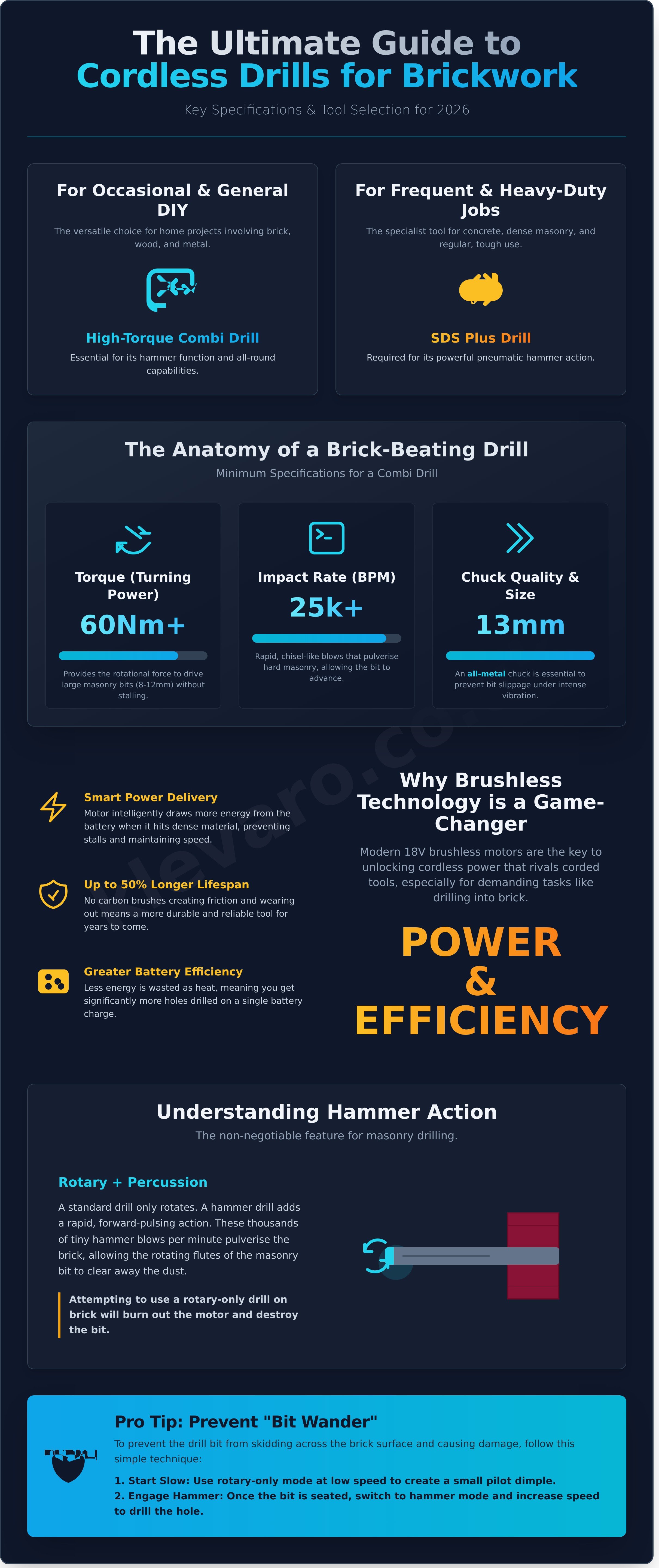
Let's get straight to it. The best cordless drill for brickwork is an 18V brushless combi drill with a minimum of 60 Newton-metres (Nm) of torque. To effectively drill into masonry, your tool must have a "hammer action" or "percussion" setting. This feature is non-negotiable for breaking through tough materials like UK house bricks. A minimum battery capacity of 2.0 Amp-hours (Ah) ensures you have consistent power to finish the job without the drill bogging down halfway through a hole. Anything less simply won't have the power and stamina for the task.
This specific combination of voltage, motor technology, and torque represents the current sweet spot for DIYers and trade professionals. It delivers reliable power for common tasks like installing security lights, hanging heavy shelves, or fitting outdoor taps. Choosing the best cordless drill for brickwork 2026 means investing in these core specifications to guarantee your projects are completed efficiently and safely.
Why 18V Brushless Technology Dominates Masonry Tasks
Modern brushless motors are a game-changer for power tools, especially when working with resistant materials like brick. Unlike older brushed motors, a brushless motor uses an onboard computer to adjust its power draw in real-time. When the drill bit hits a dense section of brick, the motor intelligently pulls more energy from the battery to maintain speed and torque, preventing it from stalling.
This efficiency brings two major benefits. First, with no carbon brushes to create friction and wear out, the motor's lifespan is extended by up to 50%, giving you a more durable and reliable tool. Second, less energy is wasted as heat, meaning you can get significantly more holes drilled on a single battery charge. It's the key technology that allows cordless drills to truly compete with their corded counterparts on tough jobs.
Minimum Specifications for Effective Brick Drilling
When you're comparing drills, the technical details matter. Understanding a few key numbers will help you cut through the marketing jargon and find a tool that's genuinely up to the job. For brickwork, focus on torque, impact rate, and the quality of the chuck. These three features work together to deliver the performance you need.
Here’s what to look for:
- Torque (Turning Force): Measured in Newton-metres (Nm), torque is the rotational power of the drill. For brickwork, 60Nm is the ideal minimum. This provides enough force to drive larger masonry bits (8mm to 12mm) through standard house brick without struggling. Drills with less than 50Nm may fail on denser materials.
- Impact Rate (BPM): The hammer action is measured in Blows Per Minute (BPM). This feature is the core of what makes a hammer drill effective. Look for a drill with an impact rate of at least 25,000 BPM. These rapid, chisel-like impacts pulverise the brick directly in front of the bit, allowing it to advance smoothly.
- Chuck Quality and Size: The chuck holds the drill bit. A 13mm all-metal chuck is essential. Plastic or part-plastic chucks can deform or lose their grip under the intense vibration of hammer drilling, leading to bit slippage and poor performance. The 13mm size is the UK standard, ensuring compatibility with all common masonry bits.
Understanding Hammer Action: How Your Drill Penetrates Hard Masonry
To drill into brick, your tool needs more than just rotational force. A hammer drill adds a rapid, high-frequency pulsing movement that strikes forward as the drill bit spins. This percussive action acts like thousands of tiny hammer blows every minute, pulverising the hard masonry and allowing the flutes of the drill bit to clear away the dust. It's this combination of hammering and rotating that allows you to penetrate tough materials efficiently.
Attempting to use a standard rotary-only drill on brickwork is a recipe for failure. The drill bit will spin uselessly, generating immense friction and heat. This will quickly burn out the motor, ruin the battery, and blunt your drill bit beyond repair. You simply won't make progress. The key is using the right tool for the job.
The synergy between the hammer mechanism and a quality masonry drill bit is what determines your drilling speed and precision. The hardened tungsten carbide tip of the bit withstands the impacts while the hammer action does the hard work of chipping the brick away. Looking ahead, the best cordless drill for brickwork 2026 models feature advanced electronic pulse management. This technology refines the hammer action, delivering smoother and more consistent impacts for greater control and less vibration, without sacrificing power.
Rotary vs Hammer Modes Explained
Knowing when to switch modes is fundamental to DIY success. Use the standard rotary mode for drilling into wood, metal, or plastics. Engage the hammer mode exclusively for hard materials like brick, concrete block, stone, and light concrete. You can easily identify the hammer setting by looking for the small hammer icon on your drill's mode selection collar. A simple twist is all it takes to engage the mechanism and prepare for masonry work.
The mechanical difference is significant. Most combi drills use a 'cam-action' system, where two ribbed discs click past each other to create the blows. This is perfect for most UK brickwork. For heavy-duty concrete work, more powerful SDS drills use a pneumatic piston system for a much harder, more direct strike.
BPM and Torque: The Numbers That Actually Matter
When you're tackling dense UK engineering bricks, the impact rate is crucial. This is measured in Blows Per Minute (BPM). A higher BPM means the drill is chipping away at the material more frequently, resulting in faster drilling. For serious masonry work, look for a drill that delivers a minimum of 25,000 BPM; the top-tier models in 2026 will easily exceed 30,000 BPM.
Torque, measured in Newton-metres (Nm), is the drill's rotational power. While BPM shatters the brick, torque is what keeps the drill bit turning, especially when it gets hot or hits a dense patch. A drill with low torque will stall and jam, which can be frustrating and even dangerous. High torque (50 Nm or more) gives the tool the muscle to power through resistance, protecting the motor and ensuring a clean hole.
Drill speed (RPM) and impact rate (BPM) are directly linked. As you squeeze the variable speed trigger to increase the RPM, the BPM increases proportionally. This gives you excellent control, allowing you to start a hole slowly and accurately before ramping up to full power. Getting the balance right between these specs is essential, which is why our curated range of high-performance cordless drills is selected for proven results on UK building materials.
Combi Drills vs SDS Drills: Which is Better for Your Home Projects?
For over 90% of home DIY projects, a quality combi drill is the best and most versatile tool for the job. It's the perfect all-rounder for drilling into wood, metal, and standard masonry like household bricks. An SDS (Slotted Drive System) drill is a specialist powerhouse designed for heavy-duty tasks, such as breaking through concrete or drilling large-diameter holes in dense stone. For the average UK homeowner, a combi drill is lighter, more affordable, and uses standard drill bits, making it the practical choice.
The core difference lies in the hammer mechanism. A combi drill uses a mechanical system where two ribbed discs click past each other to create a hammering action. It’s effective but relies on user pressure. An SDS drill uses an electro-pneumatic piston mechanism, which creates a much more powerful, air-cushioned hammer blow. This means the tool does the hard work for you with minimal pressure required.
When a Standard Combi Drill is Sufficient
A combi drill is your trusted partner for most tasks around the house. It excels when drilling into softer, common UK materials like red fletton bricks, breeze blocks, or directly into mortar joints. These materials make up the majority of interior and exterior walls in UK homes built since the 1930s. Fix, build, and create with confidence using the right tool.
It's the ideal choice for jobs like hanging pictures, putting up curtain poles, fixing mirrors to a wall, or installing light shelving units. For drilling holes up to 10mm in diameter for these common tasks, a combi drill provides all the power you need without being overkill. For most people seeking the best cordless drill for brickwork 2026, a reliable combi offers the perfect blend of power and everyday usability.
From a cost perspective, a high-quality combi drill kit is a fantastic investment, often available for under £150. They are also significantly lighter than their SDS counterparts, reducing fatigue when working overhead or for extended periods. Plus, their standard chuck accepts all your existing round-shank drill bits, adding to their convenience.
The Case for SDS Plus in Heavy Brick and Stone
You'll know it's time to switch to an SDS drill when your projects get serious. The general rule is to upgrade if you need to drill holes larger than 12mm in diameter into masonry or if you're drilling lots of holes consecutively. An SDS drill will power through these tasks in a fraction of the time and with far less effort.
This specialist tool becomes essential when you encounter tougher materials that can stop a combi drill in its tracks. Think of the dense, dark blue engineering bricks found in foundations and retaining walls, or reinforced concrete lintels above windows and doors. An SDS drill is specifically designed to conquer these demanding surfaces with ease.
The piston-driven hammer action is the SDS drill's superpower. It generates immense impact energy (measured in Joules) that pulverises hard material, allowing the drill bit to fly through. This means you just guide the drill, you don't have to force it. The unique SDS chuck also locks the special fluted bits in place, preventing any slipping under extreme force and ensuring all the tool's power is transferred directly to the job.
How to Drill Into Brick Safely and Effectively
Having a powerful tool is only half the job. To get clean, accurate holes in brickwork without causing damage, you need the right technique. The correct approach ensures your safety, protects your drill and bits, and gives you a professional finish every time. Even the best cordless drill for brickwork 2026 requires a skilled operator to perform at its peak.
Follow these four essential steps for perfect results:
- Scan the Area: Before you even mark your hole, always use a multi-detector tool to check for hidden pipes, electrical cables, and metal studs behind the wall. Hitting a live wire or water pipe can be dangerous and lead to costly repairs.
- Mark and Punch: Clearly mark your drilling spot with a pencil. Use a center punch and a hammer to create a small indentation. This crucial step prevents the drill bit from "wandering" across the uneven brick surface as you start.
- Start Slow: Begin drilling at a low speed without the hammer function engaged. This allows the bit to create a secure starting point. Once the hole is about 5-10mm deep, you can increase the speed and switch on the hammer action for more power.
- Clear Debris: As you drill, periodically pull the bit back out of the hole while it's still spinning. This action, known as pecking, clears out dust and debris, reducing friction and heat. It helps the bit cut more efficiently and prevents it from getting stuck or overheating.
Choosing the Correct Masonry Drill Bits
Your drill is only as good as the bit you put in it. For brick, the industry standard is a Tungsten Carbide Tipped (TCT) masonry bit. These are specifically designed with a hard, arrow-shaped tip to pulverise brittle materials. While multi-material bits offer versatility for drilling through wood, metal, and masonry, a dedicated TCT bit will almost always provide a faster, cleaner cut in solid brick.
You'll know your bit is blunt and needs replacing when you see these signs. The drill will make a high-pitched noise without making progress, you might see smoke coming from the hole, or the tip of the bit itself will become discoloured (often blue or black) from extreme heat. Pushing harder with a blunt bit will only burn out your drill's motor.
Safety Gear and Dust Management for Indoor Brickwork
Safety should always be your top priority. Brick is a brittle material that can splinter, sending sharp fragments flying at high speed. Because of this, wearing a pair of EN166-rated safety glasses is completely non-negotiable. Don't risk your eyesight for a five-minute job.
When you're drilling indoors, brick dust can quickly cover everything in the room. This fine silica dust is also a health hazard if inhaled. To manage it effectively, use a drill dust collector. These simple attachments use your vacuum's suction to capture dust directly at the source, keeping your air and your home clean.
Getting the right gear is essential for working with confidence. To get properly kitted out for any project, explore our full range of tools and equipment for all your safety essentials.
Finding Reliable Masonry Tools and Accessories at Klevaro
You’ve done the research and identified the perfect drill for your brickwork projects. But the tool itself is only part of the equation. Partnering it with high-quality accessories and sourcing it from a trusted UK supplier is what truly guarantees a successful, damage-free result. Using the right masonry bit prevents spalling and cracks in your brickwork, while a reliable drill ensures the motor won’t burn out mid-job. It’s the difference between a professional finish and a costly repair.
At Klevaro, we understand that your time and your home are valuable. That's why we've curated a collection of DIY essentials from brands you can depend on. Choosing a drill from a trusted ecosystem like DeWalt or Makita means your 18V batteries will be compatible across a whole range of future tools, from jigsaws to sanders. This saves you money and clutter in the long run. And with our fast UK delivery options, you can order what you need on a Thursday and have it ready for that weekend project, keeping your home improvement plans right on schedule.
Stocking Your Workshop for Success
A powerful cordless drill is the foundation of any home toolkit, but it works best as part of a team. To tackle brickwork with precision, you’ll need a few essential add-ons. High-quality masonry drill bits are non-negotiable for clean holes, while a set of sturdy wall plugs ensures your fixtures will hold securely for years. Don't forget a spirit level to guarantee every shelf and frame is perfectly straight. You can browse our hand and general tools to find everything you need to complete your set.
Why Quality Matters for DIY Longevity
It can be tempting to choose the cheapest option, but quality tools pay for themselves over time. Consider the cost-per-use of an 18V brushless system. A £150 drill that you use for the next decade offers far better value than a £50 model that fails after just a few tough jobs. Investing in the best cordless drill for brickwork 2026 isn't just about buying a tool; it's an investment in your home and your ability to get jobs done right the first time. It allows you to fix, build, and create with confidence.
Ready to power up your projects? Shop the latest cordless drills at Klevaro and get the right gear delivered directly to your door.
Conquer Your Next Masonry Project with Confidence
You're now equipped with everything you need to know about drilling into brick. Remember, a high-torque brushless combi drill with a powerful hammer action is your most reliable partner for tackling tough masonry. It offers the perfect blend of power and versatility for almost any home DIY task, from hanging shelves to mounting a garden hose reel.
Finding the best cordless drill for brickwork 2026 is about matching the right features to your project's demands. With the insights from our guide, you can confidently choose a tool that won't let you down. The only thing left to do is get the right gear in your hands and bring your project to life.
Ready to make it happen? Upgrade your DIY kit with our premium cordless drills. As a Trusted UK Store, we provide Fast UK Delivery and ensure every tool has our Quality Guaranteed promise. Find the perfect drill today and start building with confidence.
Frequently Asked Questions
Can I use a regular cordless drill for brickwork?
No, a regular cordless drill driver isn't suitable for brickwork. Standard drills only use a rotational action, which is ineffective against hard materials like brick. You need a drill with a hammer function, such as a combi drill, which adds a rapid punching motion to break up the masonry while it spins.
Using a regular drill on brick will quickly dull your drill bit and can burn out the motor, so it's essential to use the right tool for the job.
What voltage is best for a cordless drill for masonry?
An 18V cordless drill offers the best balance of power and performance for most masonry tasks. This voltage provides enough torque and impact energy for drilling into standard UK house bricks without being excessively heavy or expensive. While 12V drills are lighter, they often struggle with dense materials.
For professional, heavy-duty use on engineered brick or concrete, a higher voltage system like 36V might be necessary, but 18V is the perfect sweet spot for DIY projects.
Do I need a special drill bit for brick?
Yes, you must use a dedicated masonry drill bit for brick. These bits are easy to identify by their tough, arrow-shaped tungsten carbide tip, which is designed to chisel and pulverise hard materials. Using a standard wood or metal bit will ruin the bit almost instantly and won't make a dent in the brick.
Always match your drill bit to the material to ensure you get a clean, accurate hole and protect your drill from unnecessary strain.
Is a brushless drill better for masonry than a brushed one?
Yes, a brushless drill is significantly better for masonry work. Brushless motors are more efficient, delivering up to 50% more runtime from the same battery and generating more power under load. They run cooler and have a longer lifespan because there are no carbon brushes creating friction.
This extra power and efficiency make a real difference when tackling tough materials, making a brushless model a top feature for the best cordless drill for brickwork 2026.
How do I stop my drill bit from getting too hot in brick?
To keep your drill bit cool, drill in short bursts of 15-20 seconds at a time. Periodically pull the bit completely out of the hole to let it air cool and to clear out dust and debris. This "pecking" technique reduces friction, which is the main cause of overheating.
For particularly tough jobs, you can have a small cup of water nearby to dip the very tip of the bit into, but be careful not to get any water on the drill itself.
Can I drill into the mortar instead of the brick?
Yes, drilling into the mortar joint is often much easier than drilling into the brick itself. Mortar is a softer material, so your drill and bit will get through it with less effort and wear. This is a great choice for hanging lighter items like picture frames or small decorative shelves.
However, for heavier loads like a TV bracket or kitchen cabinets, always drill into the solid brick for a stronger, more reliable fixing.
What is the difference between a hammer drill and a combi drill?
A combi drill is a more versatile tool that combines three functions in one. It has a standard screwdriving mode, a rotary-only drilling mode for wood and metal, and a hammer-action mode for masonry. A dedicated hammer drill typically only has two modes: rotary-only and hammer action.
For most DIYers, a combi drill is the perfect all-in-one solution. More powerful SDS hammer drills are specialised tools intended for heavier-duty concrete and masonry work.
How long should a 2.0Ah battery last when drilling brick?
A fully charged 2.0Ah (Amp-hour) battery should allow you to drill between 15 and 30 holes in typical house brick. This number can vary greatly depending on the hardness of the brick, the drill's efficiency, and the diameter and depth of the holes you're drilling.
For extended work, it's a great idea to have a second battery ready to go or to invest in a higher capacity 4.0Ah or 5.0Ah battery to minimise downtime on your project.
Leave a comment