


What is a Jigsaw? The Complete Guide to Power Jigsaw Tools in 2026
Your circular saw is fantastic for straight lines, but it’s holding your creativity back. A jigsaw is the power tool specifically designed to break free from those limitations. It uses a narrow, reciprocating blade to cut intricate curves, custom shapes, and complex patterns in wood, metal, and plastic. This unique action allows it to make tight turns that other saws simply can't, making it the essential tool for creative woodworking and custom DIY projects.
We know it can be confusing to choose between power saws, and the fear of a messy, inaccurate cut is real. This guide is here to change that. You'll discover exactly how to choose the right jigsaw and blade to master everything from simple curves to intricate shapes with professional precision. Get ready to fix, build, and create with confidence as we show you how this versatile tool can unlock a new level of creativity in your workshop.
Key Takeaways
- Discover why a jigsaw is the essential power tool for cutting intricate curves and shapes in materials like wood, metal, and plastic.
- Choose between cordless models for portability in the garden and corded versions for consistent power when cutting thick materials.
- Learn when to use this tool for detailed cut-outs and when a circular saw is the better choice for fast, straight cuts.
- Achieve a clean, splinter-free finish by matching the correct blade type and TPI (Teeth Per Inch) to your specific project.
A jigsaw is a handheld power saw used for cutting curves and intricate shapes in wood, metal, and plastic.
At its core, a jigsaw is a versatile handheld power saw designed with a specific purpose in mind: cutting intricate curves and custom shapes that other saws can't handle. Its unique design features a thin, reciprocating blade that moves rapidly up and down, allowing you to slice through various materials with precision. This makes it an essential tool for any DIY enthusiast looking to move beyond simple straight cuts.
Its unmatched versatility is why it has become a cornerstone of the modern workshop. While a circular saw excels at long, straight lines, a jigsaw empowers you to cut tight-radius curves, circles, and complex patterns with ease. This ability to handle both straight and curved cuts makes it arguably the most adaptable saw you can own, perfect for everything from crafting decorative trim to custom-fitting a worktop.
To ensure accuracy and safety, the tool features a flat base plate, often called a "shoe," that rests firmly on the surface of your workpiece. This provides crucial stability as you guide the blade along your marked line, preventing wobbling and ensuring a clean, controlled cut. The shoe is the foundation for every precise cut you make.
Many modern jigsaws also include an orbital action setting. This feature moves the blade in a slight circular or pendulum-like motion, not just up and down. Engaging the orbital action allows the blade to cut more aggressively, clearing material faster for rough cuts in wood. It's a fantastic time-saver for projects where speed is more important than a perfectly smooth finish.
How the reciprocating blade mechanism works
The power of the jigsaw comes from its simple yet effective motor mechanism. An electric motor drives a set of gears that convert rotational movement into a vertical, up-and-down stroke. This rapid reciprocating action, often reaching over 3,000 strokes per minute, is what allows the blade to slice efficiently through tough materials.
With standard blades, the teeth are angled upwards, meaning the cutting happens on the upward stroke. This design pulls the material against the tool's shoe, keeping it stable and minimising vibration. The result is a smoother cut on the top surface, though it can sometimes cause minor splintering (or "tear-out") on the wood's upper face, which can be managed with specific techniques or blades.
This mechanism also allows for a useful technique called a "plunge cut." Instead of starting from an edge, you can tip the saw forward onto the front of its shoe and carefully lower the moving blade directly into the middle of a board. This is perfect for creating cutouts for sinks, hobs, or electrical sockets without needing to drill a starting hole first.
Key components of a modern power jigsaw
To get the most out of your tool, it’s helpful to understand its main features. A variable speed trigger or dial gives you precise control over the blade's speed. You'll want to use slower speeds for cutting metal and plastic to avoid overheating the material and blade, while higher speeds are ideal for making quick work of wood.
The adjustable shoe is another critical component for adding versatility to your projects. This base plate can be tilted, typically up to 45 degrees in either direction, allowing you to make accurate bevel cuts. Angled cuts like these are essential for creating mitred corners in joinery, crafting picture frames, or adding a decorative chamfered edge to your work.
Finally, keeping your cut line visible is vital for accuracy. Most quality models include a dust blower that directs a stream of air from the motor's fan onto the workpiece, clearing sawdust away from the blade. For even better visibility and a cleaner workspace, many also feature a dust extraction port where you can connect a workshop vacuum to capture debris right at the source.
Cordless jigsaws offer portability while corded models provide consistent power for thick materials.
Choosing between a corded and cordless jigsaw comes down to a simple trade-off: freedom versus endurance. Cordless models give you the flexibility to work anywhere, from the bottom of the garden to a loft conversion, without being tethered to a wall socket. Corded tools, in contrast, deliver an uninterrupted stream of power, making them the reliable choice for demanding, long-duration tasks in a workshop setting.
The primary advantage of a cordless jigsaw is its go-anywhere convenience. If you're building raised garden beds or repairing a fence panel, you don't have to worry about running long extension leads across the lawn. This portability makes them indispensable for outdoor projects and quick jobs around the house where setting up a cord would take more time than the cut itself.
Conversely, corded jigsaws are generally lighter because they don't have a heavy battery pack. A modern 18V battery can add between 0.5kg and 1kg to the tool's weight, which leads to user fatigue during prolonged use, especially when making overhead cuts. The lighter design of a corded model can make it more comfortable to handle for extended periods.
However, the power gap is closing fast. Advances in battery technology ensure that by 2026, a standard 18V cordless jigsaw is expected to consistently match the torque and cutting performance of traditional corded units. For most DIY tasks today, a quality cordless model provides more than enough power. The decision becomes less about performance and more about your specific work habits. For long sessions cutting dense materials like kitchen worktops or thick hardwood, a corded model remains the professional's choice for its unwavering power output.
The benefits of going cordless for home DIY
The freedom of a cordless jigsaw transforms how you approach projects. Imagine cutting curves into a large 2.4m x 1.2m sheet of plywood without a power cord snagging on the edge or wrapping around your feet. This unrestricted movement allows for smoother, more accurate cuts. It also significantly improves safety, as it completely eliminates the risk of accidentally cutting through a trailing lead. For the latest in battery-powered freedom, you can explore the tools and equipment collection to find a model that suits your project needs.
When to choose a corded jigsaw for your workshop
A corded jigsaw is your most reliable workshop partner. Its key advantage is the guarantee of consistent power. You'll never have a battery die halfway through a critical, intricate cut, which can ruin an expensive piece of material. Corded tools are also often more budget-friendly. For DIYers who need a reliable tool for occasional use, a corded model provides exceptional performance at a lower initial price, often costing 20-30% less than a cordless equivalent with a battery and charger. Finally, the stable power from the mains ensures consistent blade speed (RPMs), which is vital for achieving a clean, precise finish on delicate materials.
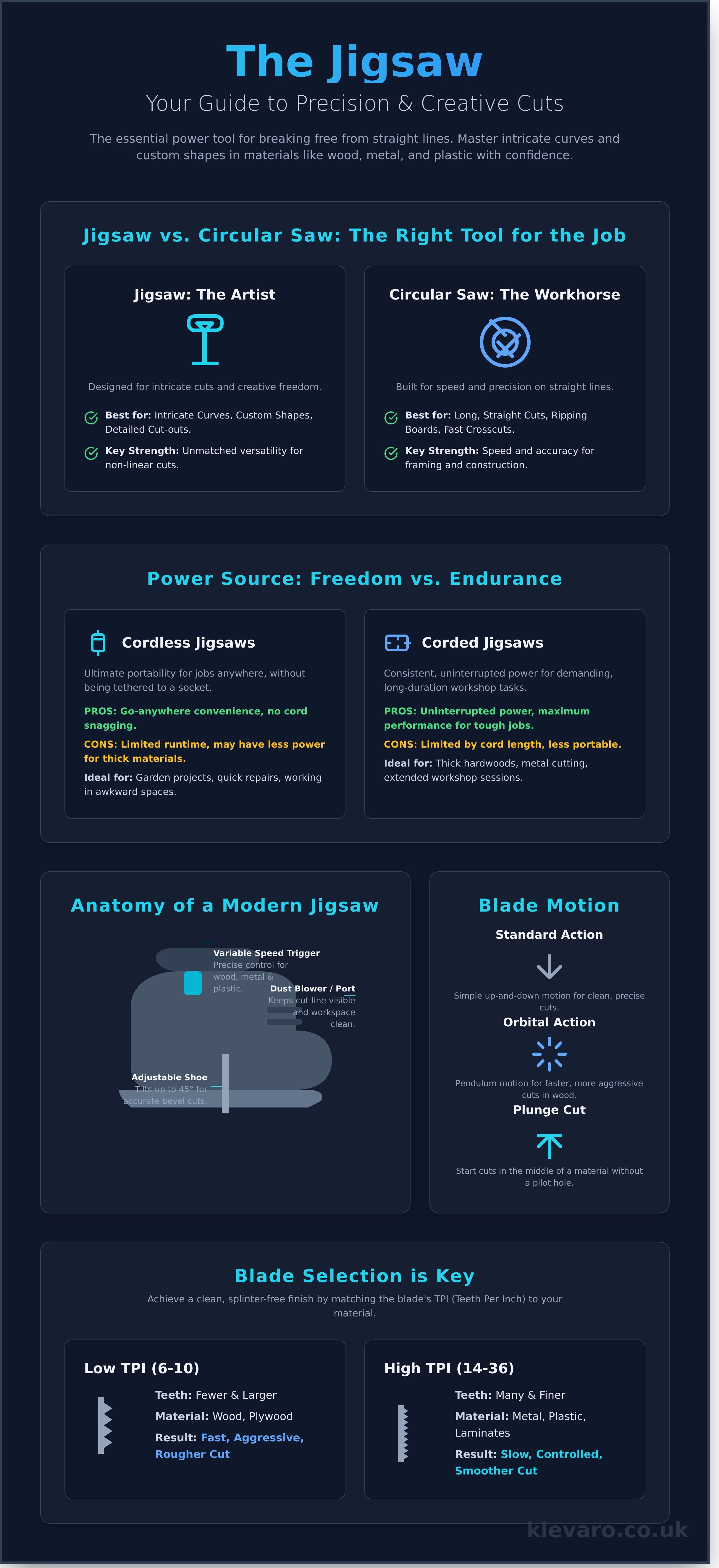
Comparing jigsaws to circular saws reveals why each tool belongs in a different stage of a project.
While both tools cut materials, their core purposes are fundamentally different. A circular saw is the powerhouse of the construction world, built for one primary job: making long, perfectly straight cuts through thick timber quickly and efficiently. Think framing a house or cutting down large sheets of plywood. It's about raw power and speed.
In contrast, the jigsaw is the artist's tool. It excels where precision and creativity are needed. Its thin, nimble blade is designed for intricate curves, detailed cut-outs, and patterns that a rigid circular blade simply cannot follow. If you need to cut a hole for a sink in a kitchen worktop or create a decorative pattern in a garden fence panel, the jigsaw is your only choice. Each saw has its moment to shine, but they rarely compete for the same task.
Jigsaw vs Circular Saw: A quick comparison
Understanding the key differences helps you grab the right tool for the job every time. A circular saw "rips" through material with brute force, ideal for breaking down large stock. A jigsaw "shapes" material with finesse, allowing you to follow complex lines and create custom designs. This distinction is crucial for achieving professional-looking results.
For projects that don't demand the speed of a power saw, or for exceptionally fine detail work, manual tools are a fantastic option. If you're building your toolkit from scratch, explore hand and general tools like coping saws and tenon saws to complement your power equipment.
Why the jigsaw is the safest entry point for power saw users
For anyone new to DIY, the high-pitched scream and spinning blade of a circular saw can be intimidating, and for good reason. The biggest danger with a circular saw is "kickback," where the blade binds in the wood and violently thrusts the tool back towards the user. This can happen in a fraction of a second and is a leading cause of workshop injuries.
The jigsaw, however, is designed for safety and control. Its blade moves in a simple up-and-down motion at a much lower speed, which dramatically reduces the chance of it jamming and kicking back. Furthermore, only a small portion of the blade is exposed during a cut, minimising accidental contact.
This saw's large, flat base plate (or "shoe") is another confidence-builder. It rests securely on the surface of your workpiece, providing excellent stability and making it easy to guide the tool along your marked line. To guarantee maximum safety and a perfectly clean cut, always secure your material to a workbench with at least two G-clamps. A steady workpiece is a safe workpiece.
Selecting the correct jigsaw blade is essential for achieving a clean and splinter-free finish.
Your jigsaw is only as good as the blade you put in it. The right blade transforms a rough tool into a precision instrument, allowing you to cut intricate curves and straight lines with a factory-quality edge. Choosing the wrong one can lead to splintered wood, melted plastic, or a snapped blade, turning a simple task into a frustrating repair job.
The secret lies in matching the blade's design, material, and tooth count to your specific workpiece. From the type of shank that fits your tool to the number of teeth per inch (TPI), every detail matters. A small investment in a good variety of blades will save you time, materials, and headaches on every project you tackle.
T-shank vs U-shank: Understanding the fit
While most modern jigsaws sold in the UK after 2005 use the T-shank system, it's wise to know the difference. Older models may use a U-shank, which is secured with a small screw. T-shank blades are the universal standard for modern jigsaws with quick-release, tool-less chucks. This design offers a faster, more secure connection that prevents the blade from wobbling. We always recommend keeping a variety pack of T-shank blades in your toolkit so you’re prepared for any material.
Matching the blade material to your workpiece
The material a blade is made from dictates its strength, flexibility, and lifespan. Using the wrong type will wear it out quickly and give you a poor result. A blunt or damaged blade is the number one cause of poor jigsaw performance, so always check its condition before you start.
- High Carbon Steel (HCS): These blades are flexible and affordable, making them ideal for cutting softer materials like softwood, MDF, and plastics. They aren't durable enough for hardwoods or metal.
- High Speed Steel (HSS): Much harder and more heat-resistant than HCS, HSS blades are designed for cutting non-ferrous metals like aluminium and copper, as well as perspex and hardwoods.
- Bi-Metal (BIM): The best all-rounder. These blades combine a flexible HCS body with durable HSS teeth, offering up to 10 times the lifespan of a standard HCS blade. They can handle wood, metal, and plastics, making them a fantastic, reliable choice for most DIY tasks.
Decoding TPI for the Perfect Cut
TPI, or Teeth Per Inch, is the most important factor in determining the speed and quality of your cut. The rule is simple: more teeth create a smoother, slower cut, while fewer teeth create a faster, rougher cut.
- Low TPI (6-10): These blades have large, deep teeth designed for aggressive, fast cutting in softwoods, plywood, and construction timber. They are perfect for rough work where speed is more important than a perfect finish.
- High TPI (14-24): With smaller teeth packed closely together, these blades deliver exceptionally clean, fine cuts in hardwoods, laminates, plastics, and non-ferrous metals. They cut slower but produce a splinter-free edge that needs little sanding.
- Speciality Blades: You can also find blades for unique materials. Carbide-grit blades have no teeth and are used to cut ceramic tiles and fibreglass. Reverse-tooth blades cut on the downstroke, preventing chipping on delicate surfaces like laminate flooring.
Ready to get the perfect cut every time? Explore our complete range of high-quality jigsaw blades to find the right match for your next project.
Mastering your jigsaw starts with proper setup and a few simple practice techniques.
You've got the ideas and the right tool for the job. Now it's time to ensure every cut is clean, accurate, and safe. Getting a professional result isn't about having years of experience; it's about following a few foundational rules. From preparing your material to guiding the tool, these simple habits will elevate your DIY projects from good to great.
First, always give your cut a clear path. A sharp pencil line is good, but for materials prone to splintering like plywood or laminate, apply a line of painter’s tape first and draw your line on that. The tape holds the top wood fibres in place, dramatically reducing tear-out and leaving you with a crisp, clean edge.
Before the blade ever touches the wood, get the motor running. Squeeze the trigger and let the jigsaw reach its full speed. Starting a cut with a slow-moving blade can cause it to catch and jump, damaging your workpiece. A full-speed start ensures a smooth entry and a much cleaner cut from the very beginning.
Your job is to guide, not to push. Apply firm, steady downward pressure on the saw's shoe to keep it flat against the material. This prevents chattering and ensures a square, 90-degree cut. Let the blade's orbital action and sharp teeth do the actual cutting work. Forcing the saw forward will only cause the blade to bend or wander, resulting in an uneven or angled cut.
For navigating very tight curves, use a technique called "relief cuts." Before you start cutting your curved line, make several straight cuts from the edge of the material up to your curved line, without crossing it. These cuts remove waste material and create space, preventing the blade from binding or twisting as you make the turn. It's a simple trick that makes complex shapes surprisingly easy.
Pro tips for a perfect finish every time
Most jigsaw blades cut on the upstroke, which can cause splintering on the top surface of your material. For a flawless finish on the visible side, simply mark and cut your piece from the back. This simple flip ensures any potential tear-out happens on the side no one will ever see.
A jigsaw isn't just for curves. To achieve a perfectly straight cut, clamp a straightedge (like a spirit level or a straight piece of scrap wood) onto your workpiece to act as a fence. Simply run the edge of the saw's shoe along this guide for a line that rivals a circular saw. It's techniques like these that help you transform your home and garden with precise custom shelving or perfectly constructed planters.
Safety essentials for every jigsaw user
Great results always start with safety. Before you make a single cut, make sure you're protected. The essential personal protective equipment (PPE) for any power saw user includes:
- Safety goggles: To protect your eyes from dust and flying debris.
- Ear protection: Power tools can be loud, and prolonged exposure can damage your hearing.
- Dust mask: To prevent inhaling fine wood dust, which can be harmful.
If you're working with reclaimed timber, always do a thorough check for hidden hazards. Run a metal detector over the wood or look carefully for any signs of embedded nails, screws, or staples. Hitting one of these can wreck your blade and potentially cause the tool to kick back, creating a serious safety risk.
Feeling inspired to get started? Your DIY journey doesn't have to be a solo one. Join the Klevaro community for more expert tips, project ideas, and support from fellow creators. Let's build something brilliant together.
Bring Your Creative Cuts to Life
Now you're equipped with the knowledge to master this essential tool. You know that a jigsaw excels at cutting intricate curves and that selecting the correct blade is the secret to a flawless, splinter-free finish. From understanding the power of a corded model to mastering basic techniques, you're ready to tackle your next creative project with confidence.
The only thing left is to find the right tool for your vision. Whether you're a seasoned pro or just starting your DIY journey, having reliable gear is non-negotiable. That's where we come in.
Shop our full range of professional DIY tools at Klevaro and discover your perfect match. As a trusted UK store, we guarantee quality on our curated tool selection and offer Fast UK Delivery on all power tools, with easy returns to get you started without delay.
Go on, bring those brilliant ideas to life. We can't wait to see what you create.
Frequently Asked Questions
What is the difference between a jigsaw and a reciprocating saw?
A jigsaw is a precision tool designed for making curved or intricate cuts on flat surfaces, while a reciprocating saw is a powerful demolition tool. You'd use a jigsaw for detailed projects like building a birdhouse or creating decorative shapes. In contrast, a reciprocating saw is perfect for rough, heavy-duty jobs like cutting through pipes, thick timber, or taking down an old garden shed. Your choice depends entirely on the power and precision your project requires.
Can a jigsaw cut through metal?
Yes, a jigsaw can cut through thin metal sheets like mild steel, aluminium, and copper when fitted with the correct blade. You'll need a High-Speed Steel (HSS) blade with a high tooth count, typically between 21 and 24 TPI. For the best results and to prevent the blade from overheating, set your saw to a lower speed. This gives you a cleaner, more controlled cut without damaging the blade or your material.
Why is my jigsaw blade bending or cutting at an angle?
Blade bending, or 'deflection', usually happens when you force the saw forward too quickly or use a blade that's too thin for the material. To get a straight cut, let the saw's speed do the work and guide it gently. Always make sure you're using a sharp, high-quality blade suited to the thickness of the wood. For very thick timber, a jigsaw may naturally struggle to achieve a perfectly vertical cut compared to a band saw.
Do I need orbital action on my jigsaw?
Orbital action is a fantastic feature for making fast, aggressive cuts, especially in thick wood. It moves the blade in a slight circular motion, clearing sawdust more effectively. However, this speed comes at the cost of a rougher finish. For delicate scroll work, tight curves, or when you need a perfectly smooth edge, it's best to turn the orbital setting down or completely off. This gives you maximum control and a much cleaner result.
What is the best TPI for cutting plywood?
For cutting standard plywood, a blade with 10 to 12 TPI (Teeth Per Inch) offers a great balance between a clean finish and a good cutting speed. If you're working with expensive veneered plywood where the surface finish is critical, choose a blade with a higher TPI. Alternatively, a 'down-cut' blade is an excellent choice as its teeth cut on the downstroke, preventing ugly splintering on the top surface of your project.
How do I make a hole in the middle of a board with a jigsaw?
The safest way to start a cut in the middle of a board is by drilling a 'starter hole'. Simply drill a hole large enough for the jigsaw blade inside the area you plan to cut out. Then, you can insert the blade into the hole and begin your cut. While experienced users might perform a 'plunge cut' by tipping the saw forward, the starter hole method is much more controlled and highly recommended for beginners to ensure safety and accuracy.
Are T-shank and U-shank blades interchangeable?
No, T-shank and U-shank blades are not interchangeable because they have different locking systems. T-shank blades are the modern standard, featuring a small tang at the top that locks into a tool-less clamp on nearly all new jigsaws. U-shank blades have a U-shaped cutout and require a set screw to hold them in place, a design found mostly on older models. Always check your saw's manual to buy the correct type for your tool.
Leave a comment