


What is a Combi Drill Used For? The Ultimate Guide to This Essential DIY Tool
Why carry three heavy power tools when a single device can handle everything from hanging a picture to drilling through solid brick? A combi drill is a versatile power tool used for driving screws, drilling into wood or metal, and hammer-drilling into masonry. When considering what is a combi drill used for, it's defined by its three distinct modes: screwdriver, drill, and hammer. This tool handles 85% of common DIY projects by combining high-speed rotation with a pulsating impact for tough materials. You can switch between these settings to securely mount shelves, build furniture, or bore holes into external stone walls.
You might feel unsure about the different icons on the drill collar or worry about damaging your project by using the wrong setting. You'll discover how a combi drill combines three vital functions to handle almost any home improvement task with total confidence. This guide explains how to master each mode, choose the right bits for your material, and decide if a combi drill is the right investment for your toolkit.
Key Takeaways
- Learn how a combi drill acts as a versatile 3-in-1 tool, combining standard drilling, screw driving, and hammer action for masonry work.
- Master the use of torque settings and mode selectors to protect your materials and achieve professional precision on every DIY task.
- Understand what is a combi drill used for compared to standard drill drivers to ensure you always choose the right power for brick and stone.
- Discover practical applications for your home and garden, from hanging heavy shelving on external walls to building durable outdoor furniture.
- Identify the key technical specifications, such as voltage and battery capacity, needed to power through your specific home improvement projects.
A Combi Drill is a Versatile Tool Combining Three Vital Functions
A combi drill is an all-in-one power tool designed to drill holes, drive screws, and perform hammer-action drilling. It combines the features of a standard drill driver with the percussive power of a masonry-capable hammer drill. This tool is the primary device for home maintenance and furniture assembly. The "combi" name refers to this specific combination of a standard rotary motor and a percussive hammer mechanism. It's the most popular choice for UK DIY enthusiasts because it handles wood, metal, and brickwork with a single unit.
When asking what is a combi drill used for, the answer lies in its three distinct modes. Most household projects involve different materials, and this tool allows you to switch between them by turning a single selection collar. It eliminates the need to own multiple specialized drills for basic renovation tasks. You can build a flat-pack wardrobe and then immediately hang a heavy picture on a brick wall using the same machine.
The Three Primary Settings on a Combi Drill
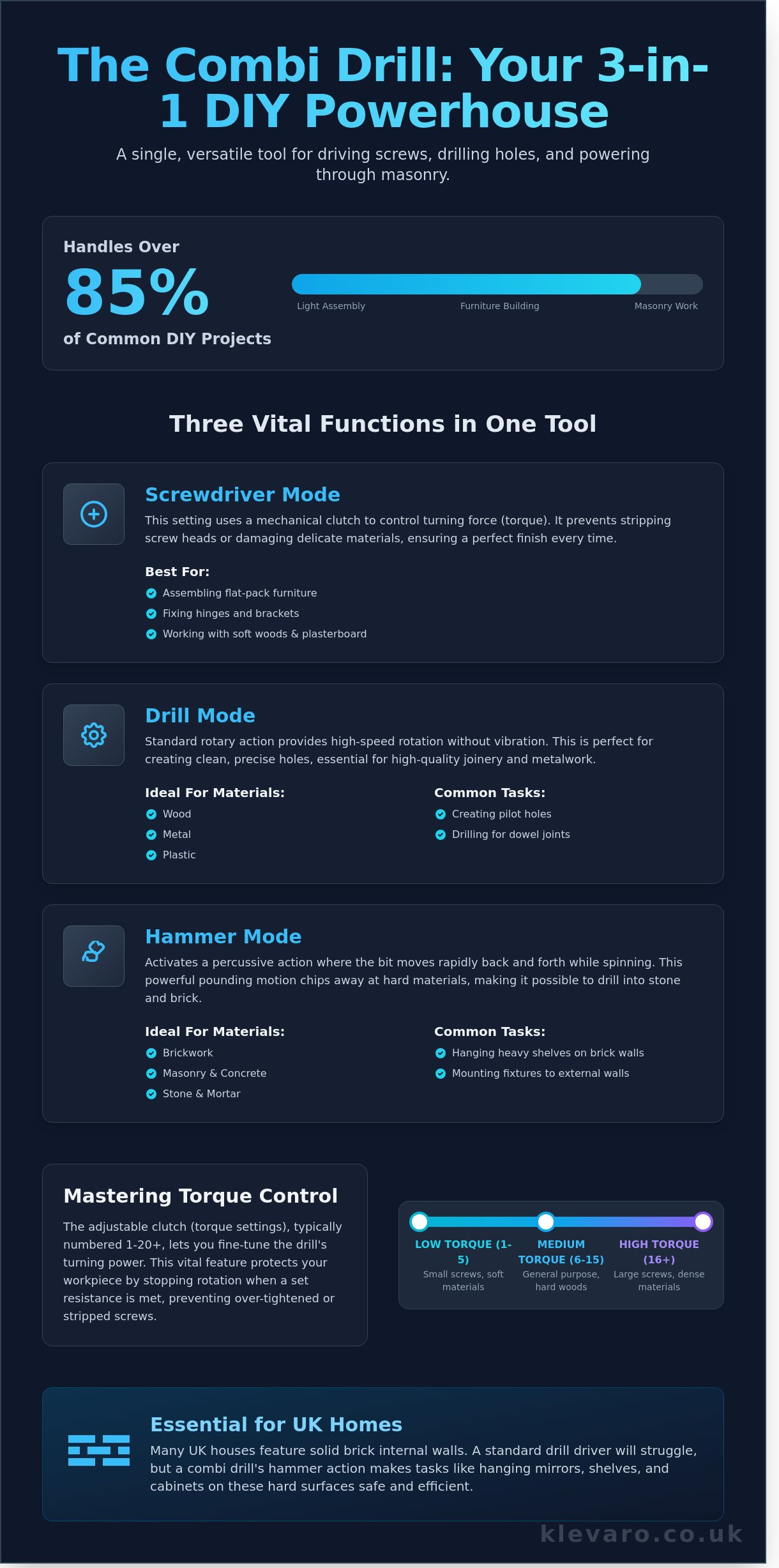
The screwdriver icon indicates the driving mode. This setting utilizes a mechanical clutch to control torque, which prevents you from stripping screw heads or damaging delicate materials. It's the go-to setting for fixing screws into pre-drilled holes or assembling wooden furniture. Using the right torque setting ensures the screw sits flush without burying itself too deep into the timber.
The drill bit icon represents the standard rotary mode. This setting provides high-speed rotation without any hammering action. It's perfect for creating clean holes in wood, plastic, and metal. Because there's no vibration in this mode, you get a precise finish that's necessary for high-quality joinery or metalwork projects.
The hammer icon activates the percussive action required for drilling into masonry and brickwork. In this mode, the drill bit moves rapidly back and forth while spinning. This pounding motion chips away at hard stone and mortar, allowing the flutes of the drill bit to clear out the debris. Without this setting, drilling into a garden wall or a chimney breast is nearly impossible.
Why the Combi Drill is Essential for UK Homes
UK houses often feature internal brick walls that require hammer action for simple tasks like hanging mirrors or installing shelving units. A standard drill driver often fails when encountering hard Victorian brickwork because it lacks the necessary impact force. The friction simply generates heat, which can ruin your drill bits in seconds. A combi drill provides the extra punch needed to penetrate these dense materials safely and efficiently.
Understanding what is a combi drill used for helps you realize why it's a staple in any modern household. This tool fits perfectly into Your First DIY Toolkit as the most versatile power tool you can own. It offers a balance of power and precision that suits everything from light decor changes to more intensive home repairs. Investing in one quality combi drill is often more cost-effective than buying separate tools for every individual task.
Understanding the Mechanical Modes and Torque Settings
A combi drill uses a mode selector ring and adjustable torque settings to adapt to different materials and tasks. The mode selector allows you to switch between driving screws, drilling into wood or metal, and using the hammer function for masonry. Torque settings control the amount of turning force applied to a fastener before the internal clutch disengages. This versatility explains exactly what is a combi drill used for in most home renovation and repair projects.
You can change between functions instantly by rotating the collar located directly behind the chuck. The drill icon is for standard holes in wood or plastic; the hammer icon adds a pulsating action for brickwork; and the screw icon activates the adjustable clutch. This mechanical flexibility makes the tool a reliable partner for any DIY task.
The clutch mechanism protects both the motor and the workpiece by stopping the drive when resistance reaches a specific level. This prevents you from over-driving screws or burning out the tool's internal components during heavy use. It's a vital feature for maintaining the life of your equipment and the quality of your finish.
Torque settings are often numbered from 1 to 20 or higher to provide precise control. High torque is essential for driving 75mm screws into dense timber, while low torque prevents stripping screw heads in soft materials. If you're looking to upgrade your kit, you can explore our range of tools and equipment to find a model with the right power for your needs.
How to Use the Screwdriver Clutch Effectively
Select a lower number, such as 1 to 5, for delicate tasks like assembling flat-pack furniture. This prevents the drill from applying too much force and splitting thin MDF or pine. You should increase the torque setting gradually when driving larger screws into thick timber or decking boards.
The tool will produce a distinct clicking sound when the clutch disengages at your set limit. This noise indicates that the drill has stopped applying rotational force to the screw. It's a built-in safety feature that ensures every screw is driven to a consistent depth without damaging the material surface.
The Difference Between High and Low Speed Gears
Most combi drills feature a mechanical slide switch on top for two distinct speed ranges. Gear 1 provides high torque and low speed, making it the best choice for driving large fixings or using 50mm hole saws. It provides the raw power needed to overcome high resistance in dense materials.
Gear 2 offers high speed and lower torque, which is best suited for drilling small holes in metal or wood quickly. A simple rule of thumb is to match the gear to the size of the bit. Use Gear 1 for large bits and heavy resistance, and switch to Gear 2 for smaller bits and fast, clean holes. Understanding these settings is key to mastering what is a combi drill used for in professional and home environments.
Comparing Combi Drills Against Drill Drivers and SDS Drills
A combi drill is the most versatile power tool for home maintenance because it combines the features of three different machines into one compact unit. It functions as a standard drill for wood, a screwdriver for assembly, and a hammer drill for masonry. This makes it the ideal middle-ground tool for 95% of DIY tasks, offering more power than a basic driver without the excessive weight of industrial equipment.
Choosing the right tool depends on the material you are working with and the scale of your project. While many tools look similar, their internal mechanisms dictate whether they can handle brick, wood, or concrete. Understanding what is a combi drill used for helps you avoid damaging your equipment or your walls by using the wrong setting.
The Limits of a Standard Drill Driver
A standard drill driver is designed for rotation only, which is perfect for wood, plastic, and metal. It lacks the internal hammer mechanism found in a combi drill. If you try to use a standard driver on a brick wall, the bit will likely spin in place without making progress, creating heat that ruins the drill bit.
This "spinning" effect is a common frustration for beginners who don't realize their tool lacks the percussion needed to crack masonry. For projects that require high torque specifically for driving long screws into timber, you should check out The Ultimate Impact Driver Guide. Impact drivers are specialized for fastening, whereas combi drills are the masters of creating holes in varied surfaces.
Choosing Between a Combi and an SDS Drill
SDS (Slotted Drive System) drills are heavy-duty machines built for demolition and drilling into reinforced concrete. They use a piston mechanism to deliver a much harder blow than the clicking plates found in a combi drill. However, an SDS drill is often 50% heavier and much harder to control for delicate tasks.
The chuck systems also differ significantly between these two tools. Combi drills use a standard keyless chuck that accepts round or hexagonal shank bits. SDS drills require specialized fluted bits that lock into a spring-loaded chuck, meaning your standard drill bits won't fit an SDS machine.
- Combi Drills: Best for hanging shelving, curtain rails, and television brackets into brick or block.
- SDS Drills: Necessary for drilling holes larger than 20mm or breaking up concrete garden paths.
- Precision: Combi drills offer better trigger control for small, accurate holes.
For most domestic renovations, a combi drill is the superior choice. It provides enough power to penetrate 100mm of masonry while remaining light enough to use one-handed. Stick with a combi drill for your tool kit unless you are planning a major structural project or professional masonry work.
Practical Applications and Common DIY Projects
A combi drill is used for three primary tasks: driving screws, drilling into wood or metal, and boring holes into masonry using a hammer action. This versatility makes it the go-to tool for 90% of tasks in our tools and equipment collection. Whether you're hanging a heavy mirror on a brick wall or building a new garden shed, this single tool replaces the need for multiple separate devices. It's the most practical choice for home maintenance and creative DIY projects. Understanding what is a combi drill used for helps you tackle almost any home improvement task with confidence.
Hanging heavy items like shelving, radiators, or TV brackets on external brick walls requires the hammer setting. This mode delivers rapid percussive blows to the drill bit, allowing it to penetrate tough materials like concrete or brick effortlessly. For garden projects, you'll use the screwdriver mode to assemble furniture or build sheds. The adjustable clutch prevents you from over-driving screws into the timber, which keeps your finish looking professional and prevents wood splitting.
Kitchen and bathroom repairs often involve drilling clean holes through plastic or copper pipes. By switching to the standard drill mode, you can achieve precise results without damaging the surrounding fixtures. Knowing exactly what is a combi drill used for allows you to switch between these modes seamlessly. This ensures you always have the right power and speed for the material you're working with.
Working with Wood and Metal Materials
Always use the standard drill mode when working with wood or metal to prevent splintering or snapping your bits. High speed settings are best for small drill bits because they ensure a clean, sharp finish on the entry and exit points. It's often helpful to explore hand and general tools to complement your power tool work. Using a centre punch for metal or a clamp for wood will help you achieve trade-quality results on every project.
Mastering Masonry Drilling for Home Improvement
When you activate the hammer mode, you must use a tungsten-carbide tipped (TCT) masonry bit. Apply firm, steady pressure instead of forcing the tool, as the hammer action is designed to do the hard work for you. To keep the bit cool and the hole clean, remember to "clear the flutes" by pulling the bit back slightly every few seconds to remove accumulated dust. This simple technique extends the life of your drill bits and ensures a more accurate hole for your wall plugs.
Selecting the Right Combi Drill for Your Toolkit
Choosing the right tool requires balancing power, runtime, and motor efficiency to match your specific DIY needs. Most domestic projects are best served by an 18V model equipped with at least a 2.0Ah battery and a brushless motor for long-term reliability. These specifications ensure you can effectively manage what is a combi drill used for, which includes everything from driving small screws into soft timber to hammer-drilling 10mm holes into exterior brickwork.
Voltage represents the raw power or "muscle" of the cordless motor. While 12V tools are available for light assembly, 18V is the industry standard for versatile home maintenance because it provides the torque necessary for demanding masonry tasks. A higher voltage allows the drill to maintain its speed even when the drill bit meets significant resistance in tough materials.
Battery capacity is measured in Amp-hours (Ah) and acts like a fuel tank for your tool. A 2.0Ah battery is lightweight and ideal for overhead tasks or assembling flat-pack furniture. If you plan on larger projects, such as building a garden deck, a 4.0Ah or 5.0Ah battery provides 50% more work time between charges, though it adds more weight to the base of the tool.
Brushless motors are a superior choice for anyone looking for durability and efficiency. Traditional motors use carbon brushes that create friction and heat, eventually wearing out over time. Brushless technology uses magnets to generate power, which results in a 50% longer motor life and up to 30% more runtime per battery charge. While these models might cost 15% to 20% more upfront, the investment pays off through better performance and less maintenance.
Cordless vs Corded: Which is Better for You?
Cordless combi drills offer unmatched portability for working in lofts, gardens, or tight corners where power outlets are out of reach. Modern 18V lithium-ion batteries provide enough power for almost any domestic masonry task, making the old power limitations of battery tools a thing of the past. Corded drills are becoming rare in DIY settings because battery advancements allow users to drill 25 to 30 holes in brick on a single 2.0Ah charge.
Key Features to Look for Before Buying
An integrated LED light is an invaluable feature for working inside dark cupboards, under stairs, or in poorly lit garages. You should also look for a metal chuck rather than a plastic one. Metal chucks offer 40% better durability and a tighter grip on larger drill bits, preventing them from slipping during high-torque tasks. Check out our full range of home and garden tools to find your perfect match.
Ready to start your next project? Join the Klevaro community for more expert tips on tool maintenance and home improvement. We love seeing how you use your gear to fix, build, and create with confidence.
Ready Your Toolkit for Every DIY Challenge
Understanding what is a combi drill used for empowers you to tackle 100% of common home renovation tasks with a single device. These 3-in-1 tools combine standard drilling, screwdriving, and hammer modes, allowing you to move from assembling furniture to drilling into solid brick in seconds. By mastering the adjustable torque settings, you ensure precision and prevent damage to your work surfaces.
Klevaro provides an expertly curated selection for DIY enthusiasts who value reliable performance. We're a trusted UK store with quality guaranteed, offering 18V power and durability for professional results. Every tool in our collection is selected to help you fix, build, and create with total confidence.
Don't let a lack of gear stall your next project. Explore our full range of professional DIY tools and equipment and benefit from fast UK delivery on all power tools. It's time to transform your home and bring your creative ideas to life.
Frequently Asked Questions
Can a combi drill be used as a screwdriver?
Yes, a combi drill is specifically designed to function as a powerful screwdriver for your home projects. You simply select the screwdriver icon on the collar and adjust the torque settings to drive screws into timber or plastic with precision. This prevents over-tightening and ensures the screw head sits flush with the surface every time. It’s a reliable way to build furniture or fix shelving without damaging the material.
Does a combi drill need special drill bits?
You can use standard round-shank or hex-shank drill bits for wood and metal, but you'll need masonry bits for brickwork. When you engage the hammer function, you must use a bit with a tungsten carbide tip to withstand the 20,000 plus blows per minute. Always ensure the bit is tightened securely in the 13mm keyless chuck before you start your project to maintain safety and accuracy.
Is a combi drill powerful enough for concrete?
A combi drill handles brick, mortar, and soft stone easily but often struggles with high-density cured concrete. For drilling holes larger than 10mm in solid concrete, an SDS drill is a more appropriate choice for the job. If you're researching what is a combi drill used for in a domestic setting, a high-quality 18V model is usually powerful enough for small fixings in standard concrete lintels.
What is the difference between a combi drill and a hammer drill?
A combi drill is a specific tool that combines hammer action with screwdriver and standard drilling modes in one unit. While "hammer drill" is a broad term for any tool with a percussive action, most modern DIY units are technically combi drills because they offer these 3 distinct functions. This versatility makes it the perfect choice for 90% of household maintenance tasks, from hanging pictures to assembling heavy garden furniture.
What do the numbers on the drill collar mean?
The numbers on the collar represent the torque settings, which control the turning force when you're in screwdriver mode. Setting the collar to a low number like 1 or 2 causes the drill to stop spinning when it meets slight resistance, protecting delicate materials. Higher settings, often reaching up to 20 or 25, provide the force needed to drive 100mm screws into dense timber with confidence and ease.
Can I use a combi drill to mix paint or plaster?
You can use a combi drill with a mixing paddle attachment for small quantities of paint or plaster under 5 litres. Always use the standard drilling mode without the hammer action and select the low-speed gear, usually Gear 1, to provide maximum torque. This helps you achieve a smooth consistency without overloading the motor. It’s an efficient way to prep for your next home transformation project.
Leave a comment