


The Ultimate Angle Grinder Guide: Choosing and Using Your DIY Powerhouse in 2026
From slicing through rusted bolts to shaping garden paving slabs, the angle grinder is the single most versatile powerhouse in any DIY toolkit. It’s the tool that transforms tough, time-consuming jobs into simple, satisfying tasks. We get it, though. The high-speed whir and shower of sparks can feel intimidating, leaving you wondering if a cordless model has enough grunt for brickwork or which of the dozen discs is the right one for the job.
This guide cuts right through the confusion. We promise to equip you with the expert knowledge to confidently choose the perfect angle grinder for your projects, match the right disc to any material without guesswork, and master the safety techniques for professional-grade results. Get ready to turn that challenging project from a worry into a weekend win.
Key Takeaways
- Decide between corded models for consistent power on heavy-duty jobs and cordless versions for ultimate portability around the home and garden.
- Learn to match the correct disc to your material, using thin cutting discs for slicing and thicker grinding wheels for smoothing and shaping.
- Master safe operation by using essential protective gear, including high-impact eye protection and ear defenders, to work with confidence.
- Unlock the full potential of your angle grinder for a huge range of DIY tasks, from cutting paving slabs to polishing metalwork.
What is an angle grinder and why is it essential for home DIY?
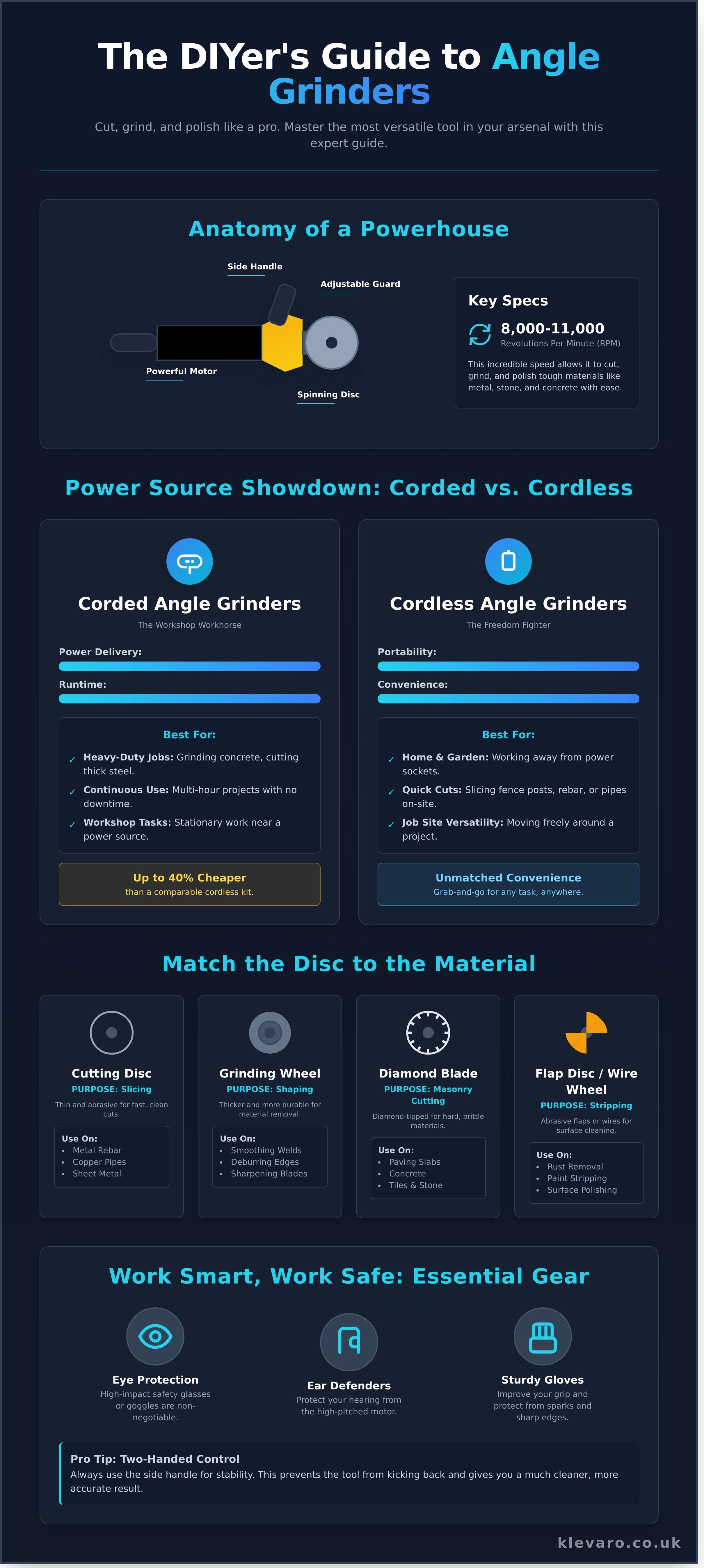
An angle grinder is a handheld power tool designed for cutting, grinding, and polishing a wide range of materials. It operates by spinning a replaceable disc at incredible speeds, typically between 8,000 and 11,000 Revolutions Per Minute (RPM), to make short work of metal, stone, tile, and concrete. This versatility is precisely why it's an essential for any serious home DIY enthusiast. It effectively replaces multiple specialist tools, saving you both money and valuable shed space on masonry, plumbing, and metalworking projects. In short, the angle grinder is a multi-purpose powerhouse for countless home renovation and garden projects.
The secret to its adaptability lies in the wide variety of discs and attachments available. A thin metal-cutting disc transforms it into a precision tool for slicing through rebar, while a diamond-tipped blade makes it perfect for shaping paving slabs. Swap that for a wire brush, and you have a powerful rust and paint remover. For a complete technical breakdown, Wikipedia provides a detailed answer to the question, What is an angle grinder?, but for the home DIYer, its value is simple: one tool, endless possibilities.
The core components of a modern angle grinder
Understanding the basic parts of your tool helps you work safely and effectively. The main body houses a powerful motor that drives a gear head at a right angle, which is where the tool gets its name and how it delivers so much torque to the spinning disc.
Crucially, every grinder includes an adjustable guard. This simple piece of metal is your primary line of defence, deflecting sparks and debris away from your face and body. Always ensure it's positioned correctly between you and the work surface before you start.
Finally, the side handle provides stability and control. For beginners, using both hands is non-negotiable as it prevents the tool from kicking back and ensures a much cleaner, more accurate cut or grind. Most models allow the handle to be fitted on either side for left or right-handed use.
Common DIY tasks you can tackle with one tool
Once you get comfortable with your grinder, you’ll find it becomes your go-to tool for jobs around the house and garden. It brings a level of power and speed to tasks that would be exhausting by hand. Here are just a few projects where it truly shines:
- Cutting paving slabs: Need to shape a slab to fit perfectly at the edge of a new patio or garden path? A model fitted with a diamond blade cuts through concrete and stone with ease, giving you a professional finish.
- Removing rust: That old metal garden bench can be brought back to life. Attach a wire wheel or flap disc to strip away years of rust and flaking paint in minutes, leaving a clean surface ready for a fresh coat.
- Shortening pipes and rebar: Whether you're doing some plumbing with copper pipes or working on a construction project with steel rebar, a grinder with a metal cut-off disc provides a fast, clean cut every time.
Cordless vs corded angle grinders: Which power source is right for you?
Choosing the right power source for your angle grinder depends entirely on your planned projects. Corded angle grinders are the best choice for heavy-duty, continuous jobs in a workshop, offering unlimited runtime and consistent power. Cordless models provide unmatched portability and convenience, making them ideal for tasks around the home and garden where a power socket is out of reach. For the vast majority of UK domestic projects, a 115mm (4.5-inch) model is the versatile sweet spot.
While battery technology as of 2026 has dramatically closed the performance gap, a corded grinder still provides more power for your pound. If your work involves long sessions of grinding concrete, cutting thick steel, or stripping paint in one location, the reliability of a corded tool is unbeatable. However, for quick cuts on fence posts or sharpening tools in different locations, the freedom of a cordless model is a clear winner.
The benefits of choosing a corded angle grinder
A corded angle grinder often has a lower initial cost, with like-for-like models being up to 40% cheaper than a cordless kit that includes batteries and a charger. This makes it a fantastic value-for-money option if you already have a well-equipped workshop with accessible power points. They are the perfect tool for stationary tasks where you need unwavering performance, such as sharpening lawnmower blades or deburring freshly cut metal on your workbench.
Perhaps the biggest advantage is the elimination of "battery anxiety." For demanding, multi-hour projects like grinding down a concrete hearth or removing rust from large iron gates, you can work continuously without stopping to swap or recharge batteries. This constant power delivery ensures a consistent finish and lets you focus completely on the task at hand.
Why cordless grinders are winning the DIY market
The sheer convenience of a battery-powered angle grinder is its main appeal. Imagine cutting paving slabs at the bottom of the garden and then moving straight to the garage to slice a seized bolt, all without wrestling with cables. This freedom is why so many people use them for a huge range of common angle grinder uses, from cleaning mortar to slicing through rebar.
Modern cordless tools benefit from advanced brushless motor technology. These motors are more efficient, meaning you get more work done from a single battery charge, and they have fewer moving parts to wear out, reducing maintenance. Of course, a corded grinder can still reach the far corners of your property, but you'll need reliable extension leads to do so safely and without significant power drop-off. Once you've decided on the right power source for your projects, you can find the perfect model in our curated collection of power tools.
Matching the right disc to your material for professional results
Using the correct disc for your angle grinder is the most critical factor in achieving clean, professional results safely. The wrong disc won't just ruin your workpiece; it can be incredibly dangerous. Your success depends on matching the disc's design and material composition to the job at hand. The main types you'll encounter are thin cutting discs for slicing, thick grinding wheels for shaping, flap discs for finishing, and diamond blades for tough masonry.
Think of these attachments as specialists. Each one is engineered to perform a specific task exceptionally well, so let's break down which one to choose for your next project.
- Cutting Discs: These are your go-to for slicing. With a thin profile, typically between 1mm and 3mm, they cut through metal, stone, or stainless steel with speed and precision, minimising material waste. They are designed only for cutting on their edge, not for grinding on their face.
- Grinding Wheels: When you need to remove a lot of material quickly, grab a grinding wheel. These are much thicker and more robust (often 6mm or more) and are perfect for smoothing out welds, removing rust, and shaping metal edges.
- Flap Discs: The secret to a perfect finish. A flap disc is made from overlapping abrasive flaps, or sandpaper, arranged on a wheel. It grinds and finishes in a single step, making it ideal for sanding, blending, and deburring on both wood and metal.
- Diamond Blades: For the toughest jobs, nothing beats a diamond blade. These discs have diamond segments on their edge that cut through hard materials like concrete, porcelain tiles, and brick. They don't wear away like abrasive discs, offering superior durability and performance.
Choosing discs for metal and plumbing
Using a disc designed for stone on metal is a serious safety risk. Stone discs are bonded differently and can shatter when subjected to the stresses of cutting metal, sending dangerous fragments flying. Always check the disc's label to confirm it's rated for metal, a point reinforced by official resources like the OSHA angle grinder safety guidelines. For rust removal, an aluminium oxide disc is a great all-rounder, but for stubborn corrosion or hard metals like stainless steel, a zirconia disc offers faster, more aggressive removal and a longer lifespan.
Thickness matters, too. For plumbing jobs involving copper pipe or thin sheet metal, a very thin 1mm cutting disc provides a fast, clean cut with minimal burring. When tackling thicker materials like 5mm stainless steel plate or rebar, a slightly thicker 1.6mm or 2.5mm disc offers more durability and stability during the cut.
Selecting masonry blades for garden and home
When you're working on outdoor projects, a segmented diamond blade is your best friend. The gaps, or gullets, between the segments help to cool the blade and efficiently clear dust and debris. This makes them the ideal choice for dry-cutting tough, abrasive materials like concrete paving slabs, bricks, and kerbstones for a new garden path.
For indoor jobs where a pristine finish is essential, switch to a continuous rim blade. This type has a solid, unbroken edge that delivers a precise, chip-free cut, making it the perfect choice for delicate materials like porcelain and ceramic bathroom tiles. Once you've perfectly cut your patio slabs, explore our garden accessories to find the perfect finishing touches for your stylish new outdoor space.
Safety and technique: How to use an angle grinder without the fear
An angle grinder is an incredibly powerful tool, and that power demands respect. For many new DIYers, safety is the biggest barrier to getting started, but it's entirely manageable with the right gear and a solid understanding of technique. Protecting yourself isn't complicated; it's about creating simple habits that keep you in control.
Your first step is to manage the stream of sparks. Always position the tool and your workpiece so that sparks and debris fly away from your body, and clear the area of flammable materials like sawdust, oily rags, or solvents. The kickback zone is the area directly behind the spinning disc where the tool can violently jump back towards you; always keep your body out of this direct line of fire to stay safe.
Essential PPE for every DIYer
Your standard reading glasses are not safety equipment. Discs can shatter, sending fragments flying at over 100 miles per hour. You need high-impact, wrap-around safety goggles or a full face shield that conforms to the UK's BS EN 166 standard for robust protection from all angles.
Heavy-duty leather or flame-resistant gloves are non-negotiable. They protect your hands from the intense heat of flying sparks and shield you from the razor-sharp metal burrs left behind after a cut. When cutting masonry, stone, or concrete, an FFP3-rated dust mask is a legal requirement on UK work sites for a reason. It protects your lungs from inhaling microscopic silica dust, a serious long-term health hazard.
The correct technique for cutting and grinding
Always start the tool before it touches the material. Bringing a stationary disc into contact with a surface and then starting it can cause the tool to jar violently and jump from your hands. Let it reach its full speed of over 10,000 RPM in the air, then gently guide it to the workpiece.
Apply steady, light pressure and let the speed of the disc do the work. Forcing the tool into the material puts stress on the motor and the disc, increasing the risk of kickback or shattering. A smooth, consistent motion will give you a cleaner and safer result every time.
For cutting, the "pull" method is widely considered safer than pushing. By drawing the tool towards you (while standing to the side of the cutting line), you maintain better control and visibility. If the disc happens to bind in the cut, its rotational force will pull it away from your body, not jump back at you. Getting the right gear is the first step to confidence, so explore our full range of essential safety equipment to make sure you're protected for your next project.
Finding the perfect angle grinder for your toolkit at Klevaro
Now that you've seen just how versatile this powerhouse tool can be, you're ready to add one to your own collection. At Klevaro, we believe that having the right tool is the first step to a successful project. That’s why we carefully curate a selection of power tools that perfectly balance professional-grade performance with the user-friendly features every DIY enthusiast needs. We make it simple to find a reliable tool that you can trust for years to come.
We hand-pick every angle grinder in our collection, focusing on trusted brands known for their durability and commitment to safety. You'll find models with essential innovations like soft-start motors for smoother handling, anti-restart functions to prevent accidental activation, and effective vibration control to reduce fatigue during longer jobs. Your safety and comfort are our top priorities.
We also know that when inspiration for a project strikes, you want to get started right away. Our fast UK delivery service is designed to get your new gear to you quickly, so you can start that garden paving or bathroom renovation this weekend. Our support doesn't end at the checkout, either. We encourage you to join the Klevaro community, a growing hub for home improvers where you can find more expert tips, project ideas, and practical advice to keep you creating with confidence.
Why shop for tools with Klevaro?
We are passionate about providing quality gear that helps you fix, build, and create. Every product in our store is chosen to be a reliable partner in your workshop, garage, or garden shed. Our customer-first approach is built on trust and convenience. If you have a question, our UK-based support team is ready to provide a clear answer, and our easy returns policy means you can always shop risk-free. While a powerful grinder is a fantastic start, a complete toolkit makes any job easier. Explore our full collection of hand and general tools to find everything from durable socket sets to precision spirit levels.
Ready to upgrade your DIY game?
The right tool is always the one that fits the job. Our selection covers all the bases, ensuring you can find the perfect match for your projects. Whether you need a compact and agile 115mm model for intricate tile cutting or a high-torque 230mm powerhouse for slicing through concrete slabs, we have the solution waiting for you. Don't let the wrong equipment hold your creativity back. Get your project moving forward today by browsing our complete range of tools and equipment.
Ready to get started? Shop our curated range of DIY tools and get fast UK delivery.
Build, Cut, and Create with Confidence
You're now equipped with the knowledge to make the angle grinder the most versatile tool in your arsenal. Remember, choosing between a corded or cordless model and always matching the right disc to your material are the two most critical steps for achieving professional-grade results safely and efficiently.
With this expert guidance, you’re ready to select the perfect angle grinder and turn your project vision into a reality. It’s time to stop planning and start doing. Find the durable, reliable gear that will help you tackle any cutting, grinding, or polishing task with ease.
Ready to power up your toolkit? Shop our curated range of DIY tools and get fast UK delivery. As a trusted UK Store with Quality Guaranteed on all our DIY gear, we’re here to help you build better. Your next great project is just a click away.
Frequently Asked Questions
Can I use an angle grinder to cut wood?
No, you should not use an angle grinder with a standard cutting disc to cut wood. It's incredibly dangerous because the tool's high rotational speed can cause severe kickback if the blade binds in the wood. This can lead to a loss of control and serious injury. For safer and cleaner cuts in timber, always choose a dedicated tool like a circular saw or a jigsaw for your DIY projects.
What is the difference between a 115mm and 125mm angle grinder?
The primary difference is the disc size, which directly impacts the maximum cutting depth. A 125mm (5-inch) grinder uses a larger disc and can cut to a depth of about 35mm, while a 115mm (4.5-inch) model typically reaches a depth of around 30mm. The 115mm models are often slightly more compact and easier to handle in tight spots, making them a popular choice for general DIY tasks and metalwork.
Do I need a brushless angle grinder for home DIY?
For most home DIY projects, a traditional brushed angle grinder is a reliable and cost-effective choice. Brushless models offer advantages like longer battery life (up to 50% more runtime) and increased durability, which are fantastic for trade professionals using them all day. However, for occasional tasks like cutting tiles or grinding metal, a quality brushed grinder provides all the power you'll need to get the job done right.
How often should I replace the discs on my angle grinder?
You must replace a disc immediately if it's cracked, chipped, or shows any signs of damage. For cutting discs, replace them once they have worn down to a point where they no longer cut effectively. Grinding discs should be replaced when they wear down close to the central hub, typically within 25mm of the locking flange. Always prioritise safety; using a worn or damaged disc is a major risk.
What does the spindle lock button do?
The spindle lock button is a crucial feature that stops the main shaft from turning, allowing you to safely change discs. When you press it, the spindle is held firmly in place so you can use a spanner to loosen the flange nut, remove the old disc, and tighten the new one. Always make sure your angle grinder is disconnected from its power source before using the spindle lock.
Is an 18V cordless grinder powerful enough to cut concrete?
Yes, an 18V cordless angle grinder is definitely powerful enough to cut concrete for most DIY jobs, like scoring paving slabs or cutting bricks. The key is to fit it with a high-quality diamond cutting disc designed specifically for masonry. While it's perfect for smaller tasks, for cutting through very thick, reinforced concrete driveways, a larger 230mm corded model would be a more efficient and powerful tool for the job.
Why is my angle grinder producing so many sparks?
Sparks are a normal and expected result of cutting or grinding ferrous metals like steel and iron. The abrasive disc is rapidly shearing off tiny, hot particles of metal, which you see as a shower of sparks. This is a sign the tool is working correctly. If, however, you see sparks coming directly from the tool's motor vents, stop work immediately and have the grinder inspected, as this can indicate an internal issue.
Can I use a 125mm disc on a 115mm angle grinder?
Absolutely not. You must never use a disc that is larger than the size your angle grinder is designed for. Fitting a 125mm disc onto a 115mm grinder would require removing the safety guard, which is incredibly dangerous and exposes you to the high-speed disc. It also puts excessive strain on the motor and increases the risk of the disc shattering during operation. Always match the disc size to your tool's specifications.
Leave a comment