


Impact Driver Uses You Didn't Know About: 7 Genius DIY Hacks for 2026
Your impact driver is likely the most underutilised tool in your workshop. The most effective impact driver uses you didn't know about include removing seized bolts through controlled vibration, driving masonry anchors into soft brick without pilot holes, and precision-driving delicate screws using the tool's internal pulse mechanism. These tools provide up to 220Nm of torque to break through rusted fixings while preventing head stripping. By using specific hex-shank accessories, you can transform this driver into a reliable maintenance powerhouse for 2026 projects. This approach ensures you get the most value from your professional-grade gear while completing tasks faster.
Most DIYers think an impact driver is only for sinking long decking screws. It's common to worry that high torque might damage delicate materials or that expensive tools should only serve one purpose. We will show you how to unlock the hidden versatility of your kit to save time on every home maintenance task. This article previews seven genius hacks that justify your investment and transform your DIY efficiency starting today.
Key Takeaways
- Learn how the internal hammer mechanism delivers high-torque strikes to drive heavy fasteners without stripping screw heads or stalling.
- Explore creative impact driver uses you didn't know about, including removing rusted garden machinery bolts and securing thick timber sleepers.
- Discover how right-angle adapters and socket attachments can transform your driver into a versatile tool for tight corners and light automotive maintenance.
- Identify the essential differences between 1/4-inch hex drivers and square-drive impact wrenches to ensure you use the safest tool for your specific DIY task.
- Pick the perfect model for your tool kit by evaluating battery voltage and the long-term efficiency of brushless motor technology.
What defines an impact driver and how does it differ from a drill?
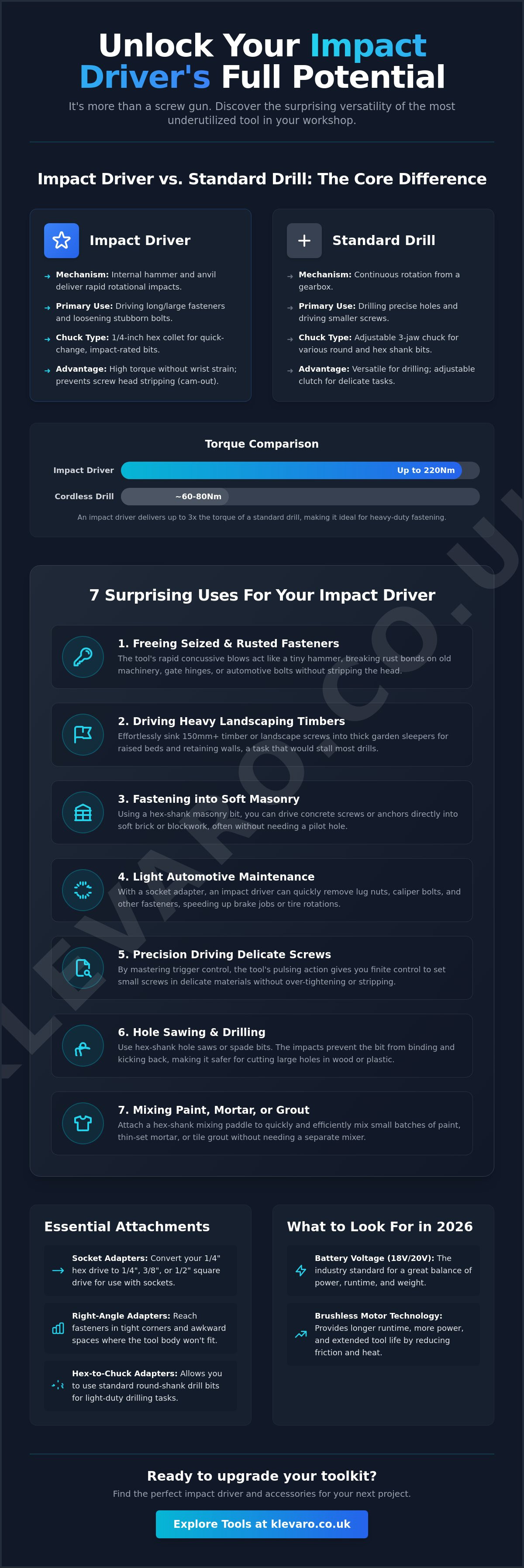
An impact driver is a high-torque power tool engineered primarily for driving long screws, lag bolts, and stubborn fasteners into dense materials. It differs from a standard drill by using a rapid internal hammering action that delivers extra rotational force when the tool meets resistance. This mechanism allows you to complete heavy-duty tasks with significantly less physical strain on your wrist. While a drill focuses on speed and precision for creating holes, the impact driver excels at raw fastening power and efficiency.
Rotational impact is the mechanical process of delivering concussive bursts of force in the direction of the turn to keep the bit locked into the fastener and prevent cam-out. This specific action is what makes the tool so effective for impact driver uses you didn't know about, such as loosening rusted bolts or driving 150mm timber screws. Unlike a drill, which uses a keyed or keyless chuck, the impact driver features a 1/4-inch hex collet for quick bit changes.
This tool provides up to three times the torque of a traditional cordless drill. It's an essential part of any modern hand and general tools kit for the 2026 DIY season. By understanding these mechanical differences, you can choose the right tool for your project and avoid damaging your materials.
The mechanics of rotational torque
An Impact driver functions using a spring-loaded hammer and anvil system located inside the tool casing. As the motor turns, the spring compresses and then releases, causing the hammer to strike the anvil with high frequency. This creates a series of rapid, powerful strikes that rotate the bit with much higher force than a steady motor could provide alone.
Standard drills rely on constant pressure and friction to turn the bit. When a drill meets high resistance, the motor often stalls or the bit slips out of the screw head, a common issue known as cam-out. The driver’s concussive bursts ensure the bit stays seated deep in the screw head, even when working with tough hardwoods or metal frames.
Why the 1/4-inch hex shank matters
The 1/4-inch hex collet is designed for speed and convenience during rapid project transitions. You can pull the collet sleeve forward to drop a bit in and release it to lock the bit in place instantly. This eliminates the need to manually tighten a chuck, which saves time when you're switching between different screw sizes on a busy afternoon.
One limitation is that you must use hex-shank bits specifically rated for impact use. Standard round drill bits won't fit the collet, but you can easily bypass this by using a hex-to-chuck adapter for light-duty drilling tasks. To learn more about specific tool specifications and how to choose the best model for your needs, read the ultimate impact driver guide for a deeper dive into the latest 2026 technology.
7 surprising impact driver uses for home and garden maintenance
Impact drivers are highly versatile tools that handle everything from loosening seized automotive bolts to driving 200mm landscape screws into garden sleepers. These tools use a rapid hammering action to provide high torque without the reactionary "kick" found in standard drills. You can also use them to drill into brickwork using hex-shank masonry bits or mix small pots of paint with a whisk attachment. These impact driver uses you didn't know about turn a standard screw-driving tool into a multi-purpose maintenance powerhouse for your home. Using the right attachments allows you to tackle projects that would typically stall a regular combi-drill.
Freeing stubborn and rusted fasteners
The internal hammer mechanism of an impact driver is perfect for breaking the bond of rust on old garden machinery or car parts. Unlike the steady pressure of a wrench, the rapid vibration of the impact action creates micro-shocks that loosen seized threads. This makes it much easier to remove bolts from lawnmower blades or rusted gate hinges without stripping the heads. You can learn more about the versatility of impact drivers when dealing with high-torque automotive tasks.
Apply a generous amount of penetrating oil to the fastener 10 minutes before you start. This allows the lubricant to seep into the threads while the tool does the heavy lifting. Be careful not to apply full power immediately on smaller bolts. Too much torque applied too quickly can shear the head off a bolt, leaving you with a much bigger extraction job.
Heavy-duty timber and landscape projects
Building raised beds with thick timber sleepers is a standard UK garden project that often pushes drills to their limit. An impact driver handles 150mm to 200mm landscape screws with ease because it doesn't suffer from "wrist snap." The rotational force stays in the tool rather than twisting your arm, making it safer for long days of construction. You can find the right gear to start your next project in our collection of quality tools and equipment.
You can often drive heavy-duty lag bolts directly into softwoods like cedar or treated pine without a pilot hole. The tool's high BPM (blows per minute) ensures the screw bites and sinks flush every time. This saves significant time when you're assembling large structures or securing decking joists.
Masonry drilling and material mixing
While not a replacement for an SDS drill, an impact driver works surprisingly well for light masonry tasks. Using specialised hex-shank masonry bits, you can quickly drill 5mm or 6mm holes into brick or mortar for wall plugs. It's a convenient way to hang garden lights or hanging baskets without swapping tools constantly.
You can also turn your driver into a high-speed mixer for small DIY tasks. Attach a hex-bit whisk to blend small batches of wood filler, grout, or paint in seconds. This prevents the lumps often found when mixing by hand and ensures a professional finish on your home repairs. These impact driver uses you didn't know about make it one of the most efficient tools in your kit for both the workshop and the garden.
Specialised impact driver attachments that expand your capability
Impact drivers become versatile multi-tools when paired with specialised attachments like right-angle adapters, socket converters, and mechanical pipe cutters. These accessories allow you to perform plumbing repairs, reach into 90-degree corners, and drive bolts without needing a full-sized impact wrench. Using impact-rated bits ensures the tool's high torque doesn't snap the attachment during heavy-duty tasks. These are among the impact driver uses you didn't know about that save time on complex 2026 DIY projects. By swapping a standard hex bit for a step drill or a PEX cutter, you transform a simple fastening tool into a precision instrument for metalwork and irrigation.
- Right-angle adapters: These allow for driving screws in tight cabinet corners or between floor joists where the tool body won't fit.
- Impact-rated socket adapters: These turn your driver into a lightweight impact wrench for automotive tasks or securing M8 coach bolts.
- PVC and PEX pipe cutter attachments: These use the driver's rotational power to slice through plastic piping with zero manual effort.
- Step drill bits: These create clean, burr-free holes in thin metal sheets or plastic without the "grabbing" effect of standard twist bits.
Turning your driver into a plumbing tool
Specific attachments from brands like DeWalt or universal manufacturers allow you to cut plastic piping using your driver’s motor. This mechanical approach provides a perfectly square cut every time, which is essential for watertight seals in PEX or PVC systems. It's a significant safety upgrade over a manual hacksaw because it eliminates the risk of the blade slipping or creating jagged plastic shards. You should keep the tool at a low speed to ensure the cleanest edges and prevent the plastic from overheating during the cut.
Accessing impossible spaces with right-angle heads
Right-angle attachments are essential for kitchen fitting and flat-pack furniture assembly where space is restricted. These heads must be "impact-rated" to survive the thousands of rotational strikes the driver delivers every minute. Standard drill adapters will often shear under this pressure, so choosing the correct gear is vital for tool longevity. You can explore our tools and equipment collection for compatible accessories that handle high-torque applications. These adapters are one of the best impact driver uses you didn't know about for avoiding the frustration of hand-screwing in cramped voids.
When to use an impact driver vs an impact wrench for DIY
Impact drivers use a 1/4-inch hex chuck and are designed for high-speed driving of screws into timber or metal. Impact wrenches feature a 1/2-inch or 3/8-inch square drive meant specifically for heavy-duty bolts and automotive lug nuts. You should choose an impact driver for household DIY projects like building decking, fixing fences, or installing cabinetry. An impact wrench is necessary when you need massive torque for vehicle maintenance or structural steel work. Using an impact wrench on soft wood will often result in split timber or snapped screw heads. While adapters exist, these tools are built for different levels of force and fastener sizes.
The primary physical difference between these tools lies in the drive type and the internal mechanism. Most impact drivers accept 1/4-inch hex bits that click into place quickly. Impact wrenches utilize a square anvil to hold heavy-duty sockets. This allows the wrench to deliver up to 1,000 Nm of torque, whereas a standard driver usually tops out around 220 Nm. Understanding this power gap helps you discover impact driver uses you didn't know about, such as assembling flat-pack furniture without damaging the boards.
Many DIYers believe a single tool can handle every task with the right adapter. While you can put a socket adapter on a driver, the internal 1/4-inch hex shaft is a significant weak point. High-torque applications will often snap the bit or damage the tool's internal anvil. Specialized tools ensure you have the right power profile for the material you are working with. Using the correct tool prevents expensive mistakes and keeps your workspace safe.
Automotive tasks and lug nut removal
Impact drivers are excellent for small engine bay bolts where space is tight. Their compact size allows you to reach into corners that a bulky 1/2-inch wrench cannot access easily. However, they lack the raw power to break loose rusted wheel nuts or heavy suspension components. Attempting to remove lug nuts with a driver risks stripping the hex drive or overheating the motor. Always reach for a dedicated impact wrench for any task involving your car's wheels or chassis.
Protecting delicate materials from high torque
High torque is a disadvantage when you are working with brittle materials like ceramic tiles or thin plastics. An impact driver can easily crack these surfaces if the hammer mechanism engages too aggressively. You can manage this by "feathering" the trigger, which involves applying light, intermittent pressure to control the speed. This level of control is one of the impact driver uses you didn't know about that makes it versatile for more than just heavy construction.
For the final tightening on delicate surfaces, it is safer to use a precision tool from a manual set. This prevents the over-tightening that often leads to material failure in home improvement projects. Manual adjustment allows you to feel the resistance of the screw, which is impossible with a high-powered motor. Keeping a set of hand tools nearby ensures your finished project looks professional and remains crack-free.
Ready to upgrade your toolkit for your next home project? Shop our full range of durable tools and equipment to find the perfect match for your DIY needs.
How to choose the right impact driver for your project needs
Choosing the right impact driver depends on matching the tool's power output to the specific scale of your home projects. For general household maintenance and light assembly, a 12V impact driver provides ample torque in a compact, lightweight frame. If you plan on tackling structural tasks like building garden decking or timber outbuildings, an 18V model is the essential standard for driving long fixings. Prioritising a tool with multi-speed settings ensures you can safely execute the impact driver uses you didn't know about, such as driving delicate screws into softwoods without stripping the heads. A brushless motor and a unified battery platform are the two most important features for long-term reliability and cost savings.
Voltage represents the raw potential of your tool. A 12V driver is perfect for internal cabinetry or fitting blinds because it reduces user fatigue during overhead work. In contrast, 18V systems deliver the high-impact force required for 100mm screws and heavy masonry bolts. Selecting the wrong power level can either leave you underpowered for tough jobs or result in snapped screw heads on smaller tasks.
Multi-speed triggers give you the precision of a traditional drill with the power of an impactor. Most modern units offer three distinct speed settings that allow you to cap the RPM and torque levels. This control is vital when you're working on fragile materials or using the tool for unconventional hacks that require a soft touch.
Ergonomics and visibility shouldn't be overlooked, especially during the darker months in the UK. Look for a model with a rubberised over-mould grip to dampen vibrations during extended use. Built-in LED rings around the chuck are indispensable for working in shadows or during those dim UK winter afternoons when natural light fades by 4 PM.
Brushless vs brushed motors: which is worth the investment?
Brushless motors use electronic controllers and magnets instead of physical carbon brushes to transfer energy. This frictionless design allows the tool to run cooler and last significantly longer than traditional brushed versions. Because the internal components are smaller, brushless tools are often more compact, making them ideal for reaching into the tight spots required for creative DIY hacks. Brushless technology can extend battery runtime by up to 50%, which means fewer trips to the charger during a busy weekend project.
Selecting the best battery platform
Sticking to a single brand for your power tools is the most efficient way to build a workshop. Most manufacturers use a "one battery fits all" system, allowing you to swap the same power pack between your impact driver, circular saw, and hedge trimmer. This saves you money, as you can purchase "bare tools" without paying for extra batteries and chargers every time.
Pay close attention to the Amp-hour (Ah) rating on the battery casing. A 2.0Ah battery is light and easy to handle for quick fixes, but you'll need a 4.0Ah or 5.0Ah version for high-drain tasks like extensive fencing projects. To start building your professional-grade kit, browse our range of DIY tools and find the right platform for your next home upgrade.
Build Better Projects Using These Expert Impact Driver Techniques
You can use an impact driver for much more than just driving screws, including mixing paint, digging garden holes with augers, and loosening rusted bolts. These impact driver uses you didn't know about demonstrate that the tool is a versatile powerhouse for any 2026 home project. Its internal hammer mechanism provides the torque needed for tough materials while protecting your wrists from strain. This makes it a superior choice over a standard drill for heavy fasteners and masonry work.
Choosing the right gear ensures your projects look professional and last for years. Whether you're upgrading your workshop or starting your first renovation, having a reliable tool makes all the difference. You'll find that trusted brands like DeWalt and Makita offer the durability needed for the most demanding tasks. It's about having the right tool for the job to save you time and effort.
Ready to upgrade your toolkit? Explore our full range of professional DIY tools and accessories at Klevaro for high-quality equipment. We provide fast UK delivery on all power tool orders and offer expert UK-based customer support for any DIY advice you need. Get started on your next home transformation today; you've got the vision and we've got the gear to help you achieve it.
Frequently Asked Questions
Can I use an impact driver to drill holes in wood or metal?
Yes, you can drill holes with an impact driver provided you use specific hex-shank drill bits. While a standard drill offers more precision, the impact driver's high torque is excellent for boring large holes in thick timber or using step bits in metal. Just be aware that the internal hammering mechanism may kick in if the bit meets resistance, which can make the hole slightly less clean.
Is an impact driver too powerful for assembling flat-pack furniture?
An impact driver is generally too powerful for flat-pack furniture made from MDF or chipboard. The high torque and lack of a clutch mean you're likely to strip the pre-drilled holes or crack the delicate laminate surfaces. Stick to a manual screwdriver or a light 12V drill with an adjustable clutch to keep your new furniture in perfect condition.
Can I use regular drill bits in an impact driver?
You cannot use standard round-shank drill bits in an impact driver because they won't fit the 1/4-inch hex collet. You must use impact-rated bits that feature a hexagonal base to lock into the tool. Standard bits aren't designed to handle the 150Nm or more of torque these tools produce and will likely snap or spin in the chuck.
What is the difference between an impact driver and a combi drill?
The main difference is the mechanism; an impact driver uses rotational "concussion" to drive screws, while a combi drill uses steady rotation. Combi drills are better for precision drilling and masonry, whereas impact drivers excel at driving long fixings into tough materials. Finding the right balance between these tools is one of the impact driver uses you didn't know about for completing projects faster.
Will an impact driver remove car wheel nuts?
A standard 18V impact driver usually lacks the 400Nm to 600Nm of torque required to safely loosen stubborn car wheel nuts. You should use a dedicated high-torque impact wrench for automotive work to avoid damaging your DIY tools. Using a small driver for this task often leads to motor burnout and won't provide the secure fastening needed for road safety.
How do I stop an impact driver from stripping screw heads?
Stop stripping screw heads by using high-quality impact-rated bits that offer a "snug" fit in the screw recess. Apply firm downward pressure and use the variable speed trigger to start the screw slowly before applying full power. Ensure you match the bit type exactly, as using a Phillips bit in a Pozi screw is the reason for 90% of stripped heads.
Leave a comment