


How to Hang a Heavy Mirror on Plasterboard: A Complete Guide
What if the only thing standing between your stylish new hallway feature and a pile of shattered glass is a 50p plastic plug that was never meant for the job? To master how to hang a heavy mirror on plasterboard, you must use high-capacity fixings like Gripit anchors or heavy-duty metal toggles rather than standard plastic wall plugs. For mirrors weighing up to 50kg, a single Gripit Blue anchor can support a load of up to 113kg when installed correctly. You should always use a stud finder to locate timber supports first for the most secure hold. If no studs are available, use at least two specialized fixings to distribute the weight safely across the plasterboard panel.
It's completely normal to feel a bit of "wall anxiety" when you're dealing with hollow surfaces that feel like they might crumble under pressure. You want a home that looks great, but you don't want to risk damaging your walls or losing an expensive mirror. This guide promises to show you the exact tools and hardware needed to secure even the heaviest frames. We'll walk you through choosing the right fixings for your specific mirror weight and the step-by-step process to get a professional, level finish every time.
Key Takeaways
- Use heavy-duty fixings like metal toggle bolts or GripIts to safely support mirrors over 15kg on hollow walls.
- Categorise your mirror’s weight to select the right anchor, ensuring your wall stays damage-free while supporting loads up to 50kg.
- Learn why locating timber studs is the most secure method for mounting mirrors that exceed 20kg in weight.
- Discover the exact steps for how to hang a heavy mirror on plasterboard while achieving a perfectly level and professional result.
- Identify the essential precision tools needed to mount heavy home décor with confidence and ease.
Heavy-duty wall anchors like toggle bolts and GripIts are the best fixings for plasterboard.
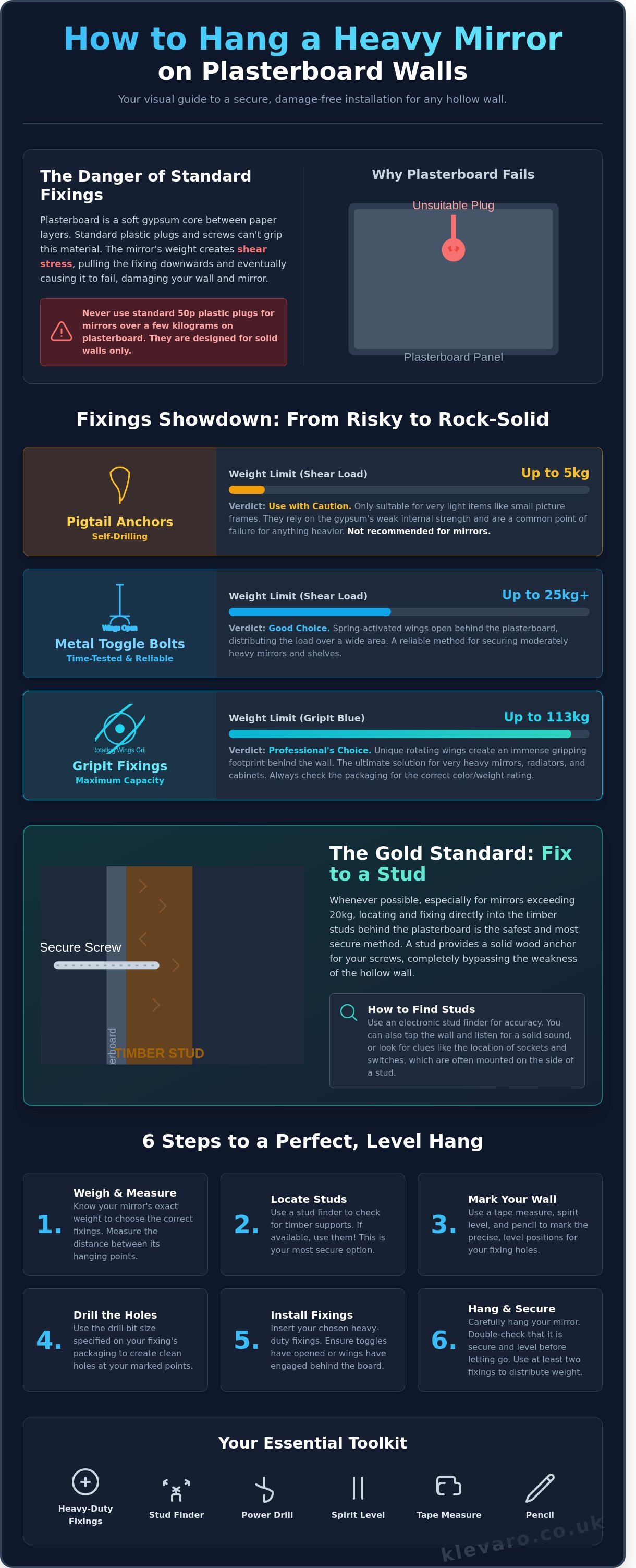
To hang a mirror over 15kg on plasterboard, you must use heavy-duty anchors such as metal toggle bolts or GripIt fixings. These specialised components provide the mechanical strength that the wall material lacks. Standard nails or screws won't hold a heavy mirror because plasterboard consists of a soft gypsum core sandwiched between two layers of heavy paper. Unlike solid brick or timber studs, this material has no internal grain to grip a threaded screw. Using the correct drywall anchor types ensures the weight is distributed across a wider surface area of the board rather than a single point. This prevents the mirror from pulling away from the wall and causing significant damage to your home.
Plasterboard is the standard building material for internal walls in the UK. While it's excellent for insulation and fire resistance, its structural integrity is limited when supporting hanging weight. A standard 12.5mm sheet of plasterboard can crumble under concentrated pressure if the wrong hardware is used. When you learn how to hang a heavy mirror on plasterboard, you quickly realise that the fixing must do more than just sit in a hole. It needs to "sandwich" the board from both sides to be truly secure.
The downward pull created by gravity, known as shear stress, focuses all the mirror's weight on a tiny section of the gypsum. Without a mechanical anchor to spread that load, the hole will slowly elongate until the fixing fails completely. This is why professional installers always prioritise "load spreading" techniques. By engaging a larger portion of the wall, you can safely mount even the most substantial decorative mirrors.
Understanding the mechanics of hollow wall fixings
Toggle bolts are a classic choice for heavy loads because they use a spring-activated metal wing. Once you push the toggle through a pre-drilled hole, the wings snap open against the back of the plasterboard. This creates a solid metal support that cannot be pulled back through the small entry hole. It's a reliable, time-tested method for securing heavy items to hollow surfaces.
For even heavier projects, GripIt fixings are often the preferred professional choice. These use unique backing wings that rotate into place to grip the rear of the board with a wide footprint. A single blue GripIt is rated to hold up to 113kg under ideal conditions, making it perfect for oversized hallway mirrors. When researching how to hang a heavy mirror on plasterboard, always check the weight rating on the packaging to ensure it exceeds your mirror's weight.
You might also see metal self-drilling "pigtail" anchors in your local DIY shop. While these are convenient for quick installs, they're only suitable for items weighing less than 5kg. Using them for a large mirror is a common mistake that leads to cracked glass and ruined walls. These anchors rely on the gypsum's internal strength, which is simply not enough for heavy glass and frames.
Why standard plastic plugs are unsuitable for heavy loads
Standard plastic wall plugs are designed for solid masonry, not hollow cavities. In plasterboard, these plugs often suffer from "creeping," where the constant downward pull of the mirror slowly drags the plastic through the soft gypsum core. You might not notice the movement for several months, but eventually, the mirror will tilt or fall without warning.
Changes in your home's environment also play a significant role in fixing failure. Central heating causes plasterboard to expand and contract; this movement can loosen inferior fixings over time. Vibrations from nearby doors or heavy foot traffic on floorboards further compromise the stability of a basic plug. Using a heavy-duty anchor prevents these environmental factors from turning into a safety hazard.
You should also avoid using adhesive strips for any mirror with a glass surface area larger than 30cm. These strips are prone to failing when exposed to humidity in bathrooms or temperature fluctuations in hallways. Stick to mechanical fixings to keep your home safe and stylish. Relying on high-quality hardware ensures your decor stays exactly where you put it.
Standard weight ratings for plasterboard fixings dictate which anchor is safest for your mirror.
To hang a heavy mirror on plasterboard securely, you must use specialised anchors like toggle bolts or GripIt fixings that distribute weight behind the 12.5mm gypsum board. Weighing your mirror is the essential first step to ensure you don't exceed the load capacity of your chosen hardware. For mirrors over 15kg, always select a fixing rated for at least double the mirror's actual weight to maintain a 2:1 safety margin. These heavy-duty anchors expand or flip open behind the wall, creating a secure grip that standard screws cannot provide. Following this weight-matching process prevents the mirror from pulling away from the wall or causing structural damage.
Weighing your mirror is the non-negotiable first step of any hanging project. You cannot guess the weight of glass and solid frames because overloading a fixing leads to immediate wall failure. For a secure installation, categorise your mirror into one of three UK standard brackets. Light mirrors weigh between 0-5kg; medium mirrors fall between 5-15kg; heavy mirrors are those weighing 15-40kg or more. Most modern UK homes use 12.5mm thick plasterboard, which provides the structural base for these ratings. If your board is thinner, such as 9.5mm, you must reduce these weight limits by approximately 25%.
Safety margins are vital when learning how to hang a heavy mirror on plasterboard. A professional rule of thumb is the 2:1 factor of safety. This means if your mirror weighs 10kg, you should use fixings rated for at least 20kg. This buffer accounts for the physical stress placed on the wall when you clean the glass or if the mirror is accidentally bumped. Using the right DIY hand tools ensures these fixings sit flush and perform to their maximum rated capacity.
Compare the load capacity of common UK fixings to find your match
Different anchors handle weight through varied mechanical methods. Metal speed plugs are convenient for light mirrors up to 5kg, as they screw directly into the gypsum. Hollow wall anchors, often called Molly bolts, expand behind the board to grip a larger surface area, making them ideal for the 5-15kg medium range. For truly heavy mirrors, toggle bolts or GripIt fixings are the gold standard. A GripIt Blue or Brown fixing can support up to 113kg, providing immense peace of mind for oversized decorative pieces. Always check that your plasterboard is dry and crumb-free, as dampness reduces these load ratings by over 50%.
If you are unsure about the internal wall structure, consult a step-by-step guide to see how these anchors behave behind the scenes. Seeing the mechanical expansion helps you understand why choosing the right diameter is essential for a tight fit. Ensure you clear away any dust from the drill hole to allow the anchor to seat perfectly against the board.
Accurately weigh your mirror at home using simple bathroom scales
The most reliable way to weigh a mirror is the subtraction method using standard bathroom scales. Stand on the scales alone and record your weight in kilograms. Pick up the mirror carefully, stand back on the scales, and subtract your original weight from the new total. This calculation gives you the exact weight of the mirror including the glass, the frame, and any pre-installed hanging wire or chains. Don't forget that these accessories add surprising mass to the final unit.
Leaning mirrors require a different safety approach than wall-mounted ones. While the floor supports the bulk of the weight, a leaning mirror still needs a tethering anchor to prevent it from sliding forward or tipping. You should treat the tethering point as if it's holding 30% of the mirror's total weight. This ensures the mirror stays upright even if the floor surface is slightly uneven or slippery.
Securing your mirror to timber studs offers the highest level of load-bearing safety.
The most secure way to hang a heavy mirror on plasterboard is by screwing directly into the vertical timber studs that form the wall's internal frame. These wooden supports provide a solid anchor point that can easily support weights exceeding 20kg, whereas the plasterboard alone may crumble under the stress. In modern UK homes built after 1990, these studs are typically spaced at 400mm or 600mm intervals. Finding these studs ensures your mirror stays fixed to the structure of the house rather than just the surface material. You should always aim to hit at least one stud when learning how to hang a heavy mirror on plasterboard to prevent the fixings from pulling out over time. Using a dedicated stud finder is the most reliable method, but manual checks like tapping or using magnets also work well.
Timber studs are the structural backbone of your partition walls. While specialist plasterboard fixings are excellent for medium loads, any mirror weighing more than 20kg requires the mechanical strength of wood. Screwing a 50mm or 60mm wood screw directly into the centre of a stud creates a bond that can support 50kg or more per fixing point. This is critical for large floor-to-ceiling mirrors or heavy ornate pieces that pose a safety risk if they fall. You can explore our range of tools to find the right equipment for this task.
In the UK, building regulations generally dictate the spacing of these vertical timbers. Most internal walls use a standard 400mm spacing, though some newer builds or non-load-bearing partitions may use 600mm centres. Measuring from a corner or a door frame in these increments can give you a strong starting point for your search. Always verify the exact centre of the stud before drilling to ensure the screw has maximum timber to bite into.
How to find a wall stud without professional equipment
You can locate studs without a digital scanner by using simple household observations. Use the "knuckle tap" method by knocking horizontally along the wall. A hollow sound indicates the gap between studs, while a solid, higher-pitched thud signals the timber. Alternatively, slide a strong neodymium magnet across the surface to feel for the hidden screws or nails that secure the plasterboard to the frame. Look at your skirting boards too. Builders often nail skirting into the studs, so a visible nail head or filled hole at the floor level often lines up with a vertical timber. Be cautious around light switches, as cables usually run vertically from the switch to the ceiling or floor.
Drilling into timber versus drilling into hollow space
Once you've identified the stud location, you must use the correct technique to avoid damaging the wood. Always drill a pilot hole using a 2mm or 3mm wood bit before driving in your main screw. This prevents the timber from splitting, which would significantly weaken the hold. You'll notice a distinct change in resistance during this process. The drill will glide through the 12.5mm thick plasterboard and then suddenly feel much tougher as it bites into the timber. Use a high-quality multi-purpose bit or a specific wood bit for the stud. Masonry bits can overheat and scorch the wood without cutting effectively. If the drill meets no resistance after the first 15mm, you've missed the stud and are in the hollow cavity.
- Timber Studs: Best for mirrors over 20kg.
- Spacing: Usually 400mm or 600mm in UK homes.
- Pilot Holes: Essential to prevent wood splitting.
- Fixings: Use 50mm-60mm wood screws for maximum depth.
A step-by-step process ensures your heavy mirror is mounted level and secure.
To hang a heavy mirror on plasterboard securely, you must use high-load metal anchors rather than standard plastic plugs. The process involves marking your centre point, measuring the distance between D-rings, and drilling holes that match your anchor diameter exactly. Once the anchors are inserted, you tighten them until the internal wings deploy against the back of the board. This creates a solid mechanical grip that can support weights exceeding 30kg. Finally, you mount the mirror and use a spirit level to confirm the alignment is perfectly horizontal.
Start by identifying the exact location where the mirror centre will sit. Mark this spot lightly with a pencil at eye level, which is typically 150cm from the floor in most UK homes. Once you have your centre point, you can determine where the specific fixing points need to be based on the mirror hardware. Using a spirit level at this stage is vital to ensure your fixing points are perfectly horizontal to avoid a slanted finish.
Measuring twice and drilling once
Accuracy is the difference between a professional finish and a DIY disaster. Measure the distance between the two D-rings on the back of your mirror precisely. Don't assume they're perfectly symmetrical; hardware can often be a few millimetres off during manufacturing. Apply a strip of masking tape to the wall across your intended hanging area. You can mark your measurements onto the tape instead of the plaster, keeping your paintwork pristine while you work.
Before you pick up the drill, safety is paramount. Use a multi-detector to scan for hidden cables or copper pipes behind the plasterboard surface. In the UK, electrical cables usually run vertically or horizontally from sockets and switches. A 3-in-1 detector provides the peace of mind you need to avoid hitting a live wire or causing a leak. If the detector stays silent, you're ready to proceed with confidence.
Selecting the right drill bit is a critical step in learning how to hang a heavy mirror on plasterboard. Match your bit size exactly to the diameter specified on the anchor packaging. If you use a bit that's too large, the anchor will spin in the hole; too small, and you'll crumble the plasterboard core trying to force it in. Drill with a steady hand and clear away any dust with a vacuum to ensure a clean fit.
Push your heavy-duty anchor into the hole until the collar sits flush against the wall. Tighten the screw using a manual screwdriver rather than a power driver for better control. You'll feel a significant increase in resistance as the anchor's wings expand against the back of the plasterboard. This mechanical grip is what provides the load capacity required for substantial glass pieces.
Perfecting the final alignment
Lift the mirror carefully and guide the D-rings onto the screws or hooks. Don't let go of the weight until you're certain both fixings have caught securely. Place your spirit level across the top edge of the frame to verify the horizontal alignment. If the bubble isn't centred, you can often make micro-adjustments by slightly loosening one screw or shifting the wire if you've used a hanging cord.
Mirrors often tilt forward at the top, which ruins the aesthetic and creates a glare. Stick small adhesive felt pads or rubber bumpers to the bottom two corners of the frame. These spacers keep the mirror perfectly parallel to the wall and prevent the frame from scuffing your wallpaper. For the best results, explore our range of spirit levels to ensure your home project looks flawless from every angle.
Now that your mirror is safely mounted, you can enjoy the extra light and space it brings to your room. If you're looking for more reliable gear for your next home improvement task, shop our professional tool collection to get the job done right.
Quality DIY tools from Klevaro make hanging heavy decorations simple and safe.
You now possess the technical knowledge of how to hang a heavy mirror on plasterboard, so the final step is to secure the right gear for the job. Achieving a professional, flush finish depends heavily on the precision instruments you choose to use. While the method is vital, high-quality tools act as the bridge between a wobbly frame and a permanent, secure installation. Investing in the right equipment ensures that your walls remain intact and your decor stays exactly where you put it.
A reliable power drill with variable speed is non-negotiable for delicate plasterboard work. Standard drills without speed control often run too fast, which can cause the drill bit to "wander" or tear the paper facing of the board. By using a drill with a sensitive trigger, you can start holes slowly and maintain total control over the torque. This prevents the common issue of "blowout" on the reverse side of the plasterboard, which can reduce the holding power of your anchors by as much as 50%.
A well-organised toolkit is another secret to DIY success. According to a 2023 industry report on home maintenance, DIYers with sorted tool sets complete tasks 25% faster than those working with cluttered equipment. Having your bits, drivers, and measuring tools in one place reduces frustration and allows you to focus on accuracy. When you aren't hunting for a specific 5mm bit, you can dedicate your full attention to the safety and level of your mirror.
Essential hand tools for every mirror project
Precision starts with the basics. We recommend a high-quality screwdriver set to ensure you don't strip the heads of your wall anchors. Using a standard Phillips head on a Pozidriv screw is a mistake that leads to stripped heads in roughly 40% of DIY cases. A proper fit ensures maximum leverage and a tighter fix. You should also use a retractable tape measure with a reliable lock function. This allows for accurate solo measuring, preventing the 2mm to 5mm errors that often occur when a tape snaps back mid-calculation. You can browse our hand and general tools to find the perfect essentials for your next project.
Completing the look with home decor and fragrances
Once your mirror is securely fixed, it's time to elevate the surrounding space. Styling the area with items from the Klevaro home and garden collection can turn a simple functional item into a stunning focal point. A well-placed mirror is known to increase perceived room brightness by up to 30%, making it the perfect spot to place home fragrances or candles. The reflected light helps to "throw" the scent further, creating an atmosphere that feels both airy and inviting. DIY is ultimately about making your space your own; you should honour your hard work with a stylish finish that reflects your personality. Your home is your sanctuary, so take the time to enjoy the results of your craftsmanship.
Secure Your Heavy Mirror Safely and Stylishly
Mastering how to hang a heavy mirror on plasterboard transforms your home's interior without risking wall damage. Always choose high-performance fixings like GripIts; these support loads up to 113kg on 15mm plasterboard. If your mirror exceeds standard weight limits, use a stud finder to secure the bracket directly into the timber frame for maximum stability. Following a methodical step-by-step process ensures your décor remains level and perfectly positioned for years to come.
You don't need to be a professional builder to achieve a flawless finish. Klevaro provides all the essential gear you need to fix, build, and create with total confidence. As a Trusted UK Store, we offer Fast UK Delivery and Quality Guaranteed on all Rolson and Precision tools. Having the right spirit level or heavy-duty drill bit makes the job safer and much more enjoyable.
Shop our full range of DIY tools and equipment to get started on your next home improvement task. You've got the knowledge; now get the tools to match your ambition.
Frequently Asked Questions
Can plasterboard really hold a 20kg mirror?
Yes, plasterboard can support a 20kg mirror if you use the correct high-performance anchors. A single 20mm GripIt fixing is rated for loads up to 93kg on 15mm board, making it more than capable of the task. When you're learning how to hang a heavy mirror on plasterboard, remember that distributing the weight across two points is the safest way to protect your walls from damage.
What is the best fixing for a heavy mirror on a hollow wall?
Metal toggle bolts and GripIt anchors are the best fixings for hollow walls because they spread the weight across the back of the board. These mechanical anchors are far superior to plastic plugs which can pull out under tension. A standard 5mm toggle bolt can hold approximately 25kg, providing a high safety margin for most domestic mirrors. Always choose metal fixings for anything weighing more than 5kg.
Do I need a special drill bit for plasterboard?
A standard multi-purpose or HSS drill bit is fine for plasterboard, but the size must match your fixing exactly. If you use a GripIt anchor, you'll need a flat wood bit to create a precise 15mm or 20mm hole. Don't use a masonry bit on the hammer setting; this will shatter the gypsum core and leave you with a loose, messy hole that won't hold a screw.
How do I stop plasterboard from crumbling when I drill into it?
Prevent crumbling by drilling at a high speed with very light forward pressure to slice through the paper liner cleanly. You should also apply a small square of masking tape to the wall before you start your project. This simple trick keeps the gypsum intact and ensures your hole stays exactly where you marked it. Avoid pushing hard, as this causes the back of the board to blowout.
Can I hang a heavy mirror on plasterboard without a stud finder?
You can hang a mirror without a stud finder by using heavy-duty anchors like umbrella toggles that grip the board itself. If you prefer to find a stud manually, tap the wall horizontally; a solid "thump" indicates a timber support, usually found every 400mm. Knowing how to hang a heavy mirror on plasterboard without studs gives you much more freedom with your room layout and interior design.
What happens if I hit a metal stud instead of a timber one?
If you hit a metal stud, you must switch to self-drilling metal screws or specialist toggles designed for steel partitions. Modern UK flats often use 0.5mm galvanised steel studs which are too hard for standard wood screws to penetrate. Use a sharp HSS bit to pilot the hole first. This ensures your fixing sits flush and provides a secure, rattle-free mount for your heavy mirror.
Is it better to use two fixings or one for a heavy mirror?
Using two fixings is significantly safer than relying on a single central point for heavy items. Two anchors halve the weight stress on the plasterboard and prevent the mirror from swinging or tilting on the wall. For a 20kg mirror, two points of contact mean each anchor only supports 10kg. This setup provides extra peace of mind and a much more stable, professional installation.
Should I use a wire or hang the mirror directly onto the screws?
Hang the mirror directly onto screws or D-rings rather than using a picture wire. Wire exerts a constant inward pull on the frame and can stretch or snap under heavy loads over time. Direct mounting keeps the mirror closer to the wall and prevents the top from leaning forward awkwardly. It's the most reliable way to ensure your heavy mirror stays exactly where you put it.
Leave a comment