


Chainsaw Kickback Prevention Techniques: A Complete Safety Guide
Did you know that the Health and Safety Executive (HSE) identifies the upper quadrant of the guide bar nose as the primary cause of most chainsaw accidents in the UK? You can master chainsaw kickback prevention techniques by avoiding this "kickback zone," maintaining a firm two-handed grip, and keeping your left arm straight to redirect sudden force. Always stand to the left of the cutting path and ensure your chain is sharp and correctly tensioned to reduce mechanical resistance. These steps, combined with a fully functional chain brake, provide the most reliable defence against dangerous saw movement.
It's completely natural to feel a bit of nerves when handling powerful garden machinery, especially when technical terms like guide bars and sprocket noses feel confusing. We're here to help you turn that uncertainty into confidence so you can tackle your garden projects safely. This guide will teach you the essential mechanical checks and physical stances required to stop kickback before it even starts. From understanding the physics of the cut to routine maintenance tips, you'll find everything you need to work like a pro.
Key Takeaways
- Identify and avoid the "kickback danger zone" at the tip of the guide bar to prevent sudden, violent upward saw movement.
- Master essential chainsaw kickback prevention techniques, including maintaining a firm grip and standing to the left of the saw's rotation plane.
- Learn how mechanical safety features, such as chain brakes and low-kickback chains, act as your primary line of defence against accidents.
- Ensure maximum control by adopting a stable boxer stance and keeping your equipment properly maintained for a smoother, safer cutting experience.
Preventing chainsaw kickback requires avoiding tip contact and maintaining a firm grip.
Effective chainsaw kickback prevention techniques involve keeping the upper quadrant of the guide bar tip away from solid objects and maintaining a locked, two-handed grip. Kickback occurs when the moving chain at the nose of the bar snags on wood, forcing the saw to rotate violently back toward the operator. You can stop this by wrapping your left thumb fully around the front handle and ensuring your chain is sharp and tensioned. These simple mechanical habits prevent the chain from catching or pinching during a cut. Understanding the physics of the "kickback danger zone" is the most reliable way to stay safe while working in your garden or on a DIY project.
Maintaining a sharp chain isn't just about cutting efficiency. A dull chain requires more pressure to bite into the wood, which increases the likelihood of the saw slipping or catching. Correct tension is also vital. A loose chain can jump the guide bar, while one that's too tight can cause the engine to stall or the bar to overheat. Check your tension every time you refuel to ensure the saw remains predictable and safe.
Why kickback happens in a split second
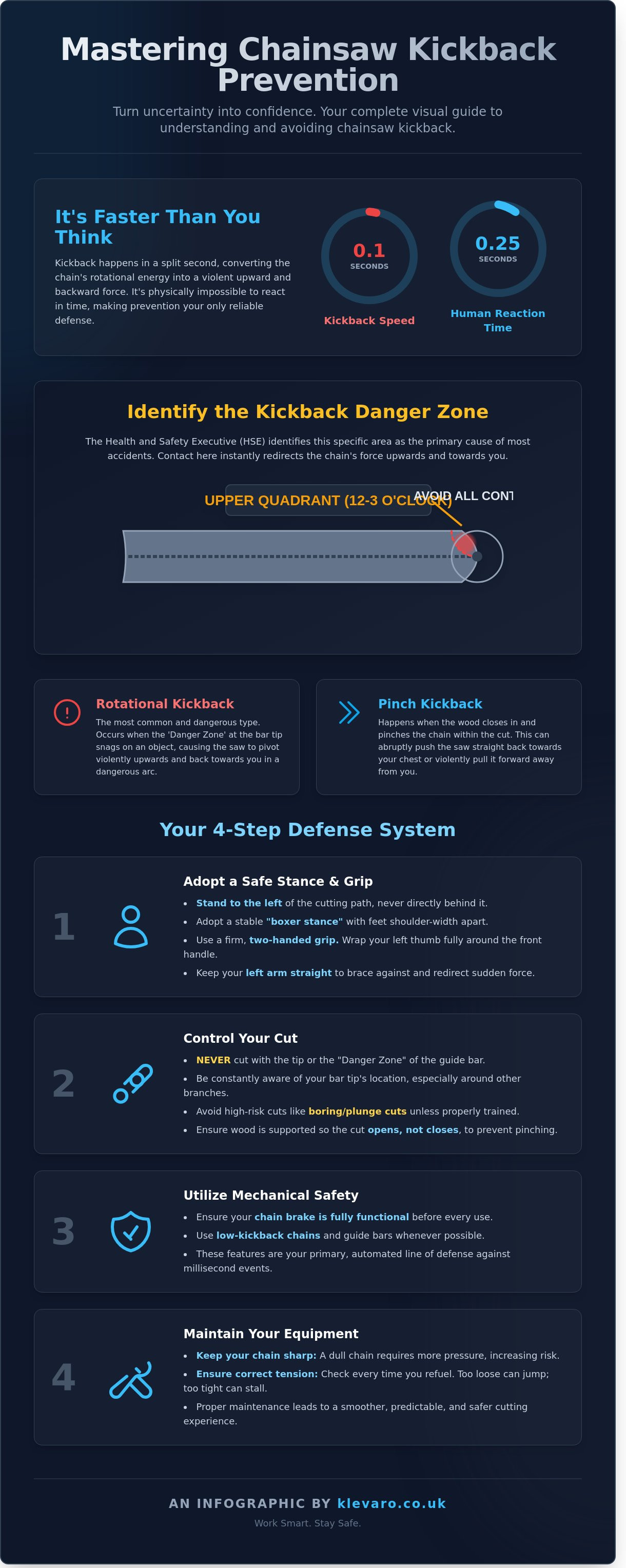
The physics of kickback involve a massive redirection of energy. When the chain teeth at the tip hit a solid object, the circular momentum of the chain is instantly converted into a backward force. This happens in roughly 0.1 seconds, which is significantly faster than the average human reaction time of 0.25 seconds. Because it's physically impossible to react to the motion once it begins, you must focus on prevention before you pull the trigger.
Understanding this speed is why choosing the right tools and equipment is the foundation of chainsaw safety. Modern saws include Chainsaw safety features designed to stop the chain during these millisecond events. Relying on your own strength to hold the saw down isn't enough. You need to be prepared with the right gear and a firm stance every time you start a cut.
The difference between rotational and pinch kickback
Rotational kickback is the primary threat for most operators. It occurs when the "kickback danger zone," which is the top half of the bar's nose, touches a branch or log. This contact causes the saw to pivot around the handle, swinging the bar toward your face or shoulders in a sudden arc. Keeping this specific part of the bar clear of obstructions is the most effective of all chainsaw kickback prevention techniques.
Pinch kickback happens when the wood itself moves. If a log isn't supported correctly, it can sag and "pinch" the chain inside the cut. This can push the saw straight back toward your chest or pull it forward into the log. You can avoid this by using wedges or ensuring your workpiece is supported in a way that the cut opens rather than closes. Both types of kickback demand your full attention and a clear understanding of how gravity affects the wood you're cutting.
The kickback danger zone is the upper quadrant of the guide bar nose.
The kickback danger zone is the upper quadrant of the guide bar nose, specifically the area from the 12 o'clock to the 3 o'clock position. When this part of the bar contacts a solid object, the chain's momentum is redirected, causing the saw to kick upwards and backwards with extreme force. Preventing this requires constant awareness of where the tip is at all times. You should never use this upper quadrant to start a cut or prune small, springy branches. Understanding this zone is the foundation of effective chainsaw kickback prevention techniques for every operator.
Visualise the end of your chainsaw bar as a clock face. The danger zone occupies that top right section where the chain begins its curve back towards the power head. If the rotating teeth in this quadrant snag on a log, a hidden nail, or even a nearby branch, the saw will pivot around the obstacle. This reaction happens in less than 0.1 seconds, which is faster than most human reaction times. For a deeper dive into the physics of this reaction, you can consult this CCOHS guide to preventing kickback, which details how chain speed and angle impact force.
Certain manoeuvres carry a significantly higher risk of triggering this reaction. Boring cuts, also known as plunge cuts, involve driving the nose of the saw directly into the wood. These are high-risk techniques that only trained professionals should attempt. For the average DIYer or gardener, keeping the tip clear of all contact is the safest way to work. You should also be wary of hidden objects like stones or other logs that might be obscured by foliage.
Identifying the danger zone on your saw
Look closely at the curve of your guide bar nose. The size of this curve directly influences how much kickback energy the saw can generate. Larger diameter noses provide more surface area for the chain to snag, which increases the potential for a violent kick. If you're a beginner, look for saws featuring "narrow kerf" or "low-kickback" bars. These designs use a smaller nose radius to reduce the size of the danger zone, making the saw much easier to manage during domestic tasks.
Environmental awareness while cutting
Before you pull the starter cord, clear your work area of brush, loose debris, and low-hanging limbs that could accidentally strike the tip. It's easy to focus on the cut you're making and forget about the log sitting just behind it. If the tip strikes a hidden object like a stone or a piece of wire, the saw will react instantly. Always check garden timber for old nails or fencing wire, as these are common culprits for tip-related accidents in the UK. Predict "log roll" by assessing the ground slope; if a log shifts and pinches the top of the bar, it can trigger a pinch kickback. Before you start your next garden project, ensure you have the right tools and equipment to work safely and efficiently.
Modern safety features and low-kickback chains reduce mechanical risk.
Modern chainsaw kickback prevention techniques rely on integrated mechanical safety features and specialised chain designs to protect the operator. The chain brake is the most vital component, designed to stop the cutting chain in less than 0.1 seconds during a kickback event. Low-kickback chains further reduce risk by using bumper drive links that deflect wood away from the kickback zone. These mechanical safeguards work alongside inertia-activated systems that trigger the brake automatically if the saw kicks upward violently. By combining these features with secondary guards like chain catchers, manufacturers have significantly decreased the frequency of serious cutting accidents.
The chain brake acts as your first line of defence. It can be activated manually by your left hand striking the front hand guard or automatically through inertia. You should also ensure your saw is equipped with a chain catcher, which is a small metal or plastic tab designed to catch a chain if it breaks or jumps off the bar. For more detailed safety protocols, you can consult this Canadian Centre for Occupational Health and Safety guide on kickback which outlines comprehensive equipment standards. These built-in tools transform a high-risk machine into a manageable tool for home and garden maintenance.
Test your chain brake before every session to ensure reliability.
A faulty brake is a major safety hazard, so you must perform a manual check every time you start your saw. To test the brake, start the engine and hold the saw firmly with both hands. With the engine at a fast idle, push the front hand guard forward with your left wrist to engage the brake. The chain should stop moving instantly. If the chain continues to rotate or takes longer than a fraction of a second to stop, the brake band is likely worn or contaminated with oil.
Never operate a chainsaw with a disabled or sluggish brake system. Look for warning signs like a loose or rattling hand guard or a brake that feels "mushy" when engaged. Keeping your equipment clean is the best way to prevent these issues. You can find high-quality maintenance gear in our hand and general tools collection to help keep your safety features in peak condition. Regular cleaning prevents sawdust and oil from clogging the mechanical linkages of the brake assembly.
Low-kickback chains use specific link geometry to deflect debris.
Choosing the right chain is one of the most effective chainsaw kickback prevention techniques available to DIY users. Chains are typically colour-coded to help you choose the right level of aggression for your skill level. Green-labelled chains are "low-kickback" models designed specifically for homeowners and casual users. These chains feature raised bumper links that fill the gaps between the cutters, preventing the teeth from snagging too deeply into the wood at the bar tip.
Professional chains are often colour-coded yellow and lack these extra safety links to allow for faster, more aggressive cutting. While yellow chains are efficient for experienced loggers, they significantly increase the risk of a violent kickback for the average user. For most garden projects and firewood prep, the green consumer chain provides a much safer experience without sacrificing too much cutting speed. Always check the packaging for the "Low Kickback" certification to ensure you are getting the safest possible equipment for your home projects.
Correct body positioning and cutting techniques ensure maximum control.
You maintain control and prevent injury by standing to the left of the saw's cutting path and keeping your feet in a wide, balanced stance. Locking your left elbow allows you to redirect the force of a kickback away from your body. Always operate the chainsaw at full throttle to prevent the chain from snagging in the wood. You should never cut above shoulder height or overreach, as this significantly reduces your physical leverage. These chainsaw kickback prevention techniques ensure that the guide bar travels safely past your shoulder if the tip strikes an external object.
The safe operator stance
A stable foundation is your first line of defence against sudden tool movement. Place your feet shoulder-width apart with one foot slightly in front of the other to create a "boxer" stance. This distribution of weight helps you absorb the saw's vibration and maintain balance throughout the entire cut. You must never stand directly behind the guide bar. If the saw kicks back, it travels in a vertical arc; by standing to the left, the saw passes harmlessly over your shoulder rather than making contact with your face or torso. This positioning also gives you a better line of sight to the wood you're cutting.
Using your body weight effectively allows you to manage the tool without relying solely on arm strength. Lean slightly into the saw while keeping your back straight. This posture helps you stay grounded if the chain catches or pulls. Keeping your left arm straight with the thumb firmly wrapped around the handle is a vital part of chainsaw kickback prevention techniques. It creates a rigid lever that forces the saw to pivot around your body rather than toward it.
Smart cutting habits for garden maintenance
Safe cutting starts with the "pulling" part of the chain, which is the bottom edge of the guide bar. When you cut with the bottom of the bar, the saw naturally pulls itself toward the wood, creating a stable and predictable contact point. Avoid using the "pushing" part on the top of the bar unless you're an experienced operator, as this can push the saw back toward you. For logs or branches on the ground, always use a sturdy sawhorse to keep the timber stable. This prevents the wood from sagging and pinching the chain, which is a common trigger for kickback.
Before you begin any garden project, it's essential to verify your equipment is ready for use. You can refer to our chainsaw safety checklist for comprehensive pre-start routines. Ensuring your chain is sharp and properly tensioned reduces the physical effort required to make a cut, which keeps you from becoming fatigued and losing focus.
Ready to tackle your next outdoor project with confidence? You can explore our range of high-quality tools and equipment to find the right gear for your home and garden.
Routine maintenance and protective gear are your final lines of defence.
Effective maintenance and high-quality protective equipment are essential for managing the risks of tree work. These chainsaw kickback prevention techniques ensure the tool operates smoothly while providing a physical barrier against injury. A sharp, correctly tensioned chain reduces the physical effort required, which prevents the operator from over-reaching or applying dangerous levels of pressure. If a kickback does occur, specialised clothing is designed to stop the chain before it reaches your skin.
A dull chain is one of the most common causes of accidents in the garden. When the cutters lose their edge, they stop slicing through wood and start rubbing against it, creating heat and friction. This often forces you to lean into the saw, which is a primary trigger for a slip or a catch in the kickback zone. Keeping the guide bar groove clean is equally important, as compacted sawdust can prevent the oil from lubricating the chain correctly. Check your chain tension every 15 minutes of use to ensure it doesn't jump the bar and cause a dangerous distraction.
Sharpening for safety
You can easily identify a dull chain by inspecting the debris produced during a cut. Sharp chains produce clean, rectangular chips, while a dull chain creates fine sawdust. The height of the depth gauges is another critical factor in preventing the saw from grabbing the wood too aggressively. Rakers are the metal tabs that determine how deep the cutters bite into the wood. If you file these down too far, the saw will become jumpy and significantly more prone to kickback.
Essential PPE for every operator
Specialised Personal Protective Equipment (PPE) provides a vital safety net for every DIY project. Chainsaw chaps or trousers are particularly effective because they contain long, loose synthetic fibres. These fibres pull into the drive sprocket on contact, stopping the chain in a fraction of a second. A full safety kit should also include:
- A safety helmet with an integrated mesh visor to protect your face from flying debris.
- Ear defenders with a high Decibel (dB) rating to prevent long-term hearing damage.
- Anti-vibration gloves that improve your grip and protect your hands from fatigue.
Chainsaw-specific boots are a non-negotiable requirement for garden work because they offer cut-resistant layers and steel toe caps. These boots provide the stability you need on uneven ground, ensuring you stay balanced while the saw is running. You can explore our home and garden range for more project essentials to help you work with confidence.
Master Your Cutting Safety Today
Mastering chainsaw kickback prevention techniques depends on a combination of mechanical safety features and disciplined operator habits. You must avoid the upper quadrant of the guide bar nose at all times; this specific area is responsible for the most sudden and violent reactive forces. Keeping your left arm straight while maintaining a firm, two-handed grip provides the leverage you need to manage any unexpected movements during a cut.
Routine maintenance of low-kickback chains and the use of full protective gear act as your final line of defence. These habits significantly reduce the risk of injury during heavy garden tasks or complex home improvement projects. When your equipment is sharp and your body positioning is correct, you can work with much greater confidence and precision. Safety is always the result of proper preparation and the right gear.
Ready to upgrade your gear? Equip your workshop with quality DIY tools from Klevaro to ensure you have the right equipment for every job. As a trusted UK store, we provide an expertly curated range for home improvement with fast UK delivery on all garden power tool accessories. You'll find everything you need to fix, build, and create with total peace of mind. Get started on your next project today!
Frequently Asked Questions
What is the most common cause of chainsaw kickback?
The most common cause is the guide bar tip hitting a solid object in the "kickback zone." This upper quadrant of the bar tip accounts for approximately 30% of chainsaw-related accidents. When the moving chain catches in this area, it drives the bar upwards and backwards toward the operator with immense force.
Can a low-kickback chain completely prevent kickback?
No, a low-kickback chain can't completely prevent kickback. These chains use specially shaped drive links to reduce the energy of a kickback by about 50%, but they don't eliminate the danger entirely. You should combine these chains with other chainsaw kickback prevention techniques, like maintaining a proper stance and using a sharp chain.
How should I hold a chainsaw to reduce the risk of injury?
Hold the chainsaw with both hands and wrap your left thumb securely under the front handle. This "locked-in" grip is vital because it ensures the saw stays in your control if it jumps. Stand slightly to the left of the saw's power head so your body isn't in the direct line of the guide bar's path.
Does the size of the chainsaw bar affect kickback risk?
Yes, a longer chainsaw bar increases the risk because it's harder to balance and has a larger tip area. Industry data shows that longer bars provide more leverage for the saw to pivot upwards during a snag. Always choose the shortest bar length suitable for your specific job to maintain the best possible control over the tool.
What should I do if my chainsaw kicks back while cutting?
If the saw kicks back, maintain your firm grip and let the chain brake do its job. A standard chain brake is designed to stop the chain in less than 0.15 seconds when your hand hits the guard. Don't try to fight the movement or push back; instead, let the saw stop and then step away to check your surroundings.
Is it safe to cut with the tip of the chainsaw?
It's never safe to cut using the upper 90-degree quadrant of the bar tip. This area is the primary danger zone where the chain is most likely to snag and cause the saw to pivot violently. Always use the middle or the base of the bar for your cuts to ensure the tool remains stable and predictable.
How often should I sharpen my chainsaw chain for safety?
You should sharpen your chain every time you refill the petrol tank or after roughly 2 hours of active cutting. A blunt chain requires you to apply more pressure, which increases the chance of the saw slipping. If your saw starts producing fine dust instead of 5mm wood chips, it's a clear sign you need to sharpen the teeth.
Do electric chainsaws have kickback?
Yes, electric chainsaws can kickback just as forcefully as petrol models. While they don't have a combustion engine, their high-torque motors reach full speed almost instantly, providing enough power to throw the bar if the tip catches. Treat your electric saw with the same respect and safety gear you'd use for any heavy-duty power tool.
Leave a comment